
.jpg)
PROTECT YOUR DNA WITH QUANTUM TECHNOLOGY
Orgo-Life the new way to the future Advertising by Adpathway
Freestanding tents are the holy grail of backpacking tents because they can be set up quickly almost anywhere, on wooden tent platforms, rock, sand, snow, and even climbers’ portaledges, without needing to be staked to the ground first. This is particularly useful in poor weather when you need to get out of the weather and can’t search for a protected tent site or dig one out in the snow.
Here are the best freestanding tents for backpacking that we recommend across a range of price points and weights:
Big Agnes Copper Spur UL 1

The Big Agnes Copper Spur UL 1 is the most popular one-person backpack tent, and with good reason. This freestanding tent is easy to set up. It features a spacious interior with ample headroom and vertical sidewalls, allowing you to change clothes and sit up inside without touching the sides. Off-the-floor storage, in the form of an oversized ceiling pocket and media pockets, provides ample space for personal items you want close at hand. Weighing just 2 lbs, the Copper Spur is an exceptionally lightweight but fully featured backpacking palace. The freestanding two-person Copper Spur is also a hiker favorite.
NEMO Dragonfly OSMO 1 Tent

The NEMO DragonFly OSMO 1 is a lightweight double-wall freestanding one-person tent with a generously sized door and asymmetrical vestibule for easy entry and access to bulkier gear. Weighing 2 lbs 3 oz, the tent is made from NEMO’s OSMO polyester/nylon ripstop fabric, which reduces rainfly sag when wet. Inside, a gear loft and gear pockets keep belongings neatly stored and out of the way. Hubbed, prebent DAC Featherlite NSL poles with a high-arching central pole significantly increase volume at the head, peak, and foot ends. White no-see-um mesh at the side increases privacy, while black mesh at the top turns virtually transparent at night for clear stargazing. Read the SectionHiker Dragonfly Tent Review.
Hyperlite Mountain Gear Crosspeak 2

The Hyperlite Mountain Gear Crosspeak 2 is a single-wall two-person tent that weighs 34 oz. Made with Dyneema DCF, it features three aluminum tent poles that slot into sleeves, creating a weather-worthy, dome-shaped tent with two doors and two vestibules. The interior is spacious with steep internal walls and a high ceiling, providing plenty of room to sit out stormy weather. In better weather, you can roll back the vestibule doors to increase cross-ventilation through the tent’s mesh doors and sides. Read our Hyperlite Mtn Gear Crosspeak 2 Tent Review.
NEMO Dagger OSMO 2 Tent

The NEMO Dagger OSMO 2P Tent is a spacious freestanding double-wall tent for two people with two doors and two vestibules. Weighing 3 lbs 6 oz, the tent is made with NEMO’s new OSMO polyester/nylon ripstop fabric, reducing rain fly sag when wet and improving waterproofing. The spacious interior and numerous livability accents make the Dagger OSMO 2P a great tent for tall people or couples who want more room to spread out. Read the SectionHiker Dagger OSMO 2 Review.
MSR Hubba Hubba LT 1 Tent

The MSR Hubba Hubba LT 1 is easy to set up and well-ventilated. Freestanding, the pole configuration creates an interior space with near-vertical walls and a rectangular floor plan, enabling the use of a wide 25″ sleeping pad. In addition to the front vestibule, there is an interior gear loft and clothes line for drying your wet socks. With a trail weight of 2 pounds and 6 ounces, the Hubba Hubba LT 1 is a bombproof shelter that’s still lightweight enough for one person. Read the SectionHiker Hubba Hubba LT1 Review.
Durston X-Dome 1+

The Durston X-Dome 1+ is a spacious double-wall freestanding tent. At just 35 oz (985 g), the X-Dome 1+ sets up fly first and has a diagonal floor plan, providing more covered vestibule space and a longer interior than comparable dome-style tents. Its crossed carbon fiber poles provide a very strong structure capable of holding heavy snow loads. The tent is made with 15d high tenacity polyester so the fly does not stretch when wet. The fly can also be pitched by itself for winter use, dropping the carry weight to 24 oz. Read the SectionHiker X-Dome 1+ Tent Review.
NEMO Dagger OSMO 2 Tent
The NEMO Dagger OSMO 2P Tent is a spacious freestanding double-wall tent for two people with two doors and two vestibules. Weighing 3 lbs 6 oz, the tent is made with NEMO’s new OSMO polyester/nylon ripstop fabric, reducing rain fly sag when wet and improving waterproofing. The spacious interior and numerous livability accents make the Dagger OSMO 2P a great tent for tall people or couples who want more room to spread out. Read the SectionHiker Dagger OSMO 2 Review.
Marmot Tungsten UL 1 Tent

The Marmot Tungsten Ultralight 1P goes fast and far with pre-bent aluminum poles that pull the walls outward for extra headroom, while a large front door with a vestibule offers easy side access. The full-mesh upper canopy reduces weight and boosts airflow, while the seam-taped, full-coverage polyester fly stays taut when wet and sheds rain. Set up’s a breeze with color-coded clips and poles, and smart touches like a headlamp pocket make life a little easier. Ultralight and ultra-livable, its stealthy color blends in with the terrain.
SlingFin Portal 2
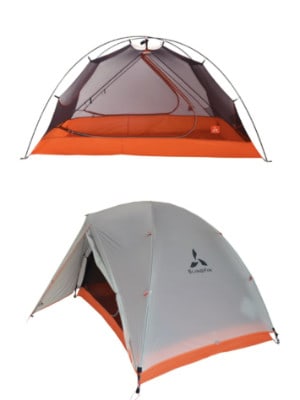
The Slingfin Portal is a lightweight two-person tent that can be used year-round in more extreme weather (Slingfin was founded by Martin Zematis, the guy who started Mountain Hardware). Weighing just 2 lbs 13 oz, it has a unique internal guyline system that adds superb wind resistance without additional weight. Two large vestibules and numerous internal pockets provide best-in-class livability, while its freestanding, dome-shaped exoskeleton makes it easy to set up. Kickstand door vents provide unrestricted cross-tent airflow for excellent condensation management without sacrificing weather protection. Read the SectionHiker SlingFin Portal Review.
KUIU Mountain Star 2

The KUIU Mountain Star is a 2-person freestanding double wall tent with two doors and two vestibules. The tent has three poles, which are available in carbon fiber or aluminum. You can also augment the strength of the vestibule cross pole using trekking poles, which is useful in high winds or heavy snow loads. With a built-in rainfly and bathtub-style floor, the interior stays protected, even during setup and takedown, although you can also set it up without the inner tent to reduce weight. Read the SectionHiker Mountain Star Review.
Tarptent ArcDome 2

The Tarptent ArcDome 2 is a 3lb 9oz double-wall freestanding dome tent made with a siliconized polyester fly and an extra durable nylon 66 floor. The ArcDome 2 has two doors and two overhanging vestibules and is a true four-season tent, with the option of a solid or mesh inner tent for better ventilation in warmer weather. The tent has two carbon fiber crossing poles inserted into sleeves, making setup easy. In addition, the interior space is offset diagonally to provide occupants with more living space. Review forthcoming shortly.
Freestanding Tent Selection Criteria
Most freestanding tents are wedge or dome-shaped, making them highly weather and wind-resistant. However, freestanding tents tend to be slightly heavier than non-freestanding ones because they have to be self-supporting, with long tent poles that add additional weight. Some two-person models can be cramped, particularly ones designed for mountaineering, where comfort is often sacrificed in the name of reduced gear weight. Still, the experience of setting up a freestanding tent is liberating because you can pitch one anywhere there’s flat ground. That kind of flexibility is highly valuable when you need to get out of the weather and into a secure and stable shelter.
When evaluating freestanding tents, it helps to research the climate conditions you expect to use the tent in, as this will inform the degree of tent pole strength and breathability required.
Fly First Pitch
Some double-wall freestanding tents can be set up with the rain fly first to keep the inner tent dry when it is raining. The inner tent is then hung under the fly with clips or toggles.This is desirable in climates where it rains a lot and on extended trips where you can’t avoid bad weather. Tents with a fly first pitch usually have externalized pole architectures.
Tent Ventilation
Tents windows, doors, and vents are Important to minimize and reduce internal condensation. This is achieved by keeping the door(s) open when feasible, through peak and side vents, and in some cases through the use of breathable wall fabrics. You can never have too much ventilation in a tent, although the addition of doors and zippers can result in increased weight.
Tent Pole Architecture
Most freestanding tents have two or three crossed poles, anchored inside or outside the tent walls. Exterior poles that are anchored in sleeves are much stronger than poles that connect to an inner tent using clips or velcro tabs. They’re much more wind-resistant and capable of withstanding heavier snow loads.
Interior Tent Space
Freestanding tents designed for high alpine mountaineering use are often smaller and more cramped than those designed for four-season use because weight savings are so critical when you have to climb many thousands of feet to reach your destination. When selecting a tent be realistic about your length and width requirements, particularly when choosing a two-person wedge-style tent.
Number of Doors
Tents designed to hold two occupants are more comfortable and convenient to use if they have two doors and vestibules because you can come and go without waking your tent partner. Dome-style tents often provide greater covered vestibule storage, which can make a significant difference in livability.
Poles
Look for tents with aluminum or carbon fiber, also called composite, tent poles and avoid any made with fiberglass, which break easily. Carbon fiber poles, while expensive, are very flexible and durable, and an increasing number of popular tents come with them.
See Also:
- What is a Freestanding Tent?
- What is a Semi-Freestanding Tent?
- How Much Should a Backpacking Tent Weigh?
SectionHiker never accepts payment for gear reviews or editorial coverage. When you buy through affiliate links on our site, we may earn a small commission at no extra cost to you. Help us continue to test and write unsponsored and independent gear reviews, hiking and backpacking FAQs, and free hiking guides.










 English (US) ·