
.jpg)
PROTECT YOUR DNA WITH QUANTUM TECHNOLOGY
Orgo-Life the new way to the future Advertising by Adpathway 
Backpacking quilts are a great sleep system option for ground sleepers and hammockers alike, when coupled with a sleeping pad or underquilt. While sleeping bags can be a better option in certain circumstances, more and more backpackers are switching from sleeping bags to backpacking quilts because they’re lighter weight, more compressible, and more comfortable, especially for side sleepers, and in warmer weather.
Here are our choices for the best backpacking quilts based on price, insulation, temperature rating, weight, features, versatility, sizing, and availability (see below for detailed explanations of each criterion)
Many of these quilts are made and sold by cottage manufacturers, which range in size from one-man shops to medium-sized businesses. The advantage of buying a custom quilt from a cottage manufacturer is that you can personalize it with added features, higher quality insulation, or custom fabric colors. An increasing number of quilt makers also offer “Stock” quilts that are much less expensive and often available immediately. These are a great option if you want to save some money or you’re trying a backpacking quilt for the first time and you’re overwhelmed by the customization choices available.
1. Enlightened Equipment Revelation Quilt
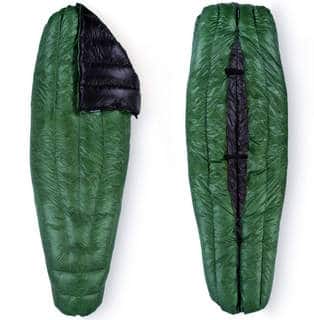
The Enlightened Equipment Revelation is a quilt that can be used for sleeping on the ground or in a hammock. It’s available as a custom or stock model in a wide range of different lengths, widths, colors, temperature ratings, and fabric weights. The Revelation comes with an excellent pad attachment system, a zippered/ drawstring footbox, and an optional draft collar. You can also choose from two grades of down: 850 or 950 fill power. A custom Revelation 20F with all the bells and whistles weighs 20.75 oz. Synthetic insulation is also available. Read our Revelation Quilt review.
2. Hyperlite Mountain Gear 20-Degree Quilt

The Hyperlite Mountain Gear 20-degree Quilt is a stock ultralight (20.1 oz) down quilt insulated with 1000-fill-power goose down, treated with a DWR coating to resist perspiration and maintain its loft. It has a highly efficient box-baffled construction with vertical and horizontal baffles to keep the down in place, and it comes with a durable, silky 7D nylon shell fabric. The footbox is sewn closed for maximum warmth, and the quilt comes with a pair of pad attachment straps. This is a great option for three-season use, particularly in cooler mountainous areas. Read the SectionHiker Review.
3. Underground Quilts Bandit

The Underground Quilts (UGQ) Bandit is a custom ultralight backpacking quilt that’s available in a wide range of sizes, temperature ratings, and loud, colorful fabrics. Ideal for hammockers or ground dwellers, the Bandit is available with a draft collar, a closed or drawstring footbox, and what they call Dynemic Tension Control, which gathers the sides of a quilt to your torso to protect against drafts, with or without pad attachment straps. UGQ also lets you request added insulation overfills in the torso or footbox if you’re a cold sleeper. Read the SectionHiker Bandit Quilt Review.
4. Therm-a-Rest Vesper 20

The Therm-a-Rest Vesper 20 is a stock 900 fill power quilt with box baffling, a draft collar, two pad attachment straps, and a closed footbox. It’s cut extra wide so it wraps over the sides of your sleeping pad and eliminates side drafts. The Vesper has a luxurious 10D nylon liner and shell and weighs 19 oz. It’s available in two lengths, a regular (6″) and a long (6’6″). For what it’s worth, this is the quilt I plan to take thru-hiking this spring in England and Scotland. A review is forthcoming
5. ZenBivy Ultralight Quilt and Sheet

The ZenBivy Ultralight Quilt and Fast Sheet is a quilt sleep system (pad not included) that weighs just 19 oz and eliminates one of the nagging problems with standalone quilts: side drafts. It includes a first-rate stock backpacking quilt, which you can purchase by itself, and what ZenBivy calls a “sheet”, which fits over your sleeping pad and hooks into the sides of the quilt to block drafts completely. The quilt is insulated with 950-fill-power down and has a 10D Pertex Shell that weighs 16 oz, making it a 25F quilt. The Fast Sheet weighs 3 oz. Different sizes and temperature ratings are available. Experienced quilts users, including thru-hikers, who’ve tried the ZenBivy sleep system love it. Read the Sectionhiker.com ZenBivy Ultralight Quilt and Sheet Review.
6. Neve Gear Waratah 18

The Neve Gear Waratah Quilt 18 is an ultralight backpacking quilt insulated with 850-fill-power down and comes with draft collars at the neck and a drawstring foot box. Made with a silky 10d nylon shell, the Waratah has box baffles oriented vertically over the torso and horizontally over the footbox to limit downshift. What makes it somewhat unique is how it addresses the side-draft issue experienced by ground sleepers, by anchoring its pad attachment straps farther from the edge of the quilt, so you can tuck more of it under your sides. This is very clever and effective (the Thermarest Vesper 20 above uses a similar technique.) Read the SectionHiker Neve Waratah Review.
7. Katabatic Gear Alsek 22 Quilt

While some quilts feel like they aren’t wide enough to wrap around, the angled “wings” and elastic binding around the bottom opening on the Katabatic Alsek 22 helps keep the quilt secure around the hiker without a major weight penalty. The stock Alsek 22 weighs just 22.2 ounces with 900-fill-power down and has a durable Pertex Quantum Ripstop shell. It also has a longer sewn footbox than many other quilts, which helps trap more heat. The Alsek is available in a wide range of lengths and with different down fills, including an overfill option. Despite that, we still consider it a stock quilt since so few options are available. Review forthcoming soon.
8. Warbonnet Diamondback Quilt
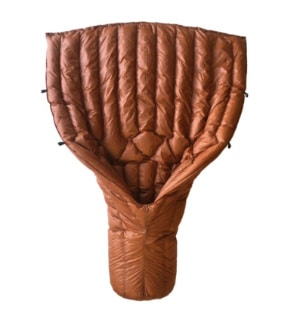
The Warbonnet Diamondback is a down quilt made using Warbonnet’s constriction-point baffle pattern that uses a series of constrictions in the baffle pattern to isolate both halves of the quilt, reducing downshift, and letting you position overfill where you want it the most. The Diamondback is available as a custom-made quilt or as a stock model. Available customizations include a wide range of widths and lengths, color options, insulation types, foot box styles, a draft collar, a back-tensioning system, and a pad attachment system. A regular-sized Custom Diamondback 20F with all the bells and whistles weighs in at 25 oz. Read the SectionHiker review.
9. Zpacks Classic Quilt Sleeping Bag

The Zpacks Classic Quilt Sleeping Bag is a stock quilt/sleeping bag with a closed foot box and a 3/4 length zipper so you can open it up, use it as a quilt, or zip it up for a draft-free sleep. The Classic is box baffled, with vertical and horizontal baffles to prevent down-shift. It is insulated with 900-fill-power duck down with a 30% overstuff. Unlike a true sleeping bag, the zipper is on the bottom, not on the side, since the assumption is that you’ll mainly use the Classic as a quilt and only zip it up on very cold nights. The Classic is available in a fixed number of lengths, temperature ratings, and colors. A regular-sized Zpacks Classic 20F weighs 18.8 oz. Read the SectionHiker Review.
10. Loco Libre Ghost Pepper Quilt

The Loco Libre Ghost Pepper is a custom down quilt available with unique chevron-shaped baffles to keep insulation from shifting. It’s insulated with 850-fill-power down and available with an astonishing number of custom options, including different temperature ratings, lengths, widths, shell and liner colors, colored stitching, a neck draft collar, different tapers, a closed or drawstring footbox, pad attachments, and down overfill. Read the SectionHiker Ghost Pepper Quilt Review.
Backpacking Quilt Selection Criteria
Here is a list of factors to consider when selecting an ultralight backpacking quilt.
Quilt Insulation
High-quality goose and duck down with fill powers of 800, 850, 900, and 950 provide excellent insulation for their weight and are widely preferred by backpackers for their lightweight nature. In addition to excellent compressibility, quilts insulated with down will last for decades of use if properly cared for. Some manufacturers only offer down that’s been treated with a water-repellent coating, while others prefer to offer it unadulterated. Down is naturally water-resistant, so the jury is still out on whether “treated” down lasts as long and insulates as well in the real world vs. a testing lab. Regardless, with a little care and common sense, you can keep a down quilt dry by carrying it in a waterproof stuff sack, picking good campsites that don’t flood in rain, and airing it out occasionally in the sun. Getting a quilt with synthetic insulation is another option and can be preferable in humid climates or for extended cold weather journeys, where it’s difficult to dry your gear.
Quilt Temperature Ratings
The introduction of standardized sleeping bag temperature ratings by the outdoor industry substantially improved their reliability. Many manufacturers had overstated their temperature ratings by as much as 10 degrees before that standard was introduced. No such testing standard exists for backpacking quilts, so you’re forced to rely on their reputation and customer reviews. When buying a backpacking quilt, the current rule of thumb is to purchase one rated for 10 degrees below your needs to ensure you’ll be warm enough. There is an enormous incentive for ultralight quilt makers to quote low gear weights, so read their customer reviews carefully. Women may want to add 15-20 degrees of insulation because they sleep colder than men due to lower body mass. No one makes women’s specific quilts yet, although there is an obvious need for them.
Since there is no standardized test for rating the warmth of a quilt, it is important to understand how manufacturers test and self-rate their quilts. Many assume that you will be wearing an insulated hat, long underwear, and socks, and using a sleeping pad with an R-value of 5 or higher. Contact them and ask before you purchase a quilt, or you’ll likely sleep colder than expected.
Gear Weight
While gear weight is important, be careful not to sacrifice your comfort by selecting a quilt that won’t keep you warm in the conditions you need it to. In fact, insulation is usually the lightest-weight component of a quilt, where the bulk of its weight comes primarily from the fabric used to make it. When choosing fabrics, consider their breathability and whether they have a DWR coating, which can be important if the foot of your quilt gets wet regularly. If you plan on using your quilt heavily, consider getting a heavier inner shell fabric, as this is where the greatest wear and tear occurs over the long term.
Standard and Custom Quilt Features
Most ultralight backpacking quilts are pretty similar when it comes right down to it. But there’s something about each of the manufacturers’ quilts listed above that improves their performance in a distinct way. For example, the use of continuous or chevron-shaped baffles, draft collars, zoned insulation, closed foot-boxes, and external snaps for quilt layering all improve cold-weather performance. A strapless pad attachment system is far more convenient and comfortable than ones that rely on straps, while a head-hole enables multi-use as a garment. Look for these differentiators, as they can profoundly influence your backpacking experience.
Differential Cut
Some quilt makers make their quilts with a differential cut. This means the top fabric and the internal fabric are sized differently (the inside is smaller) to fully loft the insulation, especially when your knees press into it. It also helps slightly reduce the quilt’s weight.
Sleeping Pad Attachment Systems
There’s a lot of variability in sleeping pad attachment systems and their ability to block side drafts. We prefer those with wide elastic straps and wafer clips (Enlightened Equipment) because they’re easier to adjust in the dark and while you’re lying on a sleeping pad. We also find them more effective than attachment systems that use cords and/or mitten clips, as they are more difficult to use when your hands are cold. All pad attachment systems are more effective when used in conjunction with a back tensioning system.
Ultralight Backpacking Quilt FAQs
What is a top quilt for backpacking?
A top quilt is just another name for a backpacking quilt that you use to cover yourself when sleeping on the ground on a sleeping pad or in a backpacking hammock. It’s basically a down comforter shaped like the top half of a sleeping bag, but without a hood, that has a shaped footbox like a sleeping bag. Many top quilts can also be opened up and used like a blanket.
What is the advantage of using a backpacking quilt instead of a sleeping bag?
Backpacking quilts are lighter weight, more compressible, and more versatile than sleeping bags. They’re also more comfortable for side sleepers and people who toss and turn at night.
How wide should a backpacking quilt be?
Ground sleepers need extra fabric and insulation to tuck under their sides to prevent drafts. A width of 55″ is a pretty standard width for ground sleepers. Larger individuals may want to go a bit wider.
How long should a backpacking quilt be?
When sizing a quilt, it’s important to understand whether the length includes the foot box, since several inches of fabric are lost when forming one. Quiltmakers often provide recommended heights for users when quoting sizes, so look for these.
What is a backpacking quilt pad-attachment system?
A quilt-pad attachment system lets you connect the sides of a backpacking quilt to the top of your sleeping pad so that drafts can’t sneak under the sides and chill you. Most pad attachment systems have elastic straps that you loop over a sleeping pad with clips that connect to the sides of your quilt. The male parts of the clips connect to female clips sewn onto the quilt. These are small and barely noticeable. All pad attachment systems are more effective when used in conjunction with a back tensioning system. In warm weather, most people skip the pad attachment system, but it is useful when it’s colder outside at night.
What temperature should a quilt be rated for?
For men, you can’t go wrong with having a 20-degree (Fahrenheit) quilt because you can vent it easily in warmer weather. Since women have less body mass and generate less body heat, we recommend getting a 10-degree quilt. If you think you’re a colder sleeper, we also recommend getting a 10-degree quilt.
Is there a temperature rating standard for quilts, like sleeping bags?
There isn’t a temperature rating standard for quilts like there is for sleeping bags. However, some testing labs apply the sleeping bag standard test to quilts, adding in a down hood, to simulate the effect of a sleeping bag hood. When in doubt, ask the quilt manufacturer how they derived their temperature rating. When in doubt, consider getting a quilt that’s rated 10 degrees colder than the lowest temperature you expect to need.
What is a draft collar?
A draft collar is a tube of fabric, usually filled with goose or duck down, located just below the hood of a sleeping bag or the head end of a backpacking quilt, that wraps around your upper chest and neck so heat can’t escape when you move around at night. For ground sleepers, it’s important that the controls for tightening the draft collar be located over your chest, within easy reach of your hands if you’re lying on your back or side.
What is the difference between a quilt with a zippered footbox vs a closed footbox?
A zippered footbox lets you open a quilt like a blanket, which is useful in warm weather. Most zippered foot boxes have drawstring closures, which can also be opened for venting. Closed foot boxes are sewn shut and more like the foot boxes on sleeping bags. They’re also warmer than zippered foot boxes since they block drafts.
What is a quilt back tensioning system?
This is an adjustable system that pulls the sides of the rear hole of a quilt together to help block cold drafts. It augments a pad attachment system and is primarily beneficial to ground sleepers. Vendors use different names for it, like Dynamic Tensioning System (UGQ), Adjustable Side Elastics (Warbonnet), and Edge Tension Control (Nunatak).
Why is a differential cut on a backpacking quilt important?
A differential cut is when the interior and exterior shell fabrics of the quilt are cut to different sizes so that all the down insulation stays fully lofted around you, even if you push against it or pull it tight. If the inner and outer fabrics were cut to the same size, the down would flatten when you pressed against it, causing it to compress and lose all of its trapped heat.
Is it worth adding down overfill to a quilt?
It really depends on the quilt’s design. Most quilts are designed with an ideal baffle height and a differential cut that optimizes the warmth for a given temperature rating. Adding some overfill might reduce the downshift inside the quilt or not, depending on how it’s designed. When in doubt, ask the quilt manufacturer. Sometimes, it’s more effective to just get the next warmer-sized quilt instead.
What does denier mean?
Denier, often abbreviated as “d” or “D”, is a unit of measurement that is used to describe the thickness of individual fibers or threads. When shopping for backpacking gear or clothing, you’ll often see 10d or 20d tacked onto the end of a specification for the gear’s fabric. Higher-denier fabrics are usually heavier and more durable than lower-denier fabrics. For example, a quilt with a 10d shell fabric will be slightly lighter weight and less durable than one made with a 20d fabric.
What sleeping clothes should you use when sleeping with a backpacking quilt?
We recommend wearing a long-sleeve jersey and long underwear, the same clothes you’d wear in a sleeping bag, to keep body oils and dirt from making the inside of your quilt dirty. Many people also wear a fleece or down hoodie when sleeping under a quilt if more warmth is needed. A fleece hat or a down hood can also be worn in colder conditions.
Are quilts good for winter backpacking and camping?
Not really. Quilts are best used at temperatures above 20 degrees, although some people drape a quilt over a sleeping bag in winter to boost its temperature rating.
When is a full-length zipper better than a 3/4 length zipper?
For cold-weather quilts rated for less than 20 degrees Fahrenheit, or if you’re a cold sleeper, we recommend a quilt with a 3/4-length or full-length zipper. When zippered closed, it eliminates the risk of cold drafts while still letting you sleep with the quilt open and draped over you in warmer weather.
What is the difference between 800- and 900-fill-power down?
Fill power is a measure of how much space goose or duck down can fill. For example, 1 ounce of 800-fill-power down will fill 800 cubic inches, whereas 1 ounce of 900-fill-power down will fill 900 cubic inches. More down generally means more warmth. So a 900-fill-power down quilt provides more warmth than an 800-fill-power quilt for the same weight of insulation. It also means that you can use less 900 fill power down by weight to get the same warmth as that supplied by 800 fill power down, thereby reducing the weight of your quilt.
Is duck down warmer than goose down?
Fill power is a species-independent measure of the warmth-to-weight ratio of duck and goose down. In other words, 800 fill power duck down is as warm as 800 fill power goose down. The difference between the two boils down to the color of the insulation, which you won’t see because it’s sewn into a sleeping bag or quilt and not visible to the eye. Duck down is also less expensive than goose down because there are a lot more ducks in the world than geese.
What is the difference between a stock quilt and a custom quilt?
Many quilt manufacturers offer stock quilts, which are pre-made, have a limited feature set, use slightly heavier fabrics, and are available in only a handful of colors. They also tend to use lower-fill-power down insulation or duck down instead of high-fill-power goose down. The advantage of buying a stock quilt is that it is usually less expensive and available much faster than a custom-made one, even if it is a few ounces lighter and comes in your favorite color.
What is the best type of sleeping pad to use with a quilt?
Most sleeping pads work well with quilt pad-attachment systems, though a few exceptions exist, including inflatable air mattresses, self-inflating pads, and foam sleeping pads. Pads that don’t work very well are thin, closed-cell foam pads that are thinner than 1/4″ and Klymit sleeping pads that have openings in them. But in general, quilts work best with inflatable sleeping pads from Therm-a-Rest, Sea-to-Summit, NEMO, and Exped.
What is an underquilt for backpacking?
An underquilt is used by backpackers who sleep in hammocks. It provides back insulation, much like a sleeping pad does for people who sleep on the ground in tents or under tarps. While you can technically sleep on a sleeping pad in a hammock, an underquilt is much more comfortable because it is hung underneath the hammock and out of the way.
What is the Responsible Down Standard?
The Responsible Down Standard (RDS) certification aims to ensure that down and feathers come from animals that have not been subjected to any unnecessary harm. Any removal of down and feathers from live birds (live-plucking or molt-harvesting) is prohibited; force-feeding is also prohibited. A professional, third-party certification body audits each stage in the supply chain. Certification ensures that the identity of RDS down and feathers is maintained at all times: from the farm to the final product.
SectionHiker never accepts payment for gear reviews or editorial coverage. When you buy through affiliate links on our site, we may earn a small commission at no extra cost to you. Help us continue to test and write unsponsored and independent gear reviews, hiking and backpacking FAQs, and free hiking guides.








 English (US) ·