
.jpg)
PROTECT YOUR DNA WITH QUANTUM TECHNOLOGY
Orgo-Life the new way to the future Advertising by Adpathway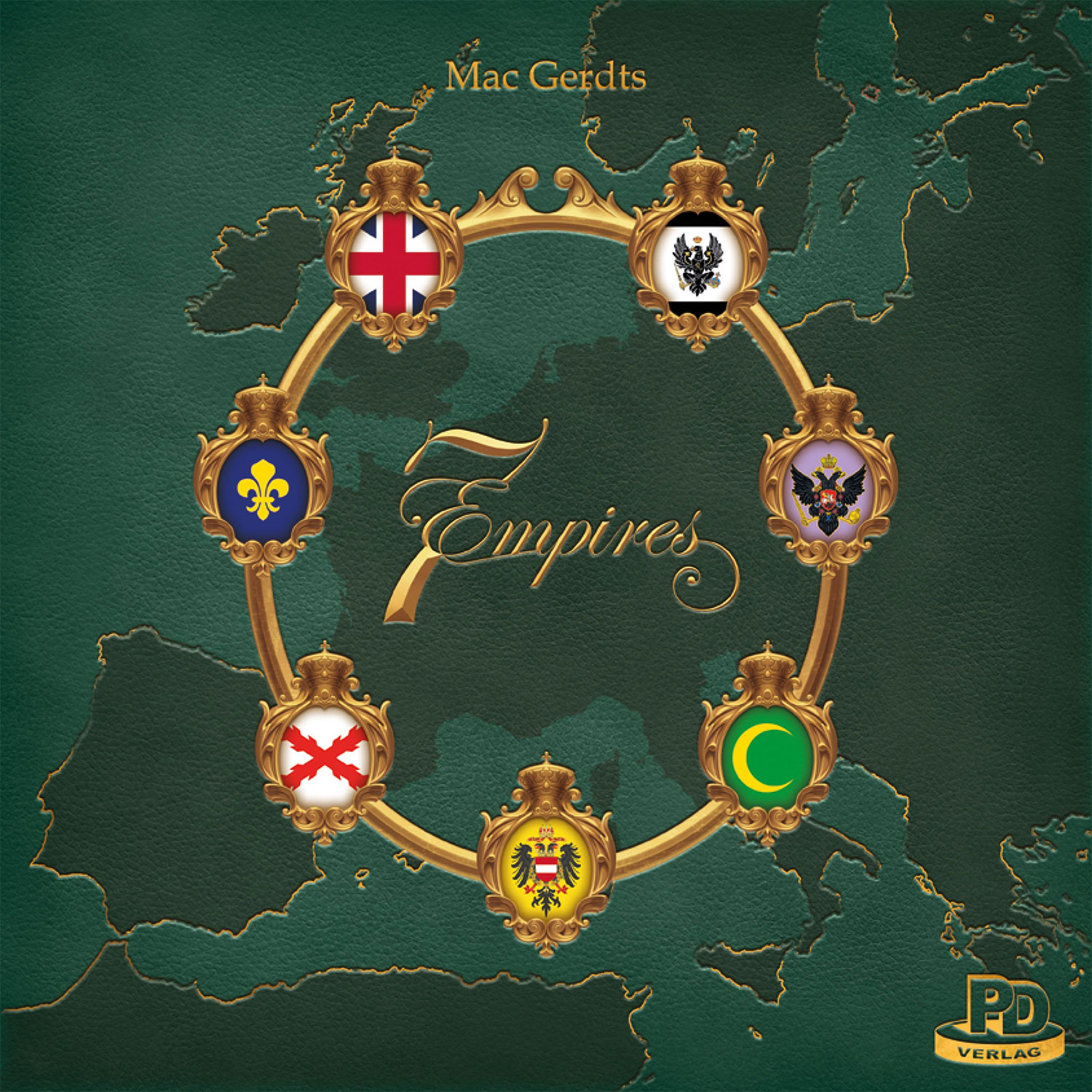 When I see a new release that promises to be filled with strategy in a European setting, my early gaming Euro sensibilities kick in, and I’m intrigued. This hasn’t always been the case. Rather than gravitate toward a heads-down strategy, I now find that interactive systems with a mix of strategic and tactical gameplay scratch that itch.
7 Empires released this year to little fanfare. On the surface, it presents as just another stuffy Euro. But it was the name Mac Gerdts, infamous designer of Concordia (among many other unique designs), that drew me in. While new, 7 Empires revisits the older release Imperial (2006) and promises to streamline by way of mechanisms and playtime. Publisher Rio Grande Games was kind enough to send this our way to test the limits of expansion on the old continent.
Gameplay Overview:
The premise of 7 Empires is simple, and it focuses on expansion. The main board features color-coded empires. An influence card is chosen that evenly distributes starting influence between players. You’ll find yourself in control of specific empires immediately, but also have a vested interest in other empires controlled by your competition. Final scoring relates to a player’s influence on an empire multiplied by the empire’s ability to expand during play.
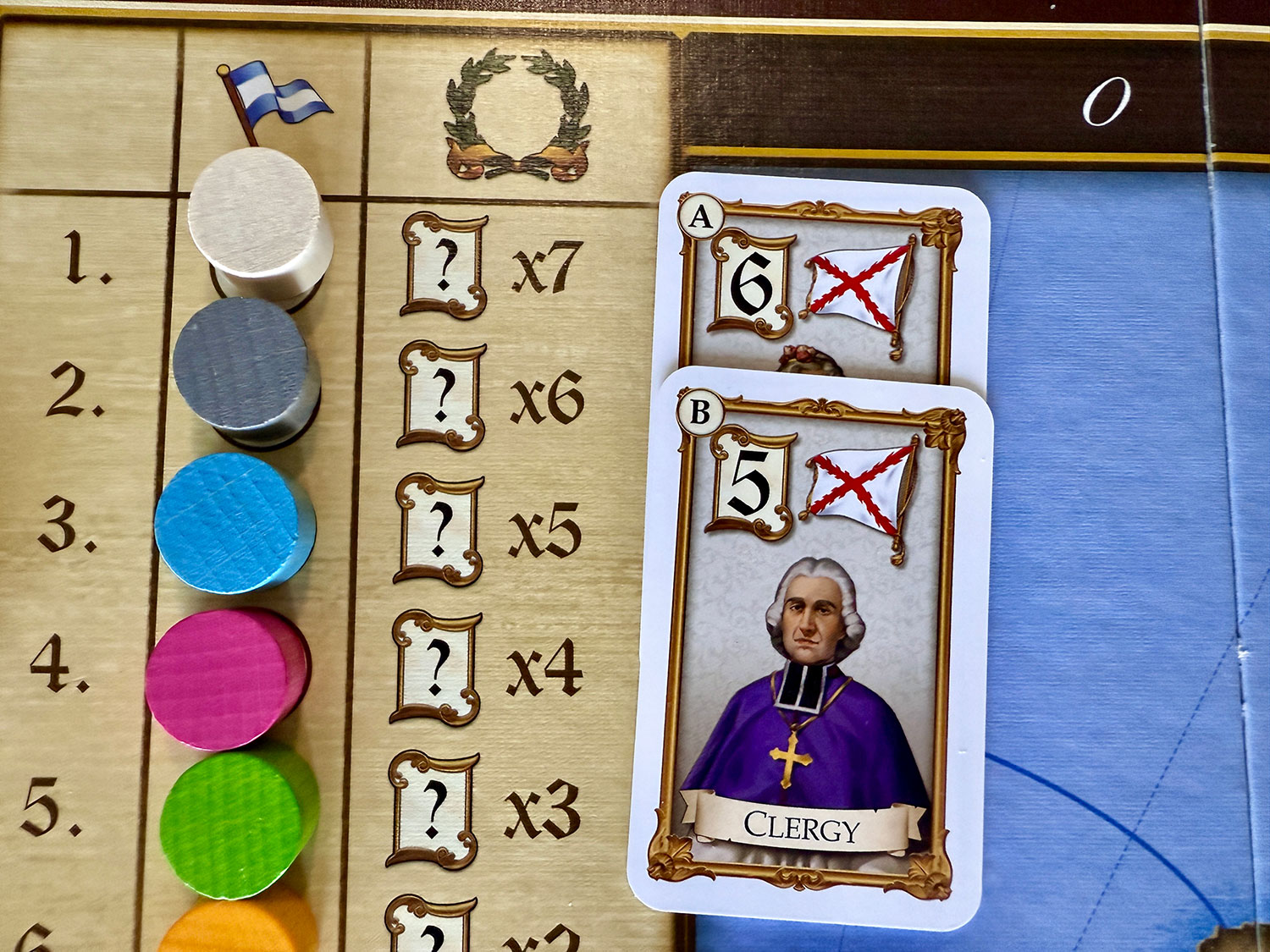 Players invest in empires and aim to see them succeed for greater rewards.
Over eight rounds, each empire takes one action. If a player has controlling influence, they are the monarch for the round (this can shift) and choose an available action for the empire. As each player takes a turn, the ability to control an empire’s action is based on majority influence when not a monarch. And if neither of these applies when your turn arrives, there is a consolation action that is taken instead.
Each empire has the option to choose its action from three available options, while two of the remaining options are unavailable during the round. The unavailable options shift back into play via a conveyor belt mechanism that finds them queuing closer each round. Due to this restriction, the choice of action taken by a player can inhibit their ability to exert control in many ways during play.
The five actions are as follows:
- Build & Deploy – Build a new city or upgrade an existing one. Then deploy a new unit to each city in the empire, or three units to one city.
- Move & Fight – Move ships, move land units, and fight opposition, then place control flags.
- Attack – Place two units in an unoccupied city region or in two different unoccupied city regions in the empire. Move and fight with both.
- Palace – Build a new palace or upgrade an existing one. Add points for the empire.
- Empire – Count all flags of the empire in land and sea regions for points.
Building cities and deploying units helps empires maintain control and expand to further reaches. Moving into lands with opposing units allows for shifting control via combat. And at opportune times, Palace and Empire actions provide scoring opportunities for each empire.
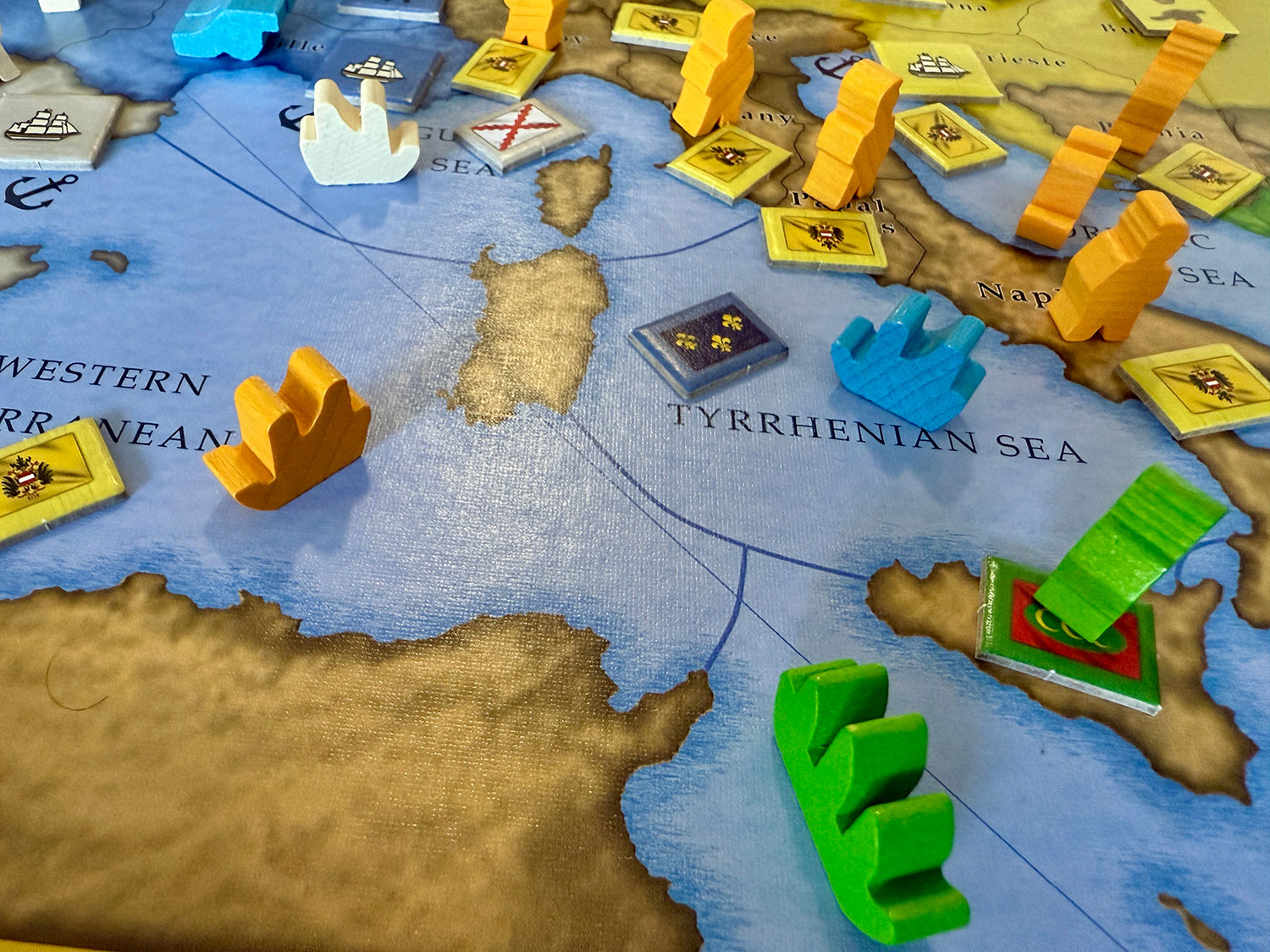 By land or sea, expansion requires contact and conflict.
Combat is deterministic, and only one color can occupy a space at the end of a round. Units are eliminated 1:1, though one land unit type (artillery) eliminates infantry 1:0. Troop and ship numbers are also limited to a maximum of three units in a specific space at the end of an empire’s turn.
Each round ends with the first player’s marker shifting to a new player. It also features an hourglass tile reveal that finds players choosing further influence cards (which may shift monarch control) or adding new units to their lands. This end-of-round choice may change the landscape considerably as player influence shifts and monarchs find themselves under the control of another.
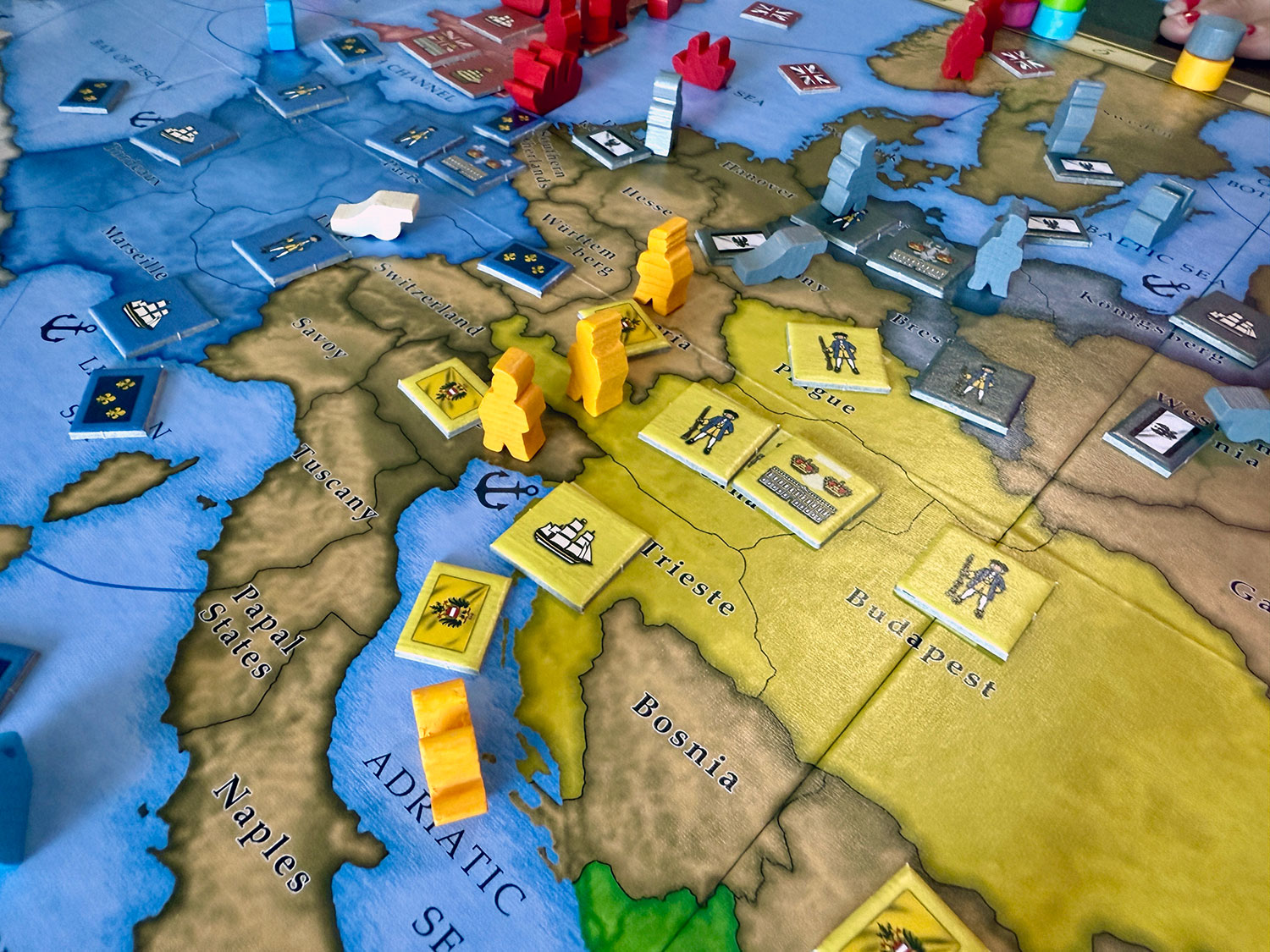 Brown regions begin the game empty and players slowly begin to gain control of these lands.
Game Experience:
One look at the Euro-centric main board and the mass of wooden components and chits and one may think this is going to be a heavy game. And from what I gather, the original design did require a dedicated group and significant chunk of time to truly live in its world. But 7 Empires is different. It shaves at least thirty minutes off the playtime and features only four pages of rules specific to the state of play. This is very easy to get to the table.
The influence system is the highlight. You may begin a game as the Russian monarch, yet find that Spain becomes more enticing based on its control of land, and see yourself seeking out new influence to get a piece of the scoring pie. Players must not only focus on control but also navigate and negotiate with other empires. Perhaps France and the Ottoman empires team up to take on the Habsburg onslaught. Perhaps an agreement is struck with Great Britain to send ships to help.
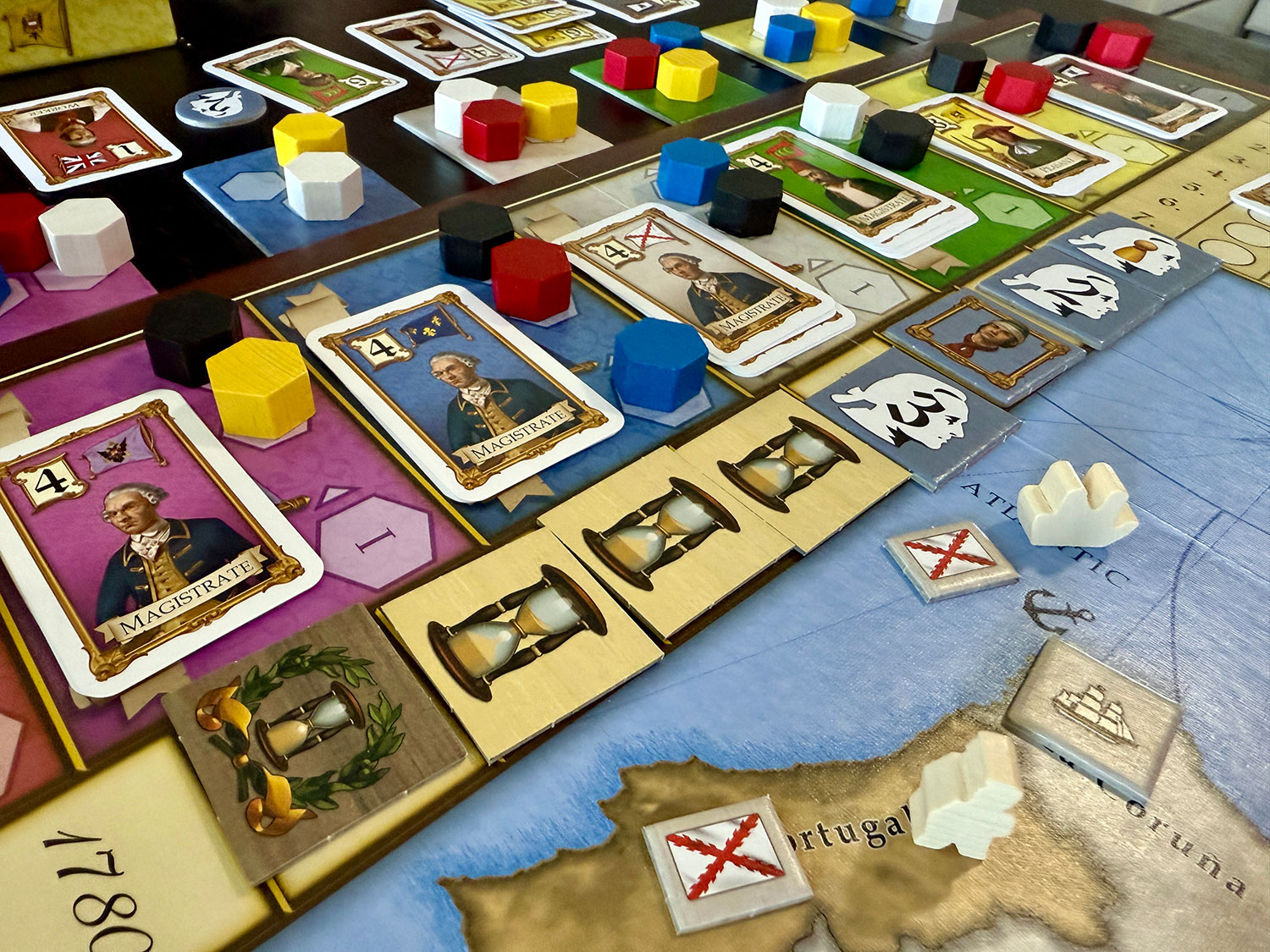 Each empire has an action selection and influence cards available to them.
It truly provides a top-down look at shifting powers with everyone’s fingers attached to different empire strings—everyone is a puppet master. It’s made manageable by offering simple actions and easy to understand influence numbers. It leaves the real gameplay to reside between players as they discuss how best to shift their units to score the most points. Or debating on which action to take now as opposed to waiting for later.
7 Empires plays from two to six players. I’ve found games at four and five to be a delight, and it’s amazing how swift it plays. There is a lot of meaty action happening even when an empire is taking only one action per round. With repeat plays, actions and combat, and influence decisions and strategy all begin to flourish. There’s even an option to draft starting influence so that the included influence cards don’t make play stale over time.
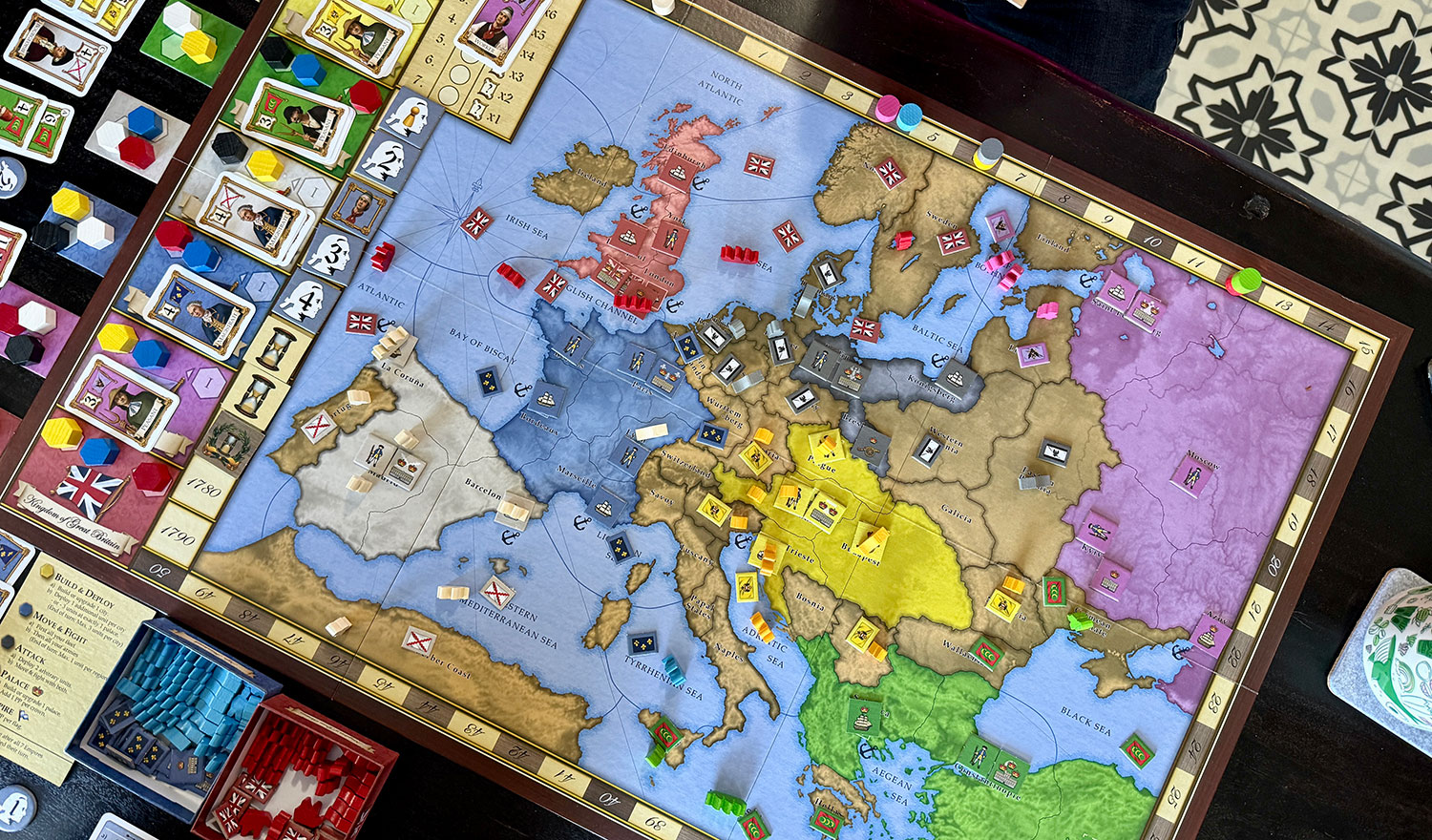 An overview of the map which thankfully keeps the focus centered on your units and potential interaction.
One aspect of the system to highlight is the end-of-round hourglass tile reveal. These are seeded randomly during setup and provide a nice wrinkle in the way that they provide influence and unit boosts. It delivers uncertainty to how influence and control shifts, thus making this top-down view of conquest much murkier and thus more energizing. Interactivity abounds here.
Even with my Euro-heavy background, I do have to comment on the uninspired presentation. The main board, the iconography, the influence cards, and beyond—it’s not going to catch anyone’s eye. It stays too close to its predecessor and really misses out on a true refresh. You know a Mac Gerdts design when you see it, and I for one, would love to see a new avenue of thematic illustration.
7 Empires also has a couple of odd component choices. The first are the seven action tiles that are set to the side of each empire space on the main board. They are not needed and add unnecessary clutter on the table. The second are the monarch tiles. It’s very easy to pass components in the included empire boxes around the table. If a player has the empire box, they have the controlling influence. I’d toss the monarch tiles right back into the box.
Final Thoughts:
7 Empires is a hit. Mac Gerdts continues to showcase elegant rulesets and mechanisms that provide exactly what I’m looking for with interactive gameplay. The influence system keeps everyone invested, sees alliances shift, finds heavy contention of land and sea, and encourages table talk. The action conveyor belt also provides a strategic choice that can both help and hinder based on your future allegiances. If you are seeking a heads-down strategy game, I suggest you look elsewhere. But don’t overlook this gem. It’s an excellent entry point into shared incentive and emergent narrative systems.
Final Score: 4.5 stars – Brush off that dust and rejoice! 7 Empires refines and expands.
 Hits:
Hits:
• Action selection/restriction
• Shared influence
• Hourglass wrinkle
• Deterministic combat
Misses:
• Tired setting/illustration
• Extraneous components

/pic9148407.jpg)








 English (US) ·