
.jpg)
PROTECT YOUR DNA WITH QUANTUM TECHNOLOGY
Orgo-Life the new way to the future Advertising by Adpathway Ada Lovelace (1815-1852) was the author of the first published computer algorithm before computers existed; to put it succinctly, she was a computer science pioneer and visionary. Sadly, her ambitions were never fully realized during her own lifetime owing both to her gender and her untimely death. In the 200 or so intervening years, society has made some great strides towards gender equality, scientific and otherwise, even though the Matilda Effect is still pervasive and there are definitely some other areas for improvement. Nonetheless, Ada Lovelace has started to receive the recognition she deserves; there’s several computer science buildings and institutes named in her honor, an eponymous computer language, and now possibly the greatest honor of all: an awesome board game.
Ada’s Dream is a heavy, competitive, point-salad Eurogame played over 90-120 minutes. Featuring dice-drafting, deck-building, and resource management, Ada’s Dream sees 1-4 players work with Ada Lovelace and fellow scientists to realize her scientific visions and build a computer that will literally calculate a large chunk of your final score.
Gameplay Overview:
One of the key goals of Ada’s Dream is to build a powerful personal computer consisting of 9 total dice arranged in a 3×3 grid that can potentially form up to six completed mathematical equations. The game-end trigger is any player placing their 9th die.
In order to reach this point, players will do one of two things on a turn.
- Draft a new die, and store it in a limited reserve (like in Castles of Burgundy)
- Place a previously drafted die into your personal computer and activate its color-specific region
There are several considerations when drafting a die:
- The pip value determines which collaborator card you can play from your hand (if any)
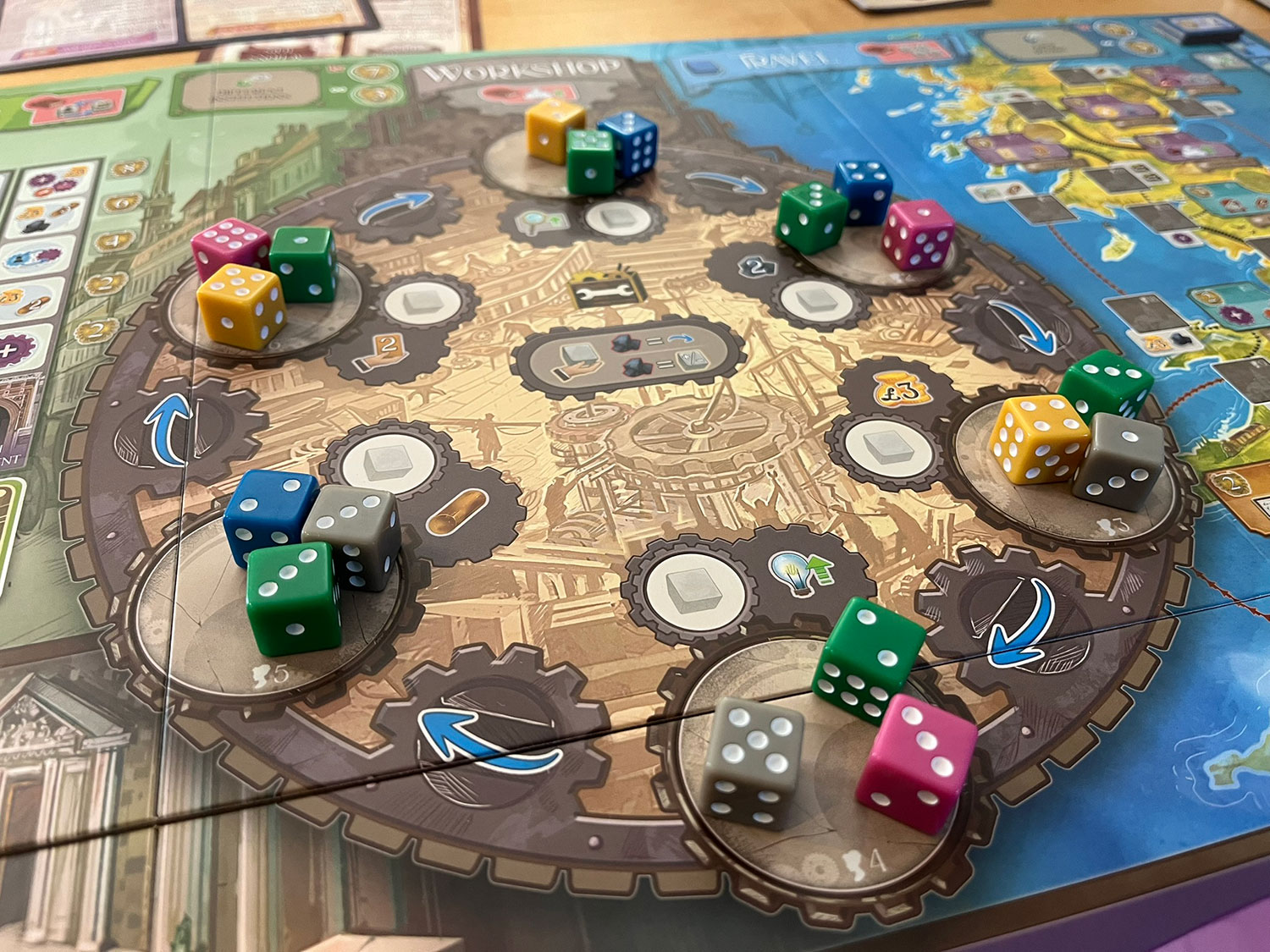
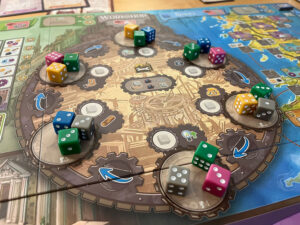 The workshop from which dice are drafted is shown here at game start with 3 dice in each location, associated with a unique one-time bonus.
 - The color determines which region can be activated later
- The location determines an immediate bonus
When placing a die, there are four color-specific regions that can get activated.
- Yellow = Meetings: acquire new, improved collaborator cards
- Pink = Ada’s Study: acquire addition gears for your personal computer, end-game scoring punch-cards, and/or task cards that provide powerful research perks
- Blue = Travel: visit cities and universities, sharing ideas and gaining stronger bonuses the further you go
- Green = Institution: give lectures at various institutions, achieving stronger bonuses the more difficult the topic
- Grey = Wild: pick any desired region
There’s a whole lot more to it, but after roughly 18+ turns, tabulate final scores, and whoever has the highest final score wins!
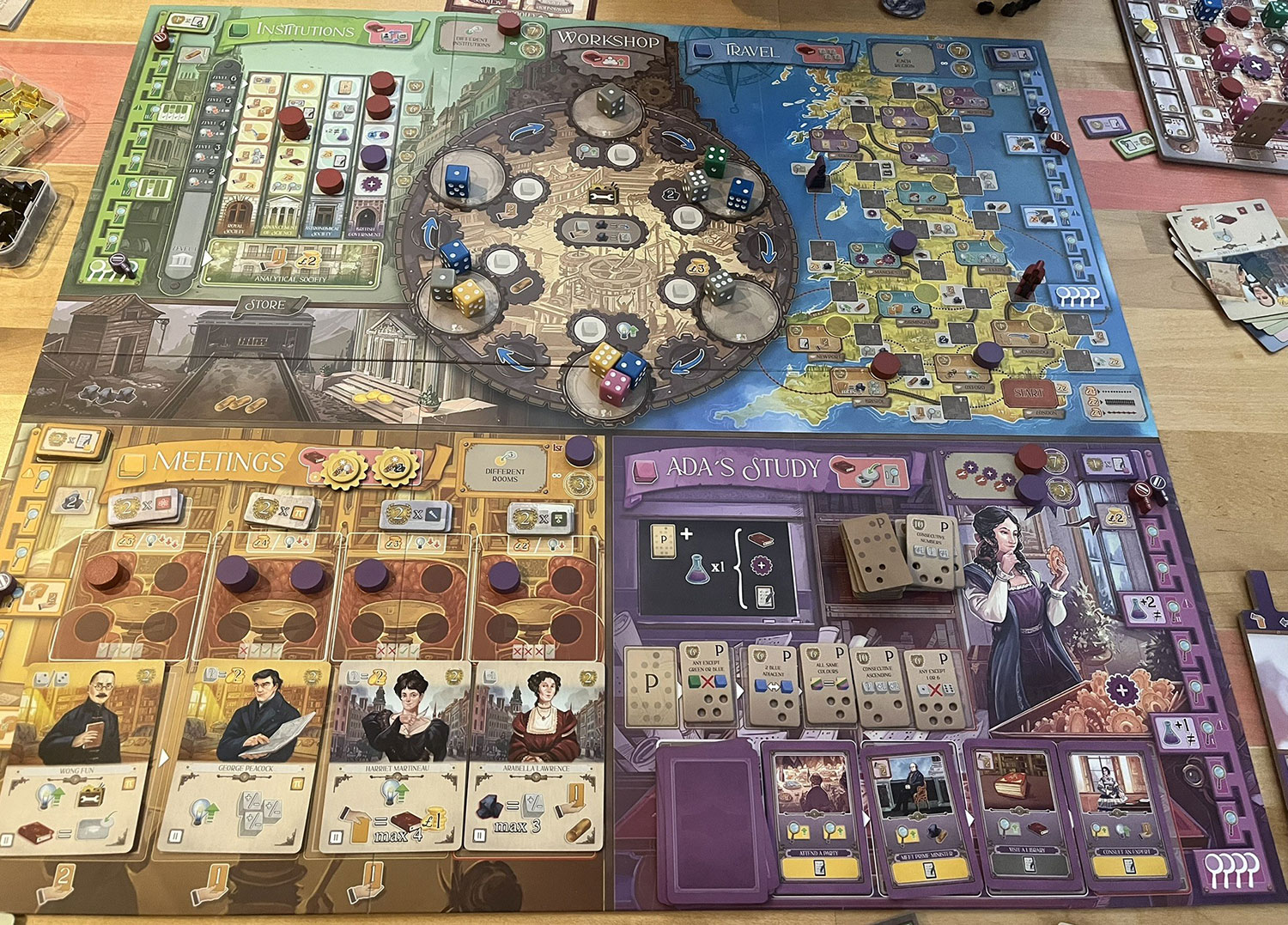 The central board at the end of a 2-player game is shown here. Four different colored regions (green, blue, yellow, and pink) surround the dice-drafting workshop.
Game Experience:
It shouldn’t come as a surprise that I LOVE this game; I selected it as my 2025 game of the year after all, and that was after only playing it once. Having now had the opportunity to play it repeatedly, I can better appreciate the diverse strategies, impacts of variable board set-up, and how much the Great Exhibition Expansion adds to the gameplay. The easiest game to compare it to is Tiletum, which, depending on the day, is my favorite game of all time, so to say Ada’s Dream provides a similar experience is incredibly high praise.
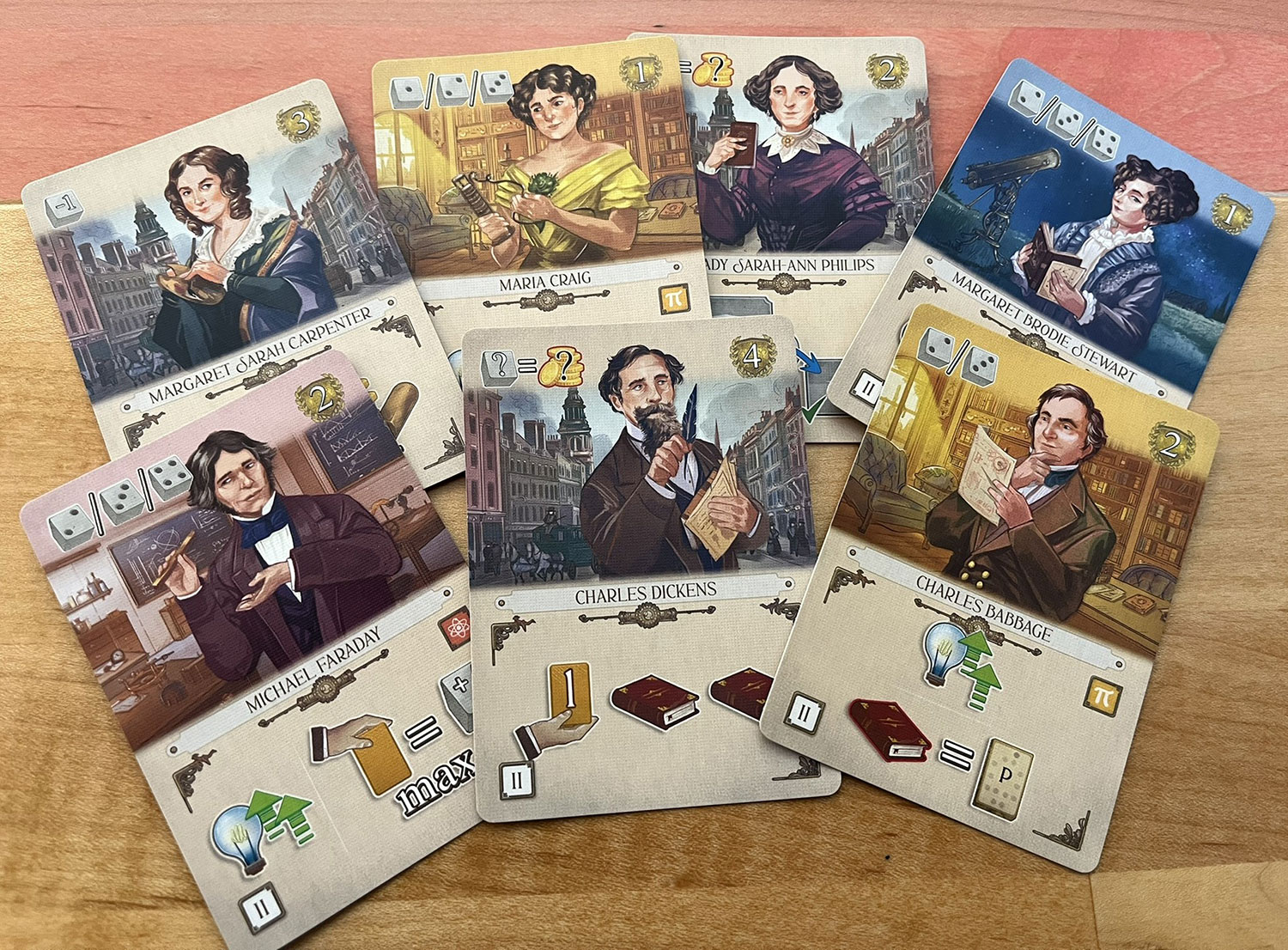 A sampling of collaborator cards are shown here, each highlighting a historical scientist or inventor, and equally representing men and women. The requirement for playing these cards is drafting a particular value die or paying the cost equal to pips of your drafted die.
The most obvious area for comparison with Tiletum is the multi-factorial dice-drafting. Players must consider the color, location, and pip value of the die being drafted, among up to 18 possible choices. The trade-off when selecting for pip values is that low pip values make it easier to play valuable cards. Yet these same dice will eventually be part of your personal calculating machine, and basic math dictates that higher pip values will yield higher computational values. Notably, the game provides several means to raise/lower pips during/after drafting as well as to swap dice in your computer with those on the board—always for a cost, of course.
There’s a lot to consider with dice drafting, and the limited number of turns requires ample planning ahead of actions. Notably, each region is associated with a unique research track, which makes actions in that region more valuable to players who achieve various levels, and it’s impossible to maximize every track, so trade-offs must be made, usually depending on which regions you think you’ll activate the most each game.
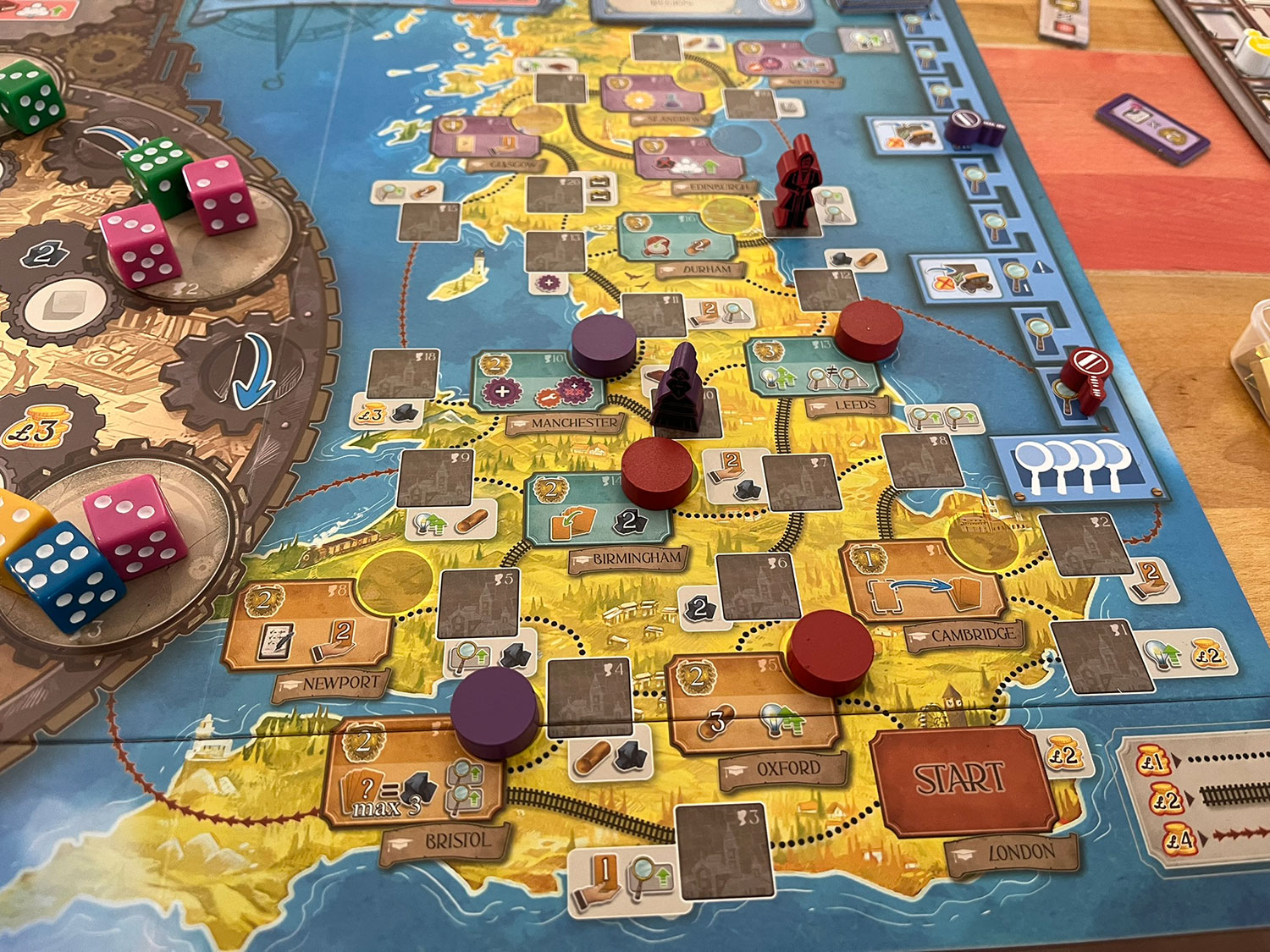 The blue (Travel) section of the board is shown here mid-game. Discs represent locations that have been visited. Only purple has advanced sufficiently far on the blue research track (magnifying glasses on far right) to be rewarded with free bonus movements.
If you intend to travel in the blue region a lot, you’ll probably want to advance on its track first, so that you’ll get a free extra travel movement (including a unique bonus) every time you visit. Additionally, certain blue locations encourage pre-planning, such as the one that awards one coal resource per card in-hand—you’ll probably want to increase your hand size before visiting here. Importantly, there are usually multiple means to achieving any given task, like drawing cards. Every region of the central board, as well as your playerboard and collaborator cards, is covered with bonuses that can be obtained in a variety of ways; thus, the game forces players to get creative regarding how to best and most efficiently achieve their desired goals.
The multiple implications of each action and the necessity of planning ahead, oftentimes by 3 or 4 turns, means this game can generate analysis paralysis of epic proportions. Decisions may further be influenced by the unique goals in each of 4 regions, which change each game, and can account for a lot of points. You’ll generally want to try to complete at least 2 or 3 of these, and the timing of completion matters, as it’s a race for the higher of two point-completion rewards. If another player is about to accomplish an objective, it may be worthwhile to alter your turn to achieve the objective earlier.
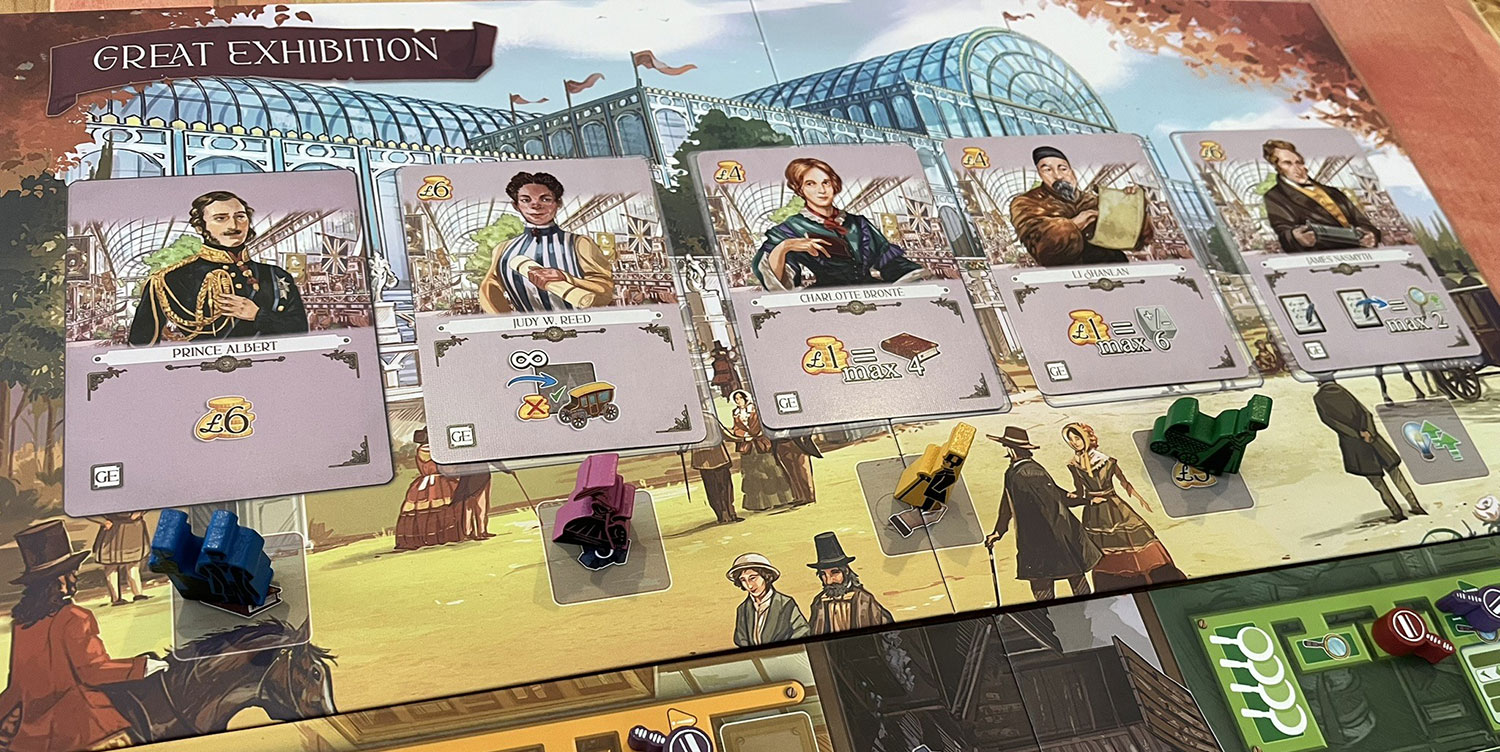 The Exhibition Expansion board is shown here.
Ultimately, these objectives create a lot of the game’s replay value, although the rest of the variable board set-up, dice rolls, and order of card availability help as well. The Great Exhibition Expansion adds even greater replayability by adding in 4 of 12 unique (very costly) super-actions to each game, each of which is linked to a particular dice color. So now there’s even more to think about with your dice drafting, and importantly, the color-associations change throughout the game as players trigger the Exhibition. Thus, if there’s an attractive Exhibition bonus currently linked with green, which happens to be your focus in this game, you may want to rush the draft of your next green die, as there’s no guarantee this will be linked with green much longer (or ever again). In this manner, the expansion adds much more player interaction and tension, which is otherwise fairly minimal, but increases a bit with more players.
Any critiques? I do feel that winning area majority in the individual Meeting Rooms and/or winning the race up to the top of the four research tracks provides relatively weak point-rewards compared to other scoring opportunities, such that players are usually not incentivized to prioritize winning these elements. This reduces some tension in the game, but it is a rather minor gripe in an otherwise fantastic game, and honestly, a minor house rule easily fixes this.
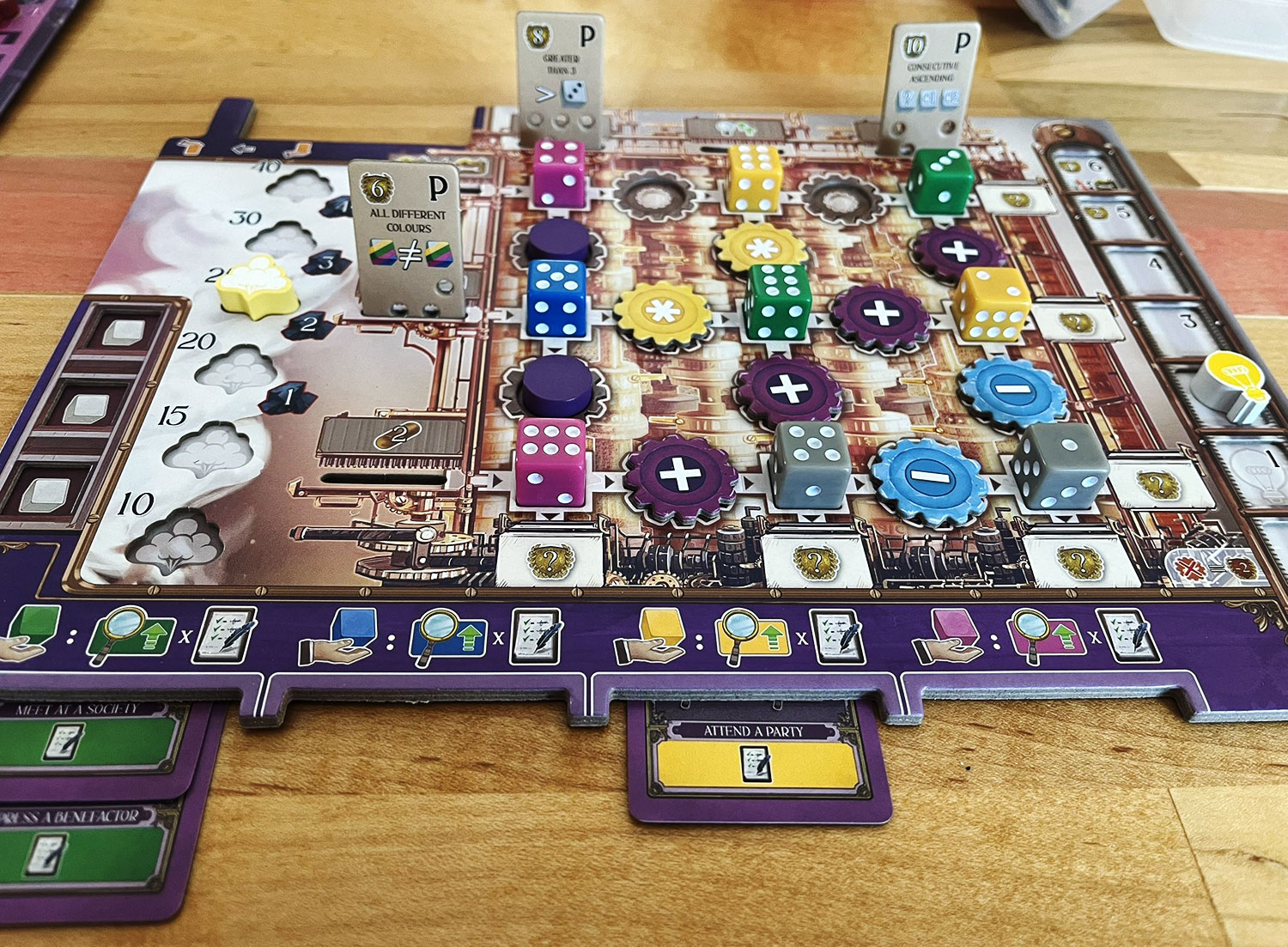 A personal playerboard/computer is shown here at game-end. The completed row equations calculate 32 and 10. The completed column equations calculate 41 and 4. The points awarded by each equation is capped by the steam track to the left (25 here) for a total computed points of 64. Additionally, this player satisfied three punch cards by having a central row of 3 different die colors (worth 6 points), the left-most column containing dies all >3 pips (worth 8 points), and the right-most column containing 3 consecutive value dice (worth 10 points).
Final Thoughts:
Ada’s Dream lives up to its title, as it truly is a dream to play. It’s a heavy Eurogame for sure, but not necessarily because of the rules overhead. Turn structures are relatively simple, but multiple paths for accomplishing any given task, multiple factors associated with each dice drafting pick, and the importance of ordering your limited actions appropriately make this an incredibly thinky puzzle that plays differently every time, owing to changing objectives and board set-up. The overlay of a revisionist historical science theme that includes many real-life scientists helps Ada’s Dream stand out from the Eurogame crowd. At end-game, you get to admire your personal computer filled with colorful dice, mathematical gears, and adorable punch cards, and you’ll feel like you’ve helped create something amazing. If your creation helps compute a superbly high score, all the better.
Final Score: 4.5 Stars – You’ll wish your brain were a computer to crunch all your many options in this dream of a Eurogame
 Hits:
Hits:
• Unique multi-factorial dice-drafting creates a thinky puzzle
• Production values and implementation of a historical science theme are awesome
• Great replay value
Misses:
• Some Meeting Room and Research Track scoring seems underpowered
• Some symbology is non-intuitive
• Some may find player interaction too minimal

/pic9148407.jpg)








 English (US) ·