
.jpg)
PROTECT YOUR DNA WITH QUANTUM TECHNOLOGY
Orgo-Life the new way to the future Advertising by Adpathway Osprey Games is back with another Fabio Lopiano and Mandela Fernández-Grandon collaboration. Last year brought us Sankoré, which made my top ten of the year. Adding to the team, yet again, is Ian O’Toole with the illustration work. This release follows the tradition of capturing a moment in history and allowing players to dabble in game mechanics that highlight the themes and/or settings of those times.
Ayar follows Incan myth as four pairs of sons and daughters traverse the land from Lake Titicaca to Cusco. They’ve been tasked with finding fertile land for their civilization, as well as pleasing the Sun and Moon Gods along the way. Only one pair survives until the end.
Gameplay Overview:
Sitting down to Ayar finds players facing a main board with four distinct paths that each Ayar traverses. They begin at Lake Titicaca and converge on Cusco. These paths are filled with icons for one of four types of activities, as well as activity scoring Raymi tiles, should an Ayar reach them along the way. Player turns are frontloaded with deciding which Ayar to move.
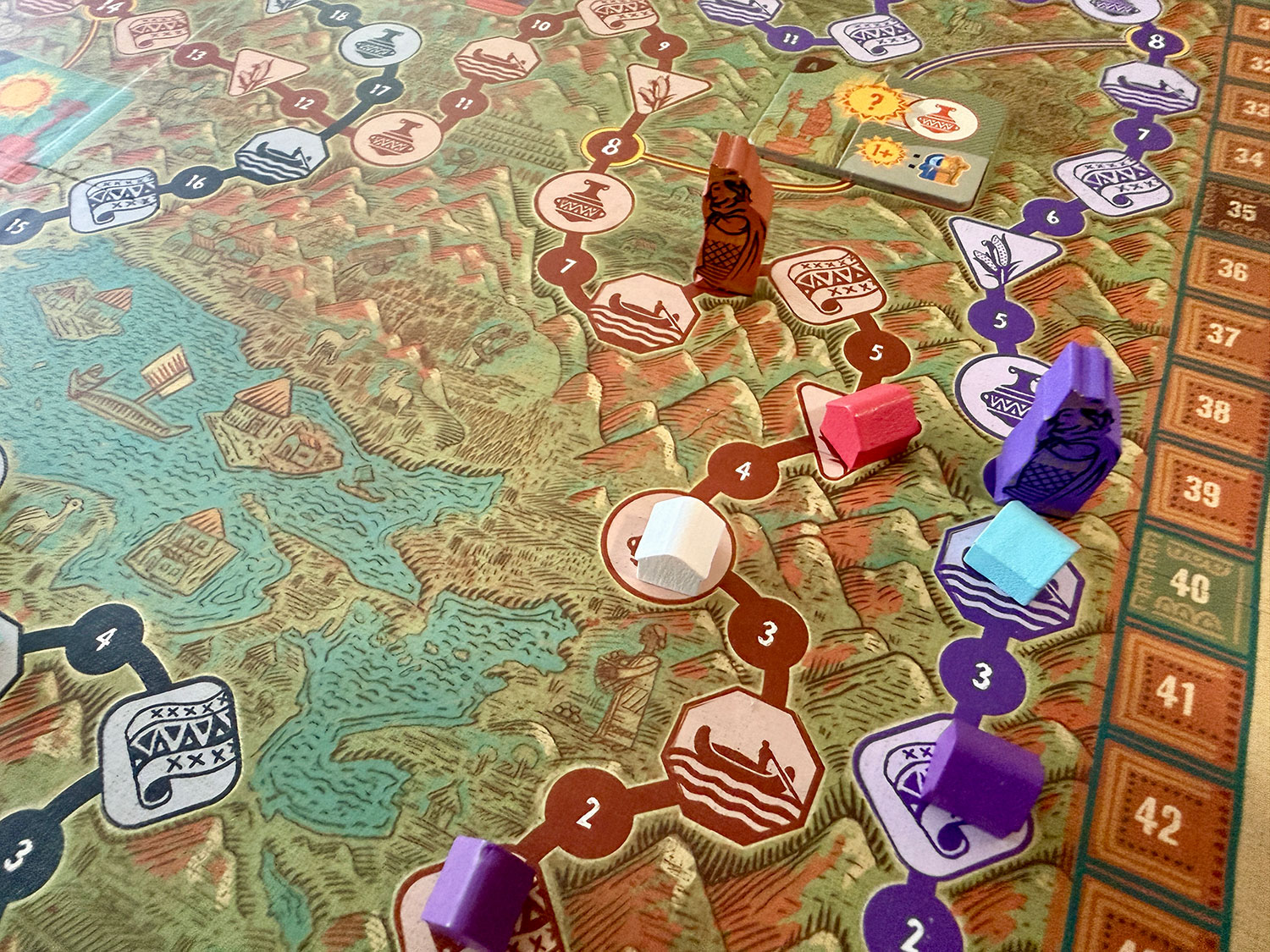 The Ayar begin their journey and place tambos along the way.
The choice of which Ayar to move not only determines your available activities (any activity icon that is available between the Ayar and the starting location) but also which Ayar is falling behind the others. At the end of each of the four rounds, the Ayar that’s fallen behind the furthest is removed from the board and reunited with its sister icon on a temple track. According to myth, they’ve either turned to stone or been trapped in a cave, unworthy of becoming Incan leadership.
Each player has their own player board that drives their action choices. There is a tambo (wooden house) grid and Ayar step tokens that determine how far the matching Ayar moves. Players must select which column or row to place their step marker and then move the main board Ayar that many spaces. They then select one tambo from the associated row/column and add it to an available activity icon on the board behind the Ayar that moved.
Each tambo removed uncovers an icon that indicates increased power for the next action in the row or column. So as more tambos are removed, actions become more powerful over time. It must also be noted that the step markers added to the grid remain between rounds and block placement until moved to a new location. The grid becomes the ultimate driver of possibility during a turn.
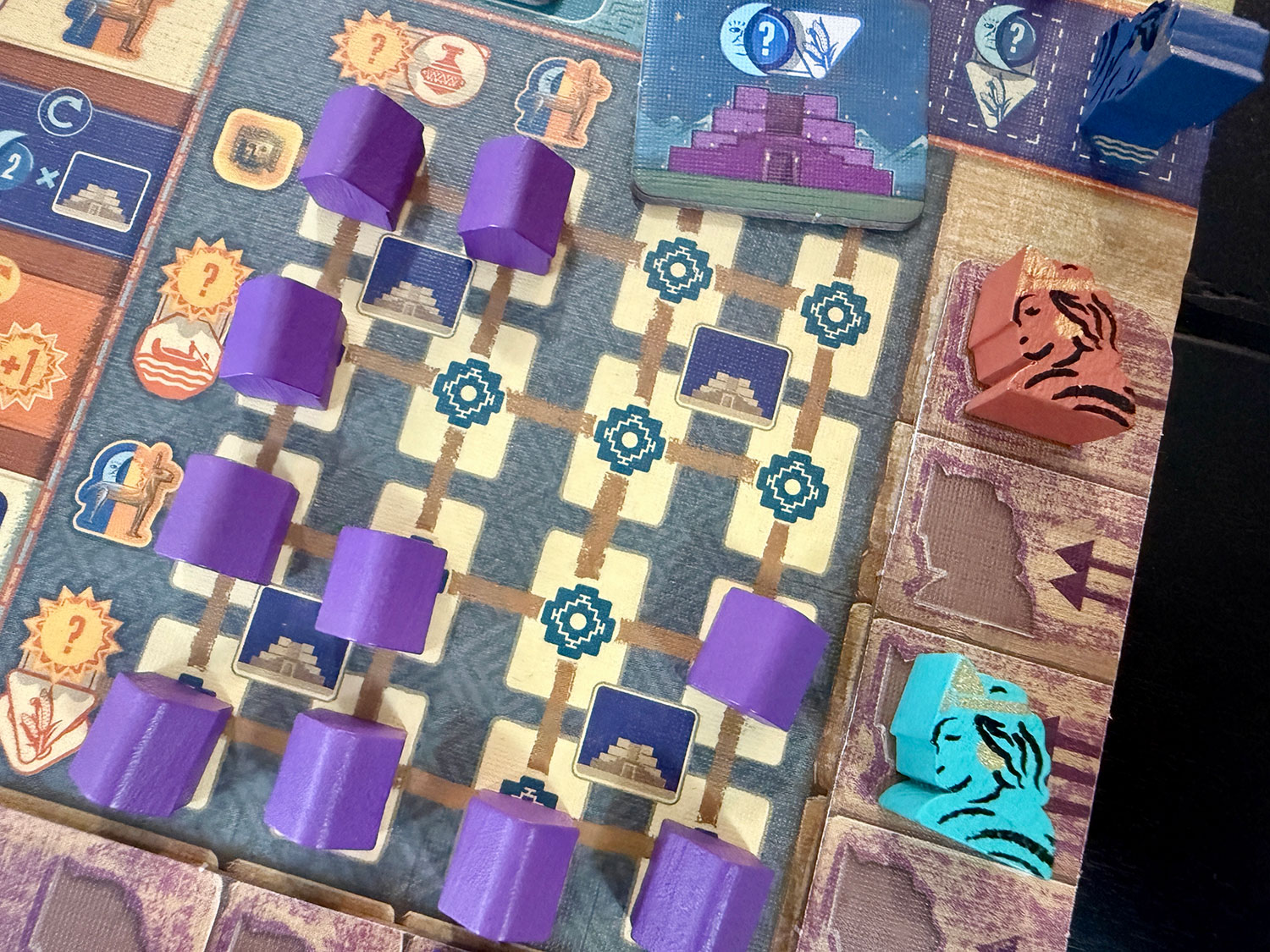 The action selection is driven by this grid on player boards.
There are four activities that can be taken: pottery, weaving, terrace farming, and reed bundling. They represent the local population assisting the Ayar on their journey. For player purposes, there are ways to either focus or diversify for sun and moon points. Before providing a brief activity overview, it’s important to know that players score sun and moon points separately, and the lesser of the two scores is the number that becomes their final score. Sun points actively accumulate over time, whereas moon points are largely scored based on Ayar retirement (falling behind).
Activities are simple actions, and scoring corresponds to their section’s sun and moon icons. Pottery is a set-collection game. Weaving is tile placement. Terrace farming is all about removing cubes from your player board and area majority. And reed bundling is about moving your boat along a separate lake board. These are all easy to understand and quick actions to take. It’s the consideration beforehand that is the crunch of this game.
Ayar retirement at the end of a round requires players to remove one of their Ayar step tokens from the grid. These are placed on an activity scoring section that provides more moon points. Thus, as each round begins, players find themselves with fewer step tokens to use. This creates a nice arc as Ayar retire and action options lessen, but each action grows in power.
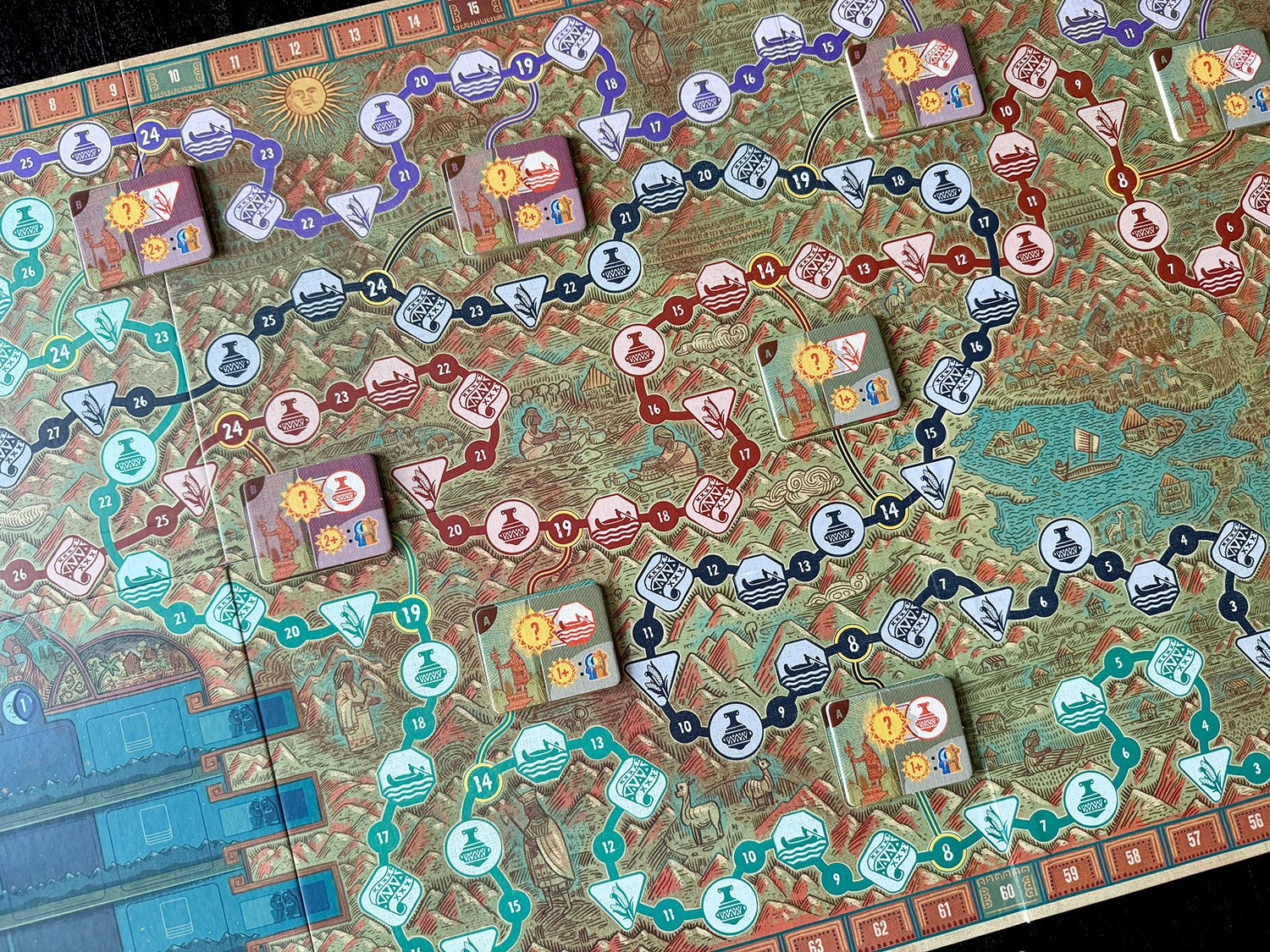 The main board is busy from afar but has intricate detail if you look closely.
Game Experience:
Ayar is the lightest of the Lopiano/Osprey releases in this pseudo-line of games that includes Merv and Sankoré. The ruleset is easy to grasp once you understand how scoring works—it’s important to note that you only move score markers during the night phase—and the rulebook is much smaller than I would’ve suspected. It also does a great job of laying out the game flow with plenty of examples.
I was intrigued by the game’s myth as well. The rulebook features several historical notes that help with immersion. As mentioned above, the game has a natural arc as Ayar progresses, fall behind, retire, press further on: rinse and repeat. It’s also satisfying that the final Ayar always reaches Cusco based on how the Ayar movement is funneled.
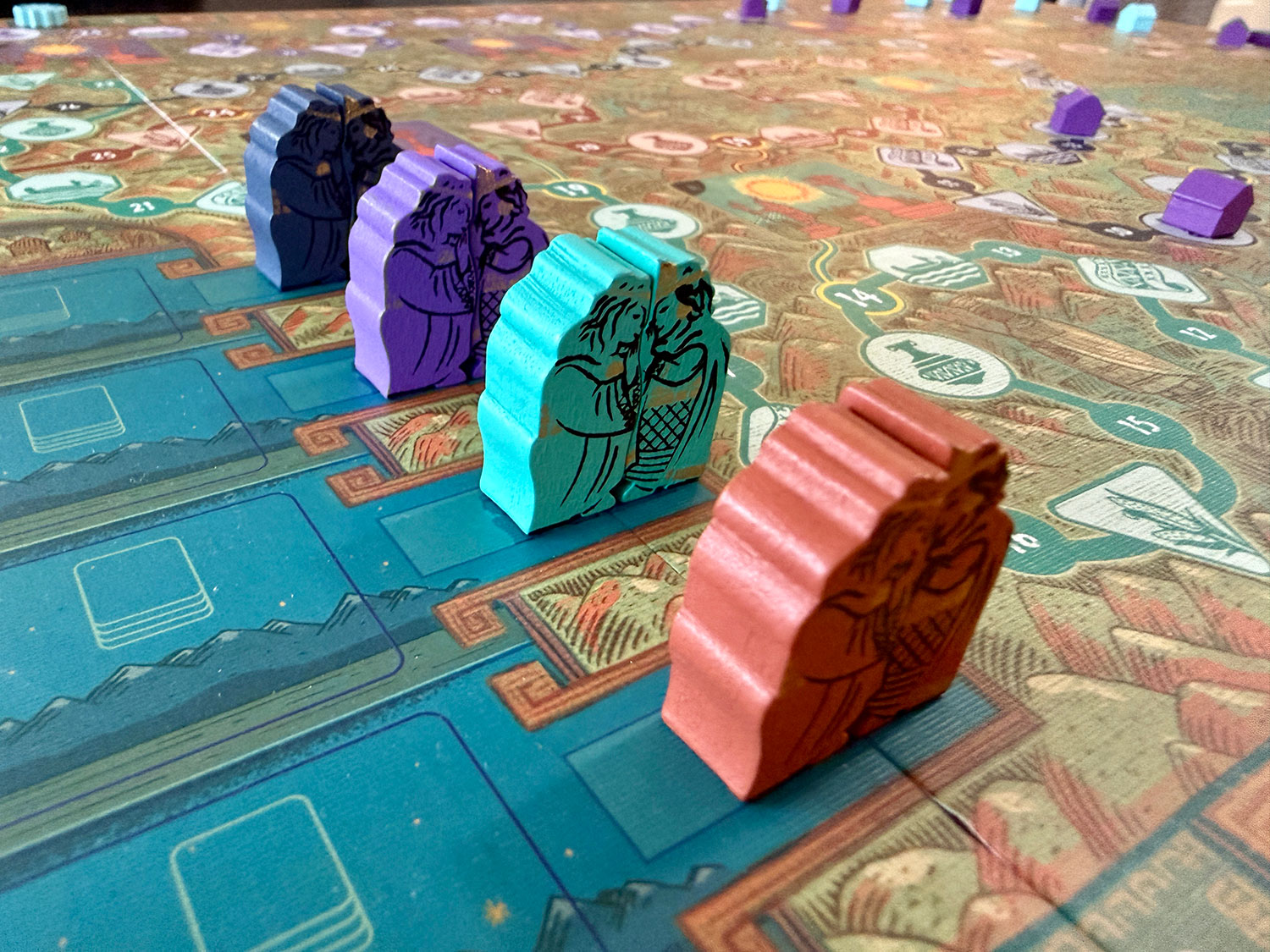 Brother and sister reuniting as they succumb to the perils of their travels.
The main board has some wonderful illustrations if you look closely, but it is washed out in a lot of brown color-tones—it would’ve been nice to see something more visually appealing, with more player interaction on the main board as opposed to individual player boards and side boards. The main board is mostly just movement paths and repeated activity icons, with space for scoring tiles and temple placements.
The highlights of Ayar boil down to the tambo grid and the dual scoring. There’s a focus to balance sun and moon points, to find a couple of activities to lean into, and to maximize the power uncovered along the way. Prior round placement may hinder options. And there’s the pull of uncovering temples for moon scoring, as well as full row/column bonuses. So much in such a little space.
Unfortunately, the activities are ho-hum. As your power grows, your options grow, but ultimately, the activities are not engaging as they lack true player interaction. The system allows players to do what they want to a degree, and this becomes even more apparent based on player count, where two-player is much more wide open due to a lack of player scaling on the paths. The game plays differently (more enjoyable in my opinion) at higher player counts due to this lack of consideration.
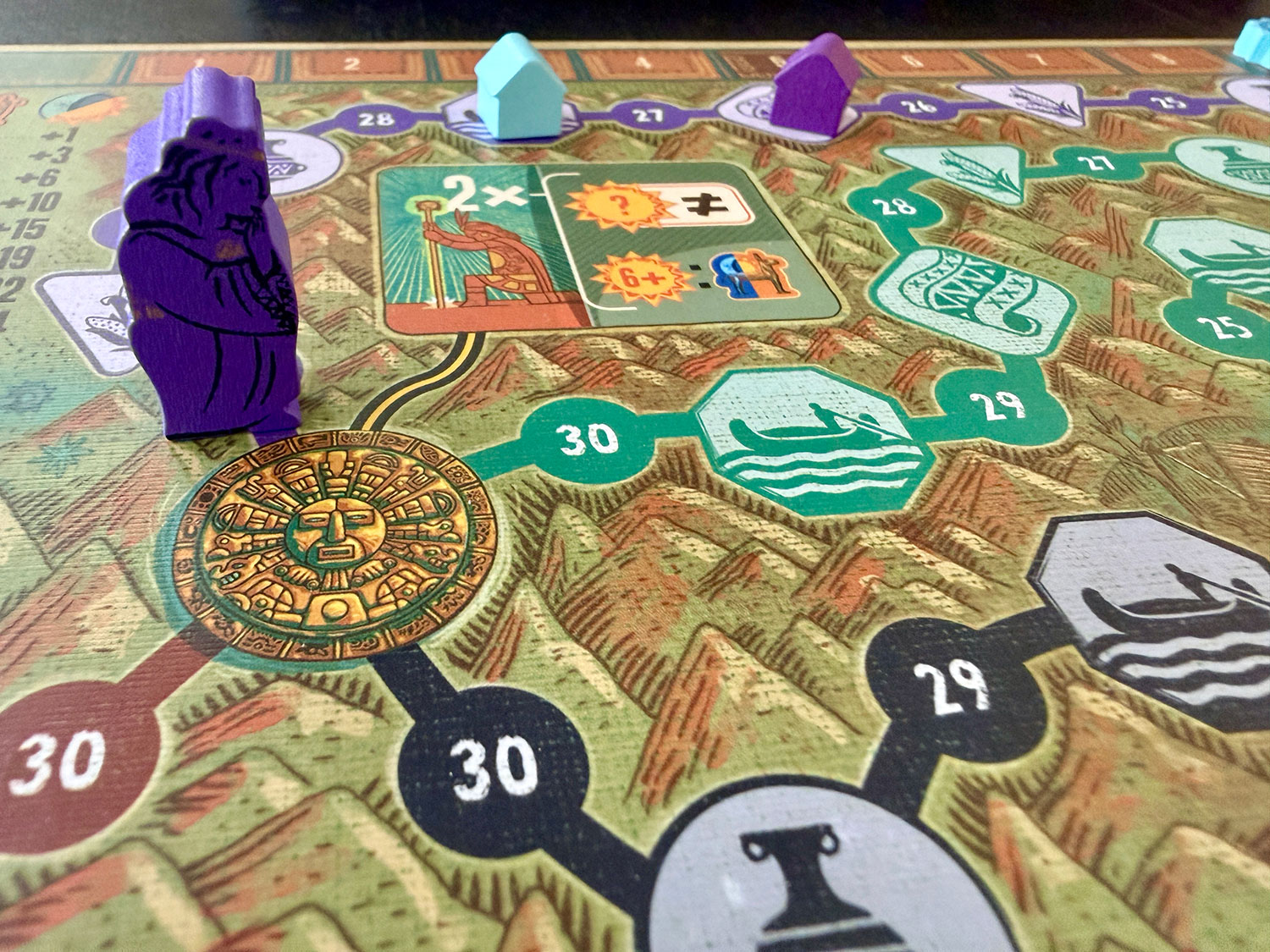 All roads converge with a single color of Ayar making it to the final destination.
In fact, player interaction is most impactful with the Ayar movement. Players can move certain Ayar to Raymi tiles to score sun points based on their best activities. This scoring can be very impactful and drives a lot of the choice behind which to move and which activities to focus on. But the lack of scaling affects which activities are available to choose after such movement.
On top of all of these mechanisms, players also gain bonus tokens that can boost the power of chosen actions. These can be found on the reed and terrace player board spaces, as well as on pottery and weaving tiles. Beyond boosting action powers, there are also options to boost your engine by activating one-time use bonuses. This adds to the decision space and allows players to specialize further.
Final Thoughts:
New myths in board games—yes! I truly enjoyed learning about the Ayar journey, and the cultural incorporation into this game system was clever on many fronts. Like the sun and the moon scoring, the game system has a lot that shines brightly, but it also has many areas that feel left in the dark. Player action selection is amazing, whereas the actual actions are not. The main board is massive and muted. But the Ayar movement and the Raymi tile scoring is intriguing.
It helps that this is a little lighter than previous releases by this team. It will appeal to a wider audience but also may ultimately fall short of expectations of those seeking a crunchier experience. It must be said that there has not been much released this year that features such satisfaction as the moment the Ayar brother and sister meet in retirement, their tokens lining up perfectly as they fade into obscurity. Yet I’ll remember their sacrifice in the end.
Final Score: 3 stars – Mythical journey that falls short of overcoming its trappings.
 Hits:
Hits:
• Incorporation of myth
• Sun vs moon scoring
• Tambo grid
Misses:
• Player scaling
• Main board illustration
• Activity actions

/pic9516264.jpg)
/pic9148407.jpg)







 English (US) ·