
.jpg)
PROTECT YOUR DNA WITH QUANTUM TECHNOLOGY
Orgo-Life the new way to the future Advertising by Adpathway
Hiking and backpacking rain pants are designed to protect you from the chilling effects of rain or wind. If you plan to hike in a climate with frequent rain, carrying and wearing rain pants or a rain kilt is probably advisable.
Cooling Effect of Rain and Wind
We constantly lose body heat under normal conditions, so if we feel cold, we add extra clothing to feel warmer and retain more heat. But if your clothes and skin get wet, your rate of body heat loss increases by a factor of 25 because water is so good at conducting heat away from an object. Rain pants can help prevent heat loss by preventing water from reaching your skin. Rain pants are also another layer that helps trap your body heat and keep you warmer.
 Rain pants vary in the amount of venting they provide to reduce perspiration and internal condensation.
Wind can also have the same effect as rain by quickly stripping away your body heat: the stronger the wind, the colder you get. You won’t notice this as much on a warm day as on a cold day in the form of wind chill, which can result in cold injuries like frostbite if it’s too high. Rain pants can also help keep the wind off your skin while also providing added insulation by trapping your body heat.
Some hikers carry wind pants instead of rain pants if they know that wind chill is an issue when rain isn’t. Wind pants are virtually identical to rain pants, except they’re seldom waterproof. Rain pants can serve double duty as wind pants and are often used for this purpose.
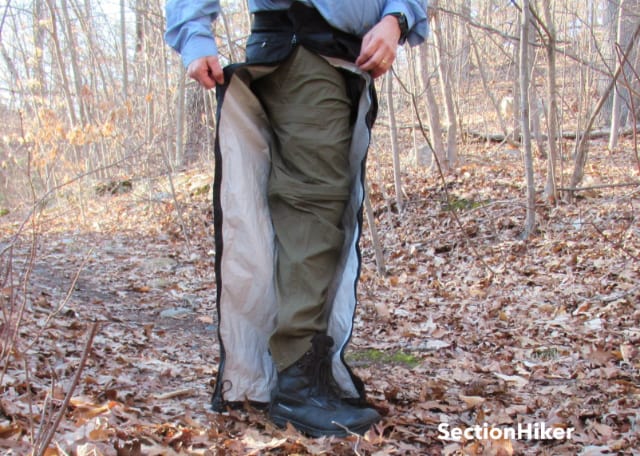 Some rain pants have full-length side zippers and can be removed or put on without removing your shoes.
Types of Rain Pants
There are many types of hiking rain pants available, each best suited to different conditions and footwear choices. Some are best used in cold weather, and some in warmer temperatures. Some have zip-off legs, zippers that run the full length of the outer leg for venting, or zippers that reach up to the tops of the ankles. You can also buy rain pants without any venting at all.
- Full-zip or hip-zip (3/4) rain pants work well with full-size hiking boots and mids because you can put them on or take them off without removing your shoes. They are also easy to vent or remove completely when winter hiking.
- Ankle-zip pants work well with trail runners and hiking shoes because you can take them off or put them on without removing your shoes
If there’s one common property of rain pants, it’s that they WON’T keep your legs absolutely dry when worn for hiking in the rain. If you’re hiking vigorously, you’re likely sweating. Plus, if you’re wearing rain pants and it’s raining, condensation will form inside your pants when it’s colder outside (that’s why rain jackets can feel wet inside when worn in the rain).
The most effective way to reduce moisture build-up is to have vents built into your rain pants that release body heat so you sweat less. Waterproof-breathable rain pants can help, but they will rarely keep up with the perspiration-levels hikers produce, let alone added condensation.
Hiking and Backpacking Rain Pants – Purchase Considerations
When choosing rain pants, consider the following factors in addition to weight.
a. Does the drawstring wrap around the entire waist or is it sewn in?
Drawstrings that run around the entire circumference of your rain pants are much more durable than ones that are only sewn to points located in the front waistband and have a tendency to rip out when you pull them tight. Hint: Loop the drawstring of your rain pants through a cord lock so that the cord doesn’t disappear into the waistband. This also makes them easier to tighten without a knot.
b. Can you pull on the rain pants and take them off without removing your shoes?
This is mainly an issue in cold wet weather when you want to avoid getting your socks wet by having to stand on wet ground while you struggle to put on or remove your rain pants.
c. Are the ankle cuff openings too baggy or adjustable?
It can be awkward and noisy to hike in baggy rain pants. Some rain pants, like the no longer made Montbell Versalite Pants or the Montane Minimus, had volume adjusters that let you reduce the volume of the legs or ankles.
d. Are they available in shorter and longer lengths?
Rain pants that are too long are also awkward to hike in. I like wearing mine short by a few inches and tucking them into stretch gaiters.
e. Do the rain pants have any external pockets?
Many rain pants are devoid of pockets, which can be a limitation if you plan to wear them during town resupplies when the rest of your laundry is in a washing machine at the local laundromat.
f. How good is the breathable membrane/factory DWR?
If you have a pair of waterproof breathable rain pants, there’s a good chance that they’re coated with a factory-strength chemical coating called DWR (durable water repellent) that makes water bead up and roll off when rain lands on it. This coating wears off a little bit every time you wear the rain pants, you fold them up or wash them. Some DWR coatings are fabulous and can last a year or more, while others fail much more quickly. While you can reapply DWR coatings to waterproof/breathable gear with a product like Nikwax TX-Direct, they’re seldom as long-lasting as a good factory treatment.
g. How warm are the rain pants?
Rain pants made from thicker, heavier materials tend to be much warmer than gossamer-thin or ultralight rain pants. Sometimes it makes sense to own two pairs and use the warmer rain pants in winter and the cooler ones the rest of the year.
Alternative Rain Clothes and Gear
A lot of people don’t like wearing rain pants because they’re an added layer to hike with if you put them over your hiking shorts/pants, they feel cold and clammy against the skin when they get wet, they’re too hot, or don’t fit well.
Rain Kilts
One alternative is to wear a rain kilt, a long waterproof skirt that you can wear over shorts or underwear to keep your upper legs dry. The kilt provides excellent airflow to combat perspiration or condensation build-up in your sensitive areas, although your feet and socks are likely to get wet when hiking in rain. Rain kilts aren’t as effective at blocking wind as rain pants, but they offer greater freedom of movement and better ventilation, especially in warmer climates.
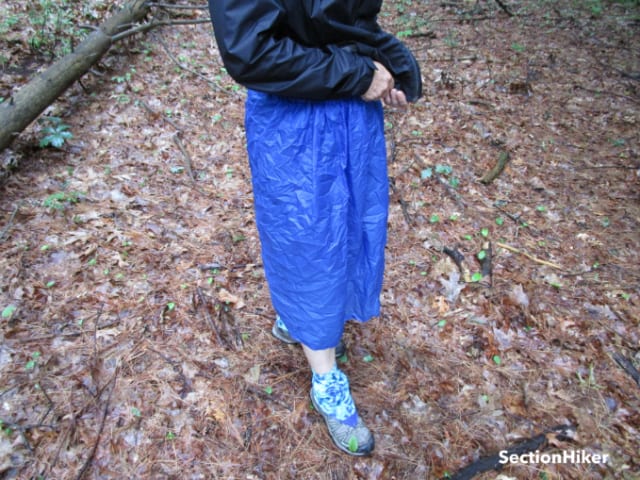 The ULA Rain Kilt is long and provides a lot of leg coverage
Rain Kilts can also easily be paired with high gaiters if you want more lower-leg warmth and mud protection. Gaiters aren’t really waterproof, but they can add a lot of warmth to your lower legs. Try the:
Rain Chaps
Rain Chaps are essentially long waterproof gaiters that come high up your thighs but leave the area around your crotch and between your butt cheeks uncovered so less perspiration accumulates there. Whereas rain kilts are designed to keep your upper legs warm, rain chaps are designed to keep your lower legs warm. They’re also particularly well suited for wading through high wet grass (provided there aren’t snakes around) or off-trail, where you’ll brush up against wet vegetation.

Rain chaps also provide good wind protection. While they are a bit more involved than pants to put on, that’s offset by their lighter weight.
Ponchos, Cagoules, Trench Coats, and Umbrellas
While rain kilts and rain chaps can be used with a regular rain jacket, they are more comfortable and effective with looser-fitting upper garments like ponchos, cagoules, hiking trench coats, or when used with an umbrella.
- Ponchos come in two main flavors. Some are loose-fitting body-sized shrouds, while others can be used as a combination poncho and pack covers. Ponchos can be a bit unruly in wind, but they provide excellent airflow around your torso and waist.
- A trekking umbrella makes a good adjunct to a rain kilt in desert conditions and can serve double duty as a sun shade or as a front door for an A-frame tarp.
- A cagoule is a British term for a long hooded raincoat designed for hiking. Its American counterpart is a hiking-style trench coat. Both fit less closely than a regular waist-length raincoat. Sierra Designs tried to revive both types of jackets a few years ago during its glory days, but the idea never caught on in the United States.
SectionHiker never accepts payment for gear reviews or editorial coverage. When you buy through affiliate links on our site, we may earn a small commission at no extra cost to you. Help us continue to test and write unsponsored and independent gear reviews, hiking and backpacking FAQs, and free hiking guides.








 English (US) ·