
.jpg)
PROTECT YOUR DNA WITH QUANTUM TECHNOLOGY
Orgo-Life the new way to the future Advertising by Adpathway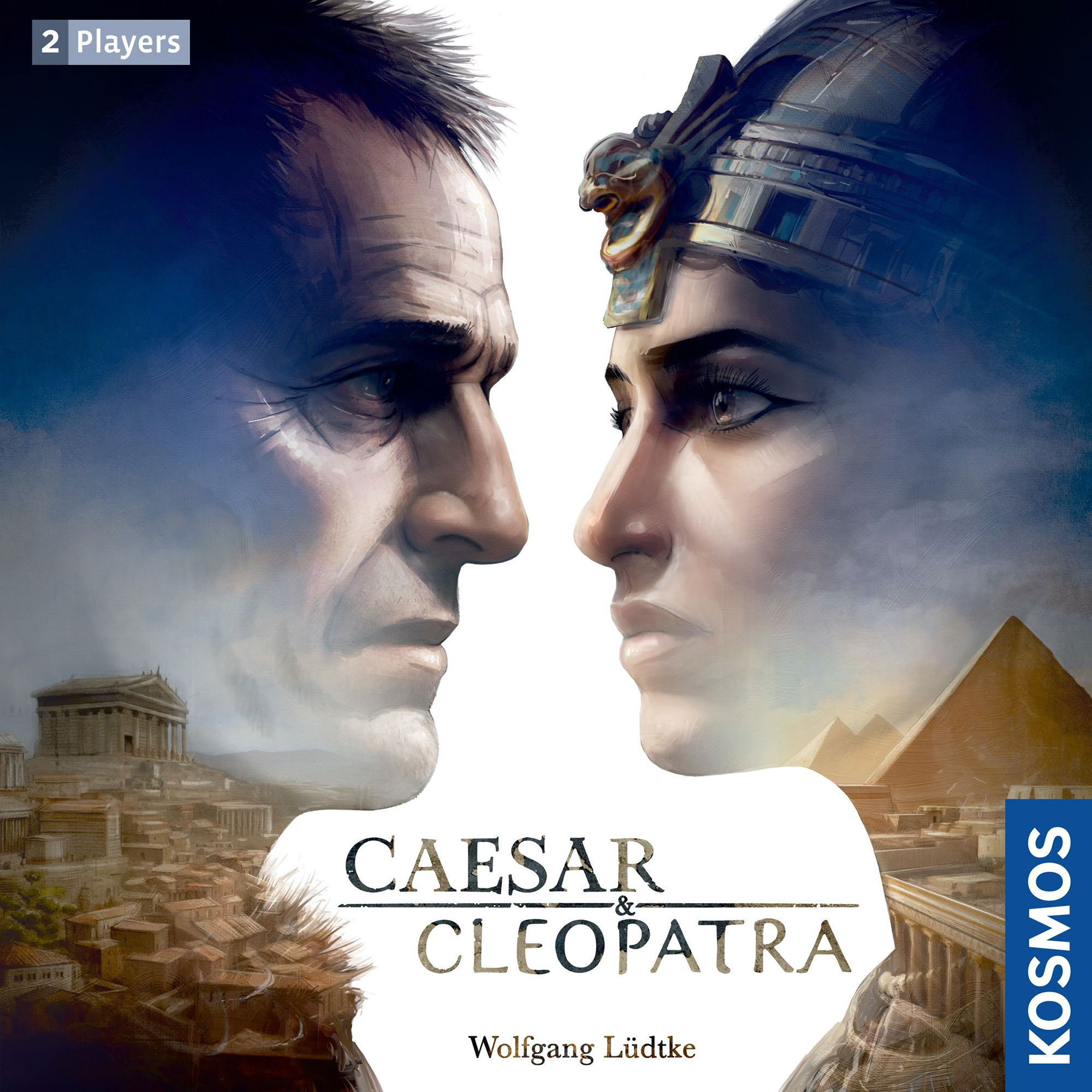 Many of the games I loved playing as a kid were some variation of area influence or area majority. These days, with scheduling and just the financial landscape, I find myself gravitating to more solo or two-player games. When Caesar & Cleopatra came up as a potential review candidate, I had to give it a try. I enjoy historical settings, both inspired by and accurate depictions, and I love that card games in general take up less space in a bag.
It’s a set collection and area influence card game for 2 players that takes about 60 minutes to play.
Gameplay Overview:
One player is Caesar, and the other is Cleopatra, which comes with individualized influence cards and action cards to be used for their advantage throughout the game. On your turn, you will play one influence card face down and one influence card face up from your hand. One or both cards will be placed below one or two different patrician groups on your half of the game area. Note that you may only place a maximum of five influence cards below any group on your own side, so plan accordingly! You may also play exactly one action card, which can be done before or after playing the two influence cards. The other player may then decide to use a veto card to prevent the action.
 Play as Caesar or Cleopatra, taking advantage of their unique traits.
One special influence card is the Philosopher, which can be played face up or face down. If there is a vote of confidence for a patrician group, the winner is not whoever has the higher total value of the influence cards, but whoever has the lower total value.
After these cards are played, you draw one bust from the bag included with the game. If it is a white, yellow, green, blue, or pink bust, then place the bust next to the patrician group with the corresponding color and trigger a vote of confidence.
During a vote of confidence, all influence cards from Caesar and from Cleopatra will be compared in value against one another, and whoever has the higher total value wins the top patrician card in this group and places it face up on their half of the game area. The winner must now remove their influence card with the highest value from this group and discard it. The loser must remove their influence card with the lowest value from this group and discard it.
Sometimes during the game, a special vote of confidence is triggered if a patrician group has eight or more influence cards at the end of the turn. Keep an eye on the state of the patrician groups as well as what you might want to play during your turn to perhaps meet this condition at a strategic time.
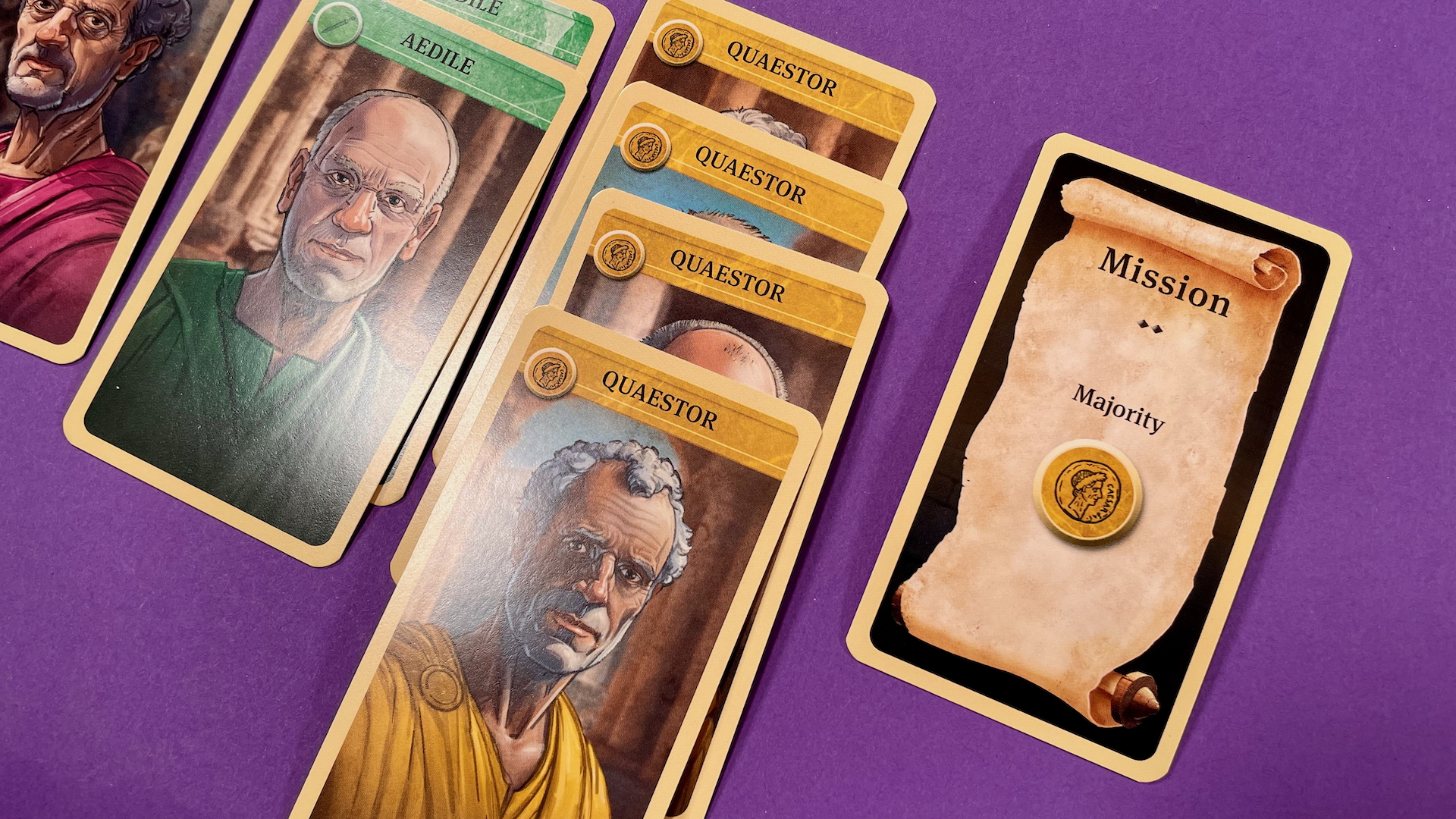 Aim to complete your mission card for more points.
If the bust drawn is grey, there is no vote of confidence, and the bust is placed next to the bag. If the bust drawn is black, there is no vote of confidence, and all busts are immediately collected to be put back in the bag along with the black bust.
As soon as the first patrician group is emptied, players must keep only one of the two mission cards they received during setup. Mission cards have varying combinations of set collection requirements for players to work towards.
You will then draw influence and action cards until you have six cards in your again. It’s up to you whether you find drawing from the influence card pile versus the action card pile is to your advantage or not.
The game ends if all patrician cards have been won, or if both players have no more influence cards left. The scores are totaled based on patrician cards won, majority in a patrician group, having all cards in a patrician group, and the completion of one’s mission card. Whoever has the most points wins!
 Use your Influence to win Patricians over to your side and collect sets.
Game Experience:
My favorite part of this game is being able to feel like I’m truly at war with the other player. Some two-player card games don’t always have this level of delicious tension, so Caesar & Cleopatra was a welcome addition to the game shelf. I’ve always enjoyed area-influence games, and pairing this with a set collection mechanic means that you can tell fairly quickly that you and your opponent may be vying for the same group of patricians.
This brings me to my second favorite part of this game, which is trying to read what your opponent is doing. Due to the fact that you have a limited number of high-value influence cards, it would be risky trying to keep going head-to-head with your opponent for the same patricians. Knowing when to let them have what they want and going for a secondary objective shows one’s mastery of reading the table or situation at hand. This aspect of the game is deeply satisfying, in knowing that your opponent’s temporary victory won’t guarantee them the endgame.
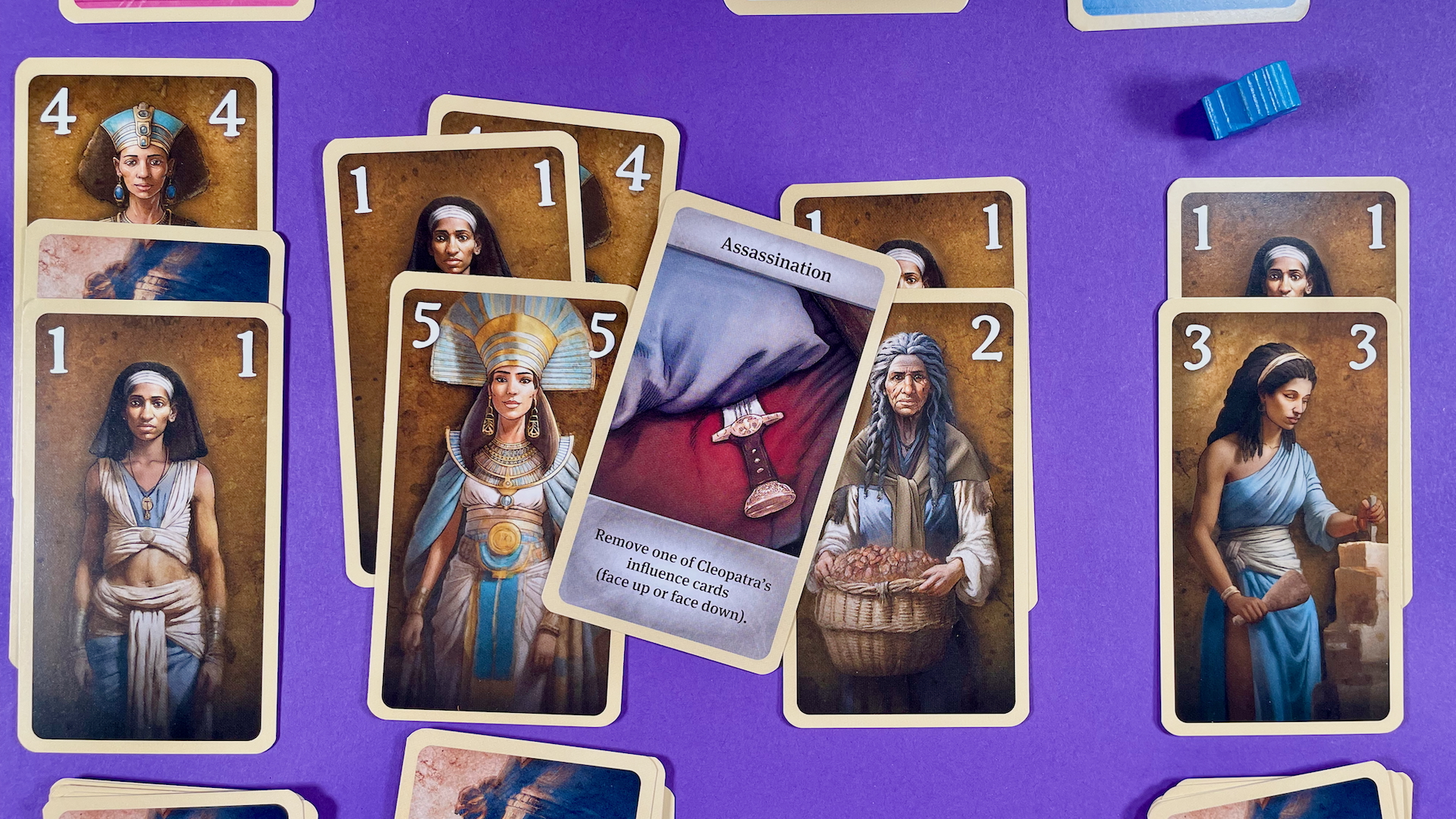 Well-timed Action cards can help manipulate the outcome of Influence cards.
What I’ve found over the years when it comes to replay value is the incorporation of a tasteful variable mechanic, whether it’s a different setup or timing on specific phases of gameplay. In this game, while players are trying to decide on their patrician priorities, the end of each player’s turn marks a potential for the clock to be sped up on their plans for influence. This encourages players to get a feel for when to rush for influence now or to take their time for future votes of confidence. The excitement of not knowing exactly when the values of their influence cards will be assessed adds more to the tension I mentioned, and creates a sense of urgency that would not otherwise be there in a card game like this.
As much as I’m positively glowing about this game, like any game, it comes with a few minor flaws. During one’s turn, both influence and action cards may be played, and some of them have Take That mechanics that can frustrate players. The Philosopher influence card has definitely ruined some of my plans for patrician domination, and the Wrath of the Gods action card, which removes all influence cards from a patrician group, has dumped valuable moves in the discard pile.
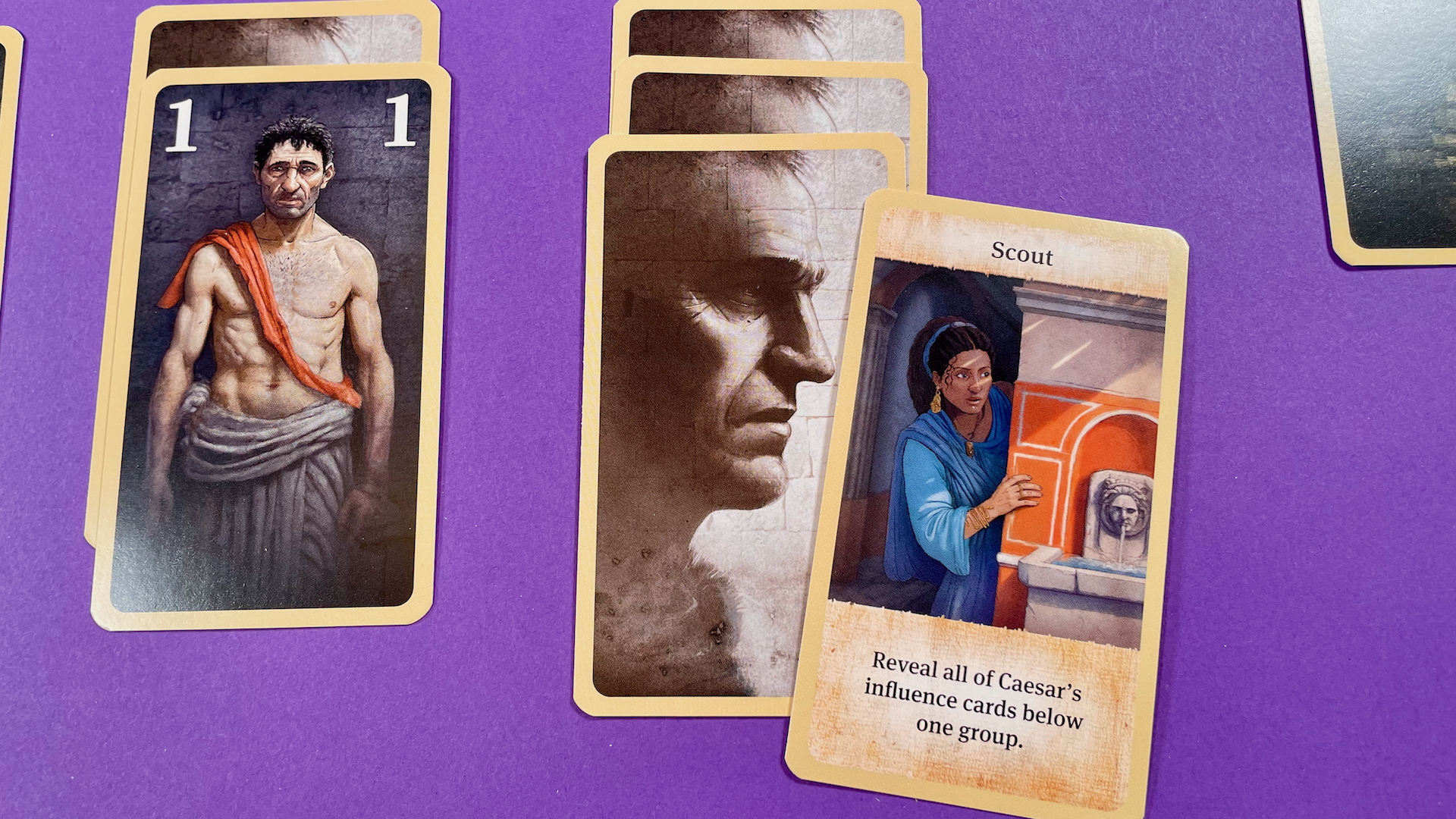 Use Action cards to gain more information than you would otherwise have.
Luckily, these cards are rare and limited, so they don’t often show up during gameplay, but they still hurt! This kind of futility can happen during votes of confidence as well, if your opponent just happens to draw a patrician bust that contains a group of your half-baked influence. Even if they aren’t drawing busts that ruin your plans, not running through a bit of housekeeping on counting influence cards can also ruin your day. Neglecting that mental housekeeping means you can notice a special vote of confidence too late, as the count of eight or more influence cards can sneak up on you very quickly.
Final Thoughts:
Caesar & Cleopatra is for anyone looking for a new two-player card game that has the right amount of tension and need for mastery, without sacrificing any of the excitement you need for a good game night. While experienced board gamers may find the gameplay too lightweight to make it a staple at the table, casual gamers, as well as those who focus on two-player card games, will want this as part of their collection. However, if any gamers dislike Take That mechanics, unpredictability in the game clock, or diligently paying attention to the state of the influence cards, then the positive aspects of this game may not have enough pull to encourage play.
Final Score: 3.5 Stars – Win the loyalty of Rome’s powerful patricians as Caesar or Cleopatra in this two-player game of influence.
 Hits:
Hits:
• Good tension for a two-player game
• Encourages mastery of reading the table
• Variable times for assessment add excitement
Misses:
• Take That cards can be frustrating
• Unpredictable assessments can make planning futile
• Housekeeping issues for special votes

/pic9148407.jpg)








 English (US) ·