
.jpg)
PROTECT YOUR DNA WITH QUANTUM TECHNOLOGY
Orgo-Life the new way to the future Advertising by Adpathway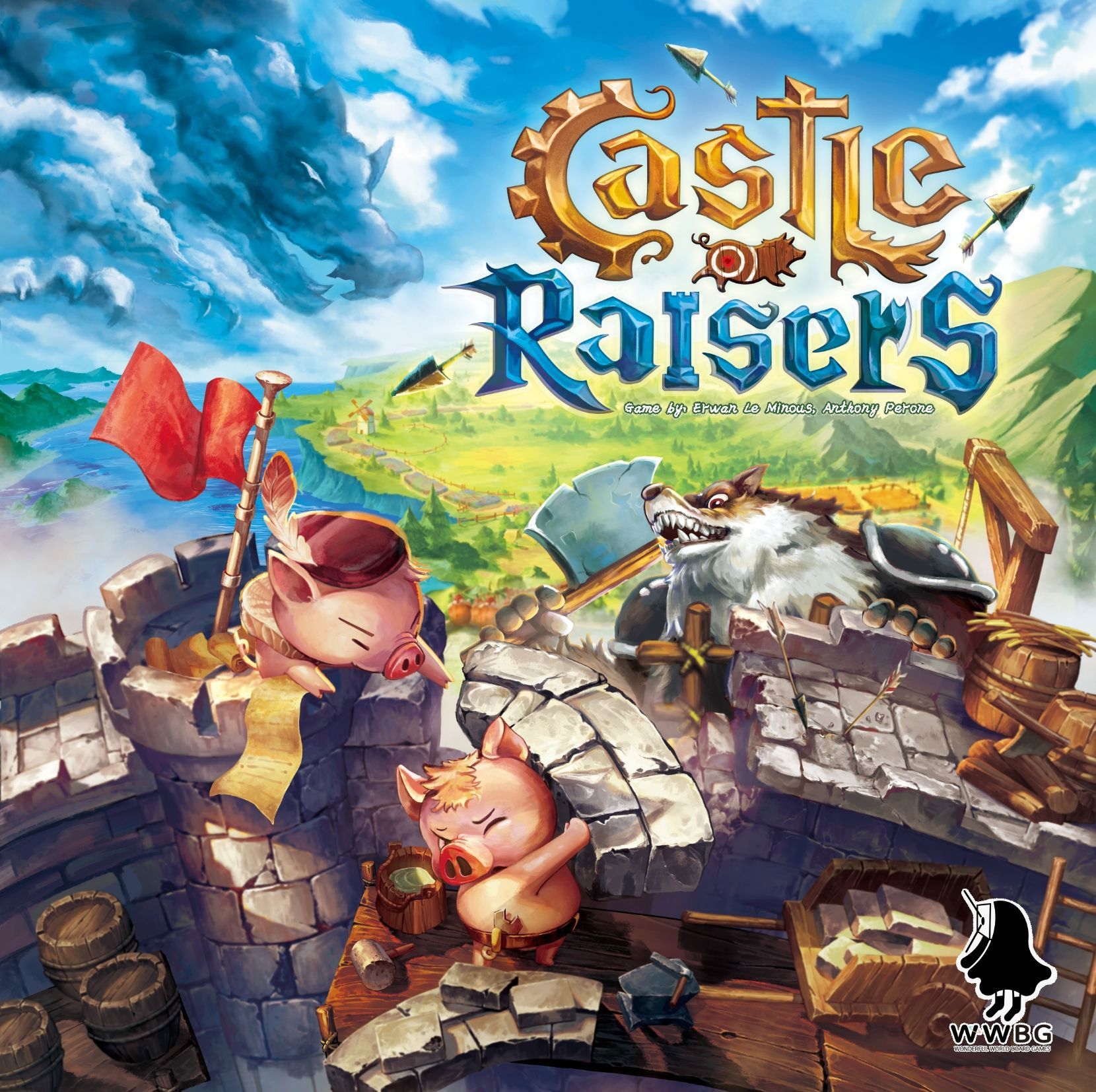 We learn fairy tales during our youth as parables, and then they periodically pop into our lives through other media. Sometimes it’s pop culture, like music or things like board games.
An alternative take on the Three Little Pigs is the theme of Castle Raisers and as much as I’d like to wax poetic on Green Jelly’s song “Three Little Pigs”, which may have had talented greats like Les Claypool (Primus) and Maynard Keenan (Tool), and Pauly Shore (Goofy Movie, also uncredited) perform on it, we’re here today to talk about the board game.
Castle Raisers is a one- to four-player game that can be played competitively or cooperatively, published by Wonderful World Board Games and designed by Erwan Le Minous and Anthony Perone.
Gameplay Overview:
Each game of Castle Raisers consists of three ages, each of which feature four turns followed by an end-of-age phase. In general, you’re trying to build up your castle defenses while also trying to reduce the number of wolves assaulting your castle across three distinct zones.
On each turn, you’ll take one of the face-up castle wall tiles and then activate the symbol or symbols that are covered. In a two-player game, the first player removes a tile and activates the dispatching wolves symbols on the discarded tile, and the fourth tile is likewise discarded between the second player picking and placing their tile.
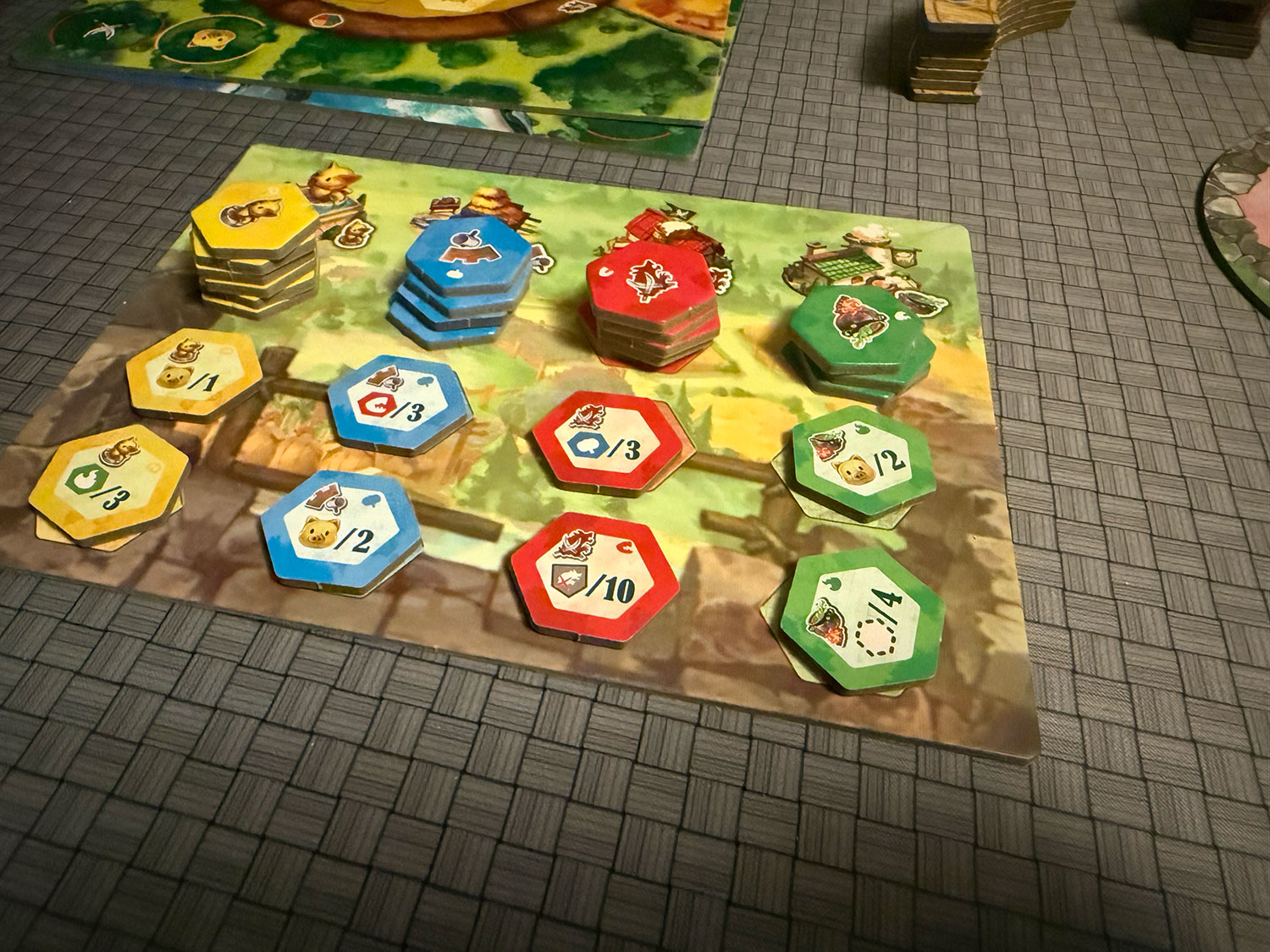 This little piggy went to market.
The five symbols on the player boards and the wall tiles represent the following actions:
- Four colored hexagon (Settling Villages) – This symbol lets you grab one of the eight face-up or four face-down tokens on the village board. These provide end-game scoring and may be placed in any of the three zones.
- Golden pig statue (Establishing Prestige) – Take control of the mother pig or first-player token and take one prestige token for each symbol covered. Each token is worth two points at the end of the game.
- Fortification wall shape and a hammer (Fortifying the walls) – These tokens add height to your castle but don’t cover symbols. At the end of the game, the tallest section of your castle is worth five points per level, and that height is also important for repelling wolves.
- Pot of boiling green oil (Defending the Castle) – Each symbol covered allows for one cauldron of boiling oil to be poured on the wolves in that sector. Most wolves are taken out with a single cauldron but the black-ringed vicious wolves need two cauldrons to do them in.
- Wolf with crossed swords (Dispatching wolves) – The player who covered this icon draws an attack token and then each other player places a wolf in the region shown on the attack token.
When tiles with the dispatching wolves tokens are discarded in a two-player game, wolves are drawn for all the players and placed by a random draw of attack tokens. And to make things worse, the number of wolves increases with each of the three ages.
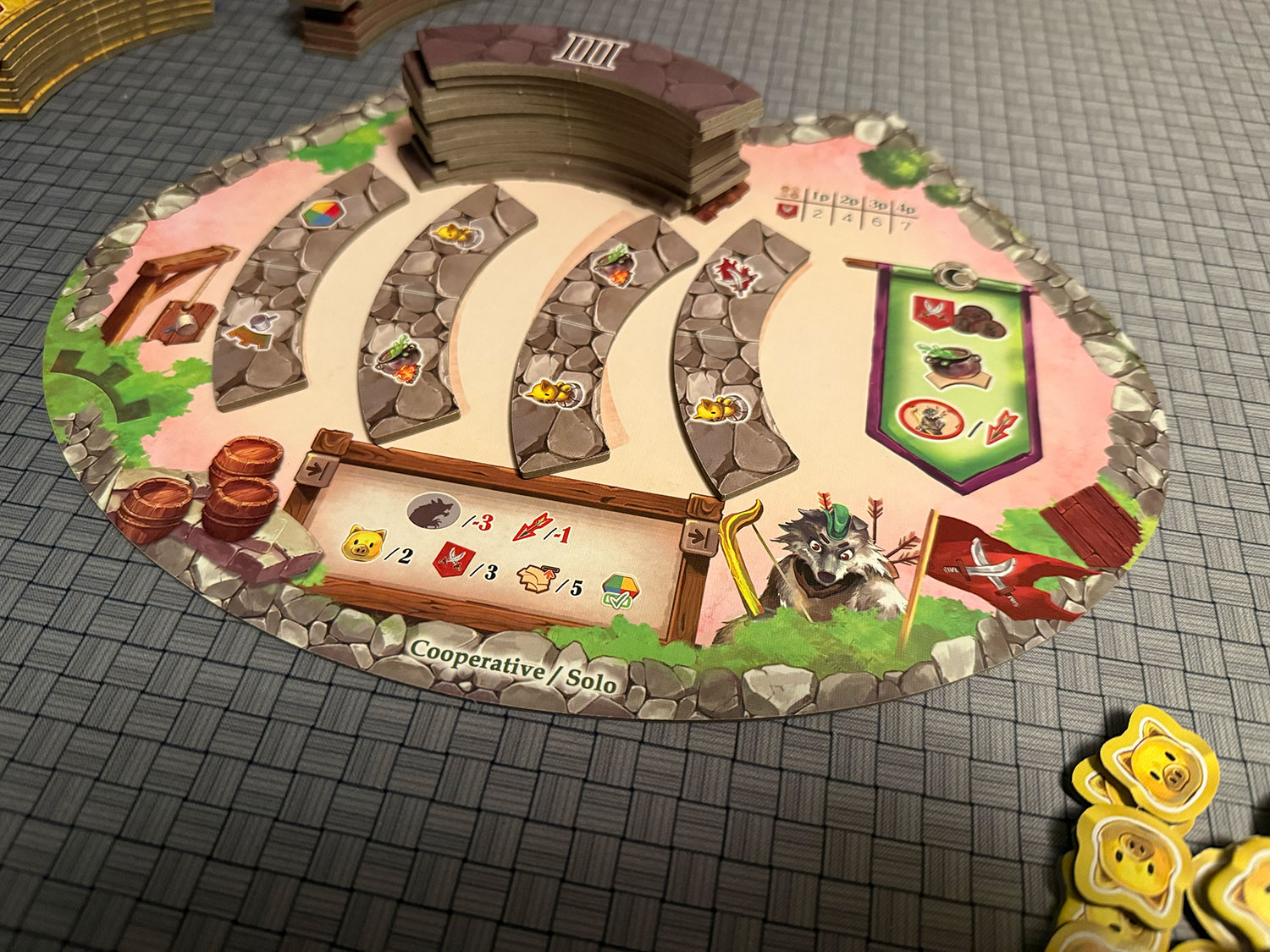 You’ll be drafting your wall pieces from this board
After all the wall tiles have been used for an age, there’s an end-of-age phase, made up of two actions. The first is to pour boiling oil on the wolves. This is done by counting the number of uncovered symbols in a section, as the icons and removing wolves.
Then, each attacking (wolf) archer remaining on a player’s board will give them an arrow token, which is worth -1 points at the end of the game.
At the game’s end, the walls repel one wolf per level. However, if there’s a single wolf with a ladder in each zone, they all enter, regardless of the wall height. The player with the most wolves gets -10 points, with the second-worst defender losing five points. Then you score the various tokens, as mentioned above.
The cooperative mode works similarly, except there are also extra event cards that generally make your life harder.
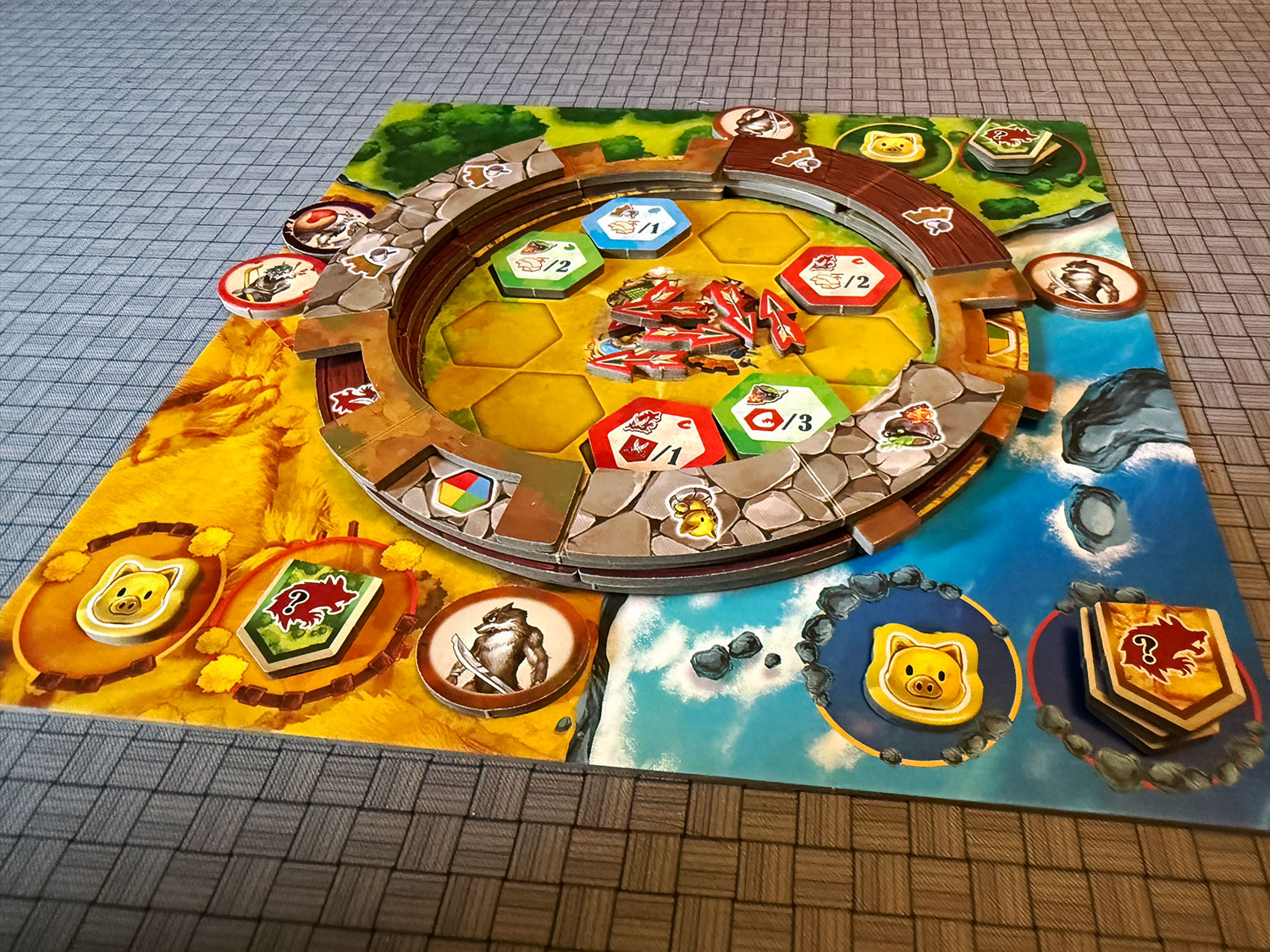 A couple of pigs got pincushioned by arrows but I took care of the ladders.
Game Experience:
Castle Raisers looks like a kids’ game and the 10+ age rating suggests it might be, but it’s far from it. The basic concept is straightforward, but the number of icons you have to juggle makes this a more complicated game to teach than it first appears. It clicked for me after a few very tedious plays with the rulebook, pouring over the myriad of symbols as I guessed which icon would net me the most points at end game.
There are nine different scoring symbols on the village tiles. In the rules for settling villages, the rulebook says the symbols in the middle count for all areas, but they aren’t counted in the examples for the end of the age. This type of error in a final rulebook makes early plays frustrating, and I’m still not sure if I’ve played it right (I’m ignoring the symbols). Do the village tokens also strengthen the actions? Page 8 says yes, but the examples on pages 14 and 17 say nothing.
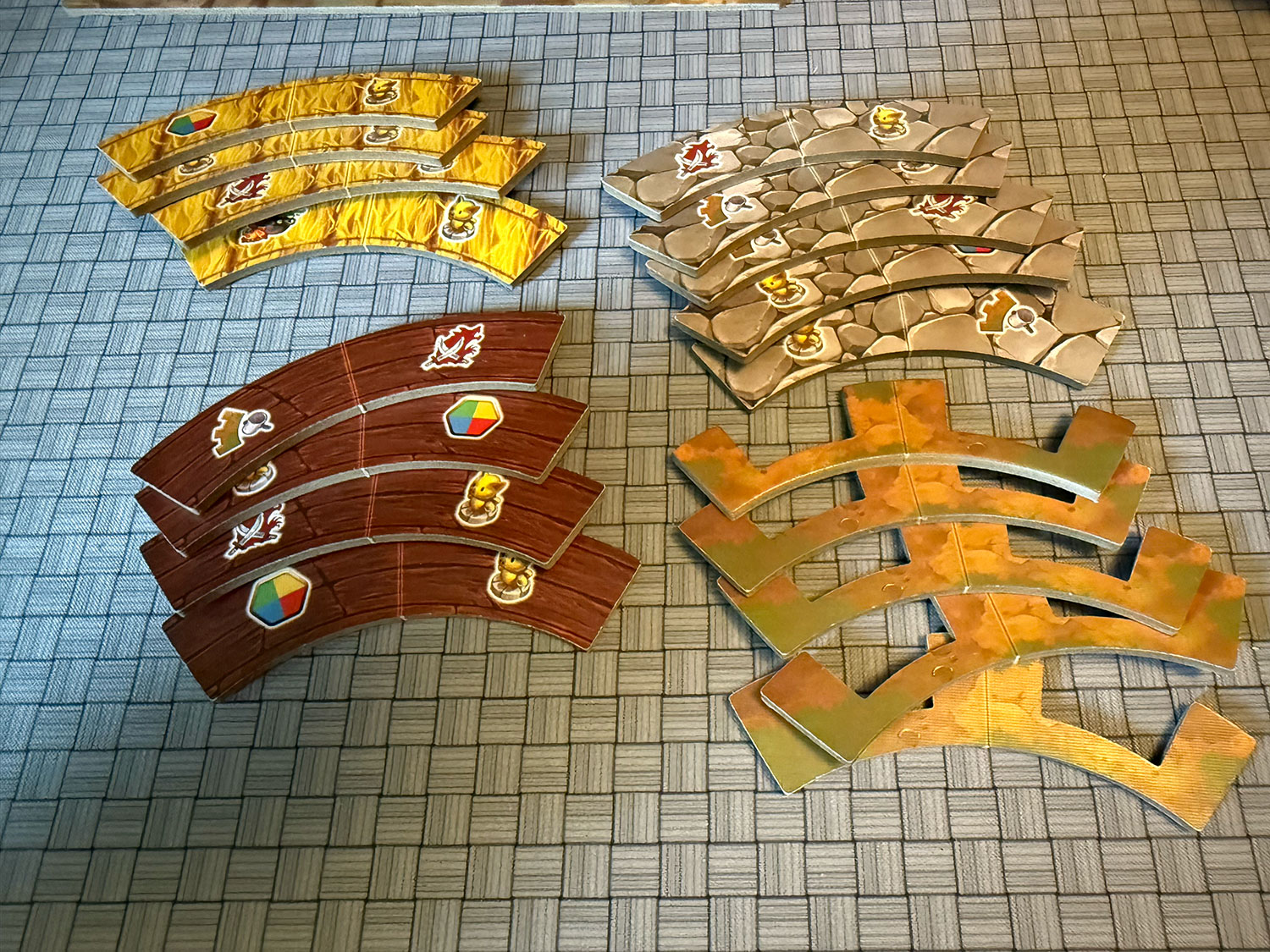 The wall pieces are straw, wood, and stone. I don’t recall a fortification pig in the old cartoons but maybe he’s in the live-action remake.
This game starts slowly as you cover one symbol at a time but then for the second level and one of your fortress each piece covers two symbols. Covering symbols to take actions and then having them visible for end of era is an interesting puzzle but essentially you’re either picking between eliminating wolves (gaining two points) or three points (inflicting wolves on your opponents, or grabbing an end-game scoring tile.
The rulebook aside, my biggest turnoff for the game is the slightly take-that nature of dispatching wolves actions. This action gives you points at the expense of your opponents having to deal with more wolves. In a way, it’s not dissimilar to cooperative games where something bad is going to happen to you at the end of your turn, but it’s a different feeling when my opponent is doing it to me or I’m doing that to them. At least the randomness ensures that you can’t intentionally overload one section of their board.
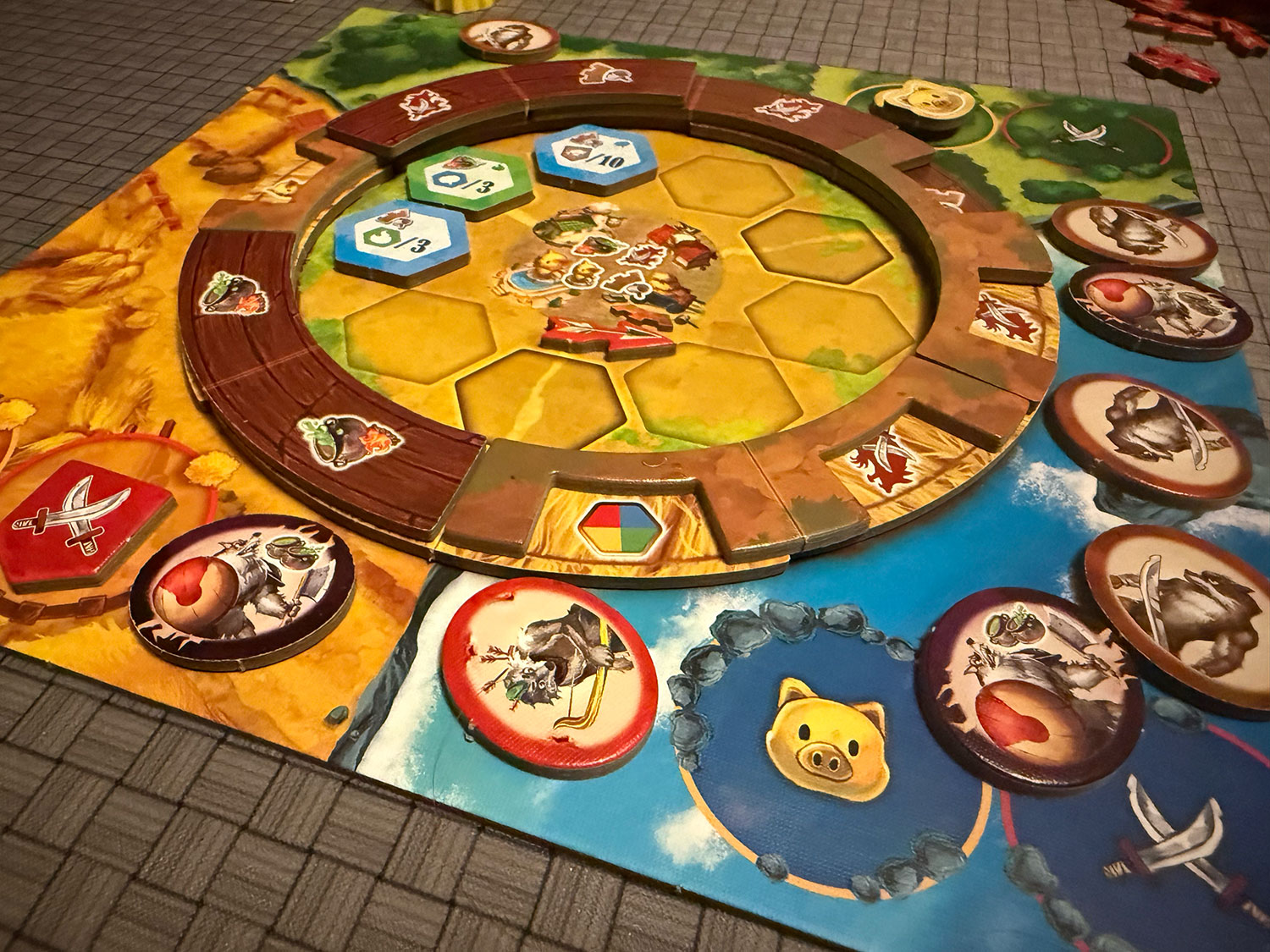 The wolves don’t huff and puff as much as shoot and climb.
While it seems like I’m complaining a lot, I do want to write about what I enjoyed in the game. I liked the puzzle of trying to build up my fortress and eliminate wolves, balancing short-term gains and long-term problems. That core loop is fun, especially with a lower player count, where certain tiles hurt everyone and you need to decide if taking one for the team is worth it. Even the choice of actions, like using fortifications to build up your castle, repels more wolves at the end, but you also need to drop oil like it’s hot on the ladder carriers and archers, or wall height won’t matter anyway.
And this is a weird thing to talk about, but I loved the insert in this game as it cleanly held all the wall tokens, which made setup and teardown pretty fast. The components for Castle Raisers are quite good overall, with thick punchboard for the tokens and walls. But nothing is as thick as the pig meeple, which is 100% chonk. The art by Zingco Kang is good, but the graphic design gets cluttered with symbols. Part of that was a nice choice of each color having a symbol to assist color blind players, but it comes at the expense of overall busyness.
Final Thoughts:
Much like the Green Jelly song, Castle Raisers takes the beloved fairy tale of Three Little Pigs and definitely does something with it, but whether it’s good is harder to say.
I went into Castle Raisers expecting a family-weight tower defense game a la Castle Panic, but what I got was a more thinky and quasi-mean tower defense game. This isn’t for me, but I do think there’s a good game here for the right audience. But know what you’re getting into early and play it solo once or twice before trying to teach it. For me, at least, this game took a few plays for it to click, but even so, I only got to a feeling of “it’s fine” which is a pretty good climb from total disdain.
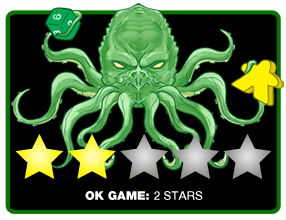
Final Score: 2 Stars – There are some neat ideas in Castle Raisers, but, much like the Green Jelly song, it isn’t a modern classic for me.
 Hits:
Hits:
• Great quality components and insert
• Some interesting choices around tile selection and placement
Misses:
• Disliked the take-that element of dispatching wolves on opponents
• Rulebook wasn’t great and had errors and/or inconsistencies.

/pic9516264.jpg)
/pic9148407.jpg)







 English (US) ·