
.jpg)
 1 year ago
96
1 year ago
96
PROTECT YOUR DNA WITH QUANTUM TECHNOLOGY
Orgo-Life the new way to the future Advertising by AdpathwayNadya Zeitlin engages with AI-driven 'medusai' at the Goat Farm. (Photos by Robin Wharton)
To most casual observers, medusai — a car-sized sculpture comprising steel panels, colored lights, sophisticated electronics and processors, seven cleverly articulated appendages and instrumental strings — is an object, complex and perhaps even beautiful, but an object nonetheless. PhaeMonae and Nadya Zeitlin, who have spent dozens of hours in a Goat Farm Arts Center studio observing and teaching the machine how to dance, however, refer to medusai as “she.”
“When I’m dancing with her, I feel her feeding energy back to me,” said Zeitlin, an Atlanta-based choreographer known for creating site-specific work that incorporates digital art and technology. “It’s not quite like being on stage with another human, but she’s not just an inert thing that I have to feed with my energy in order to bring it into the dance.”
PhaeMonae, too, described medusai as an agent in her own right. “She has different modes. In installation mode, especially when she’s surrounded by people, she’s hissing and moving her arms to let them know they’re getting too close, too fast.”
Gil Weinberg, a professor at Georgia Tech’s School of Music and the founding director of the Georgia Tech Center for Music Technology, created medusai with an interdisciplinary team. He said Zeitlin and PhaeMonae are tapping into something that he has felt himself when improvising musically with medusai.
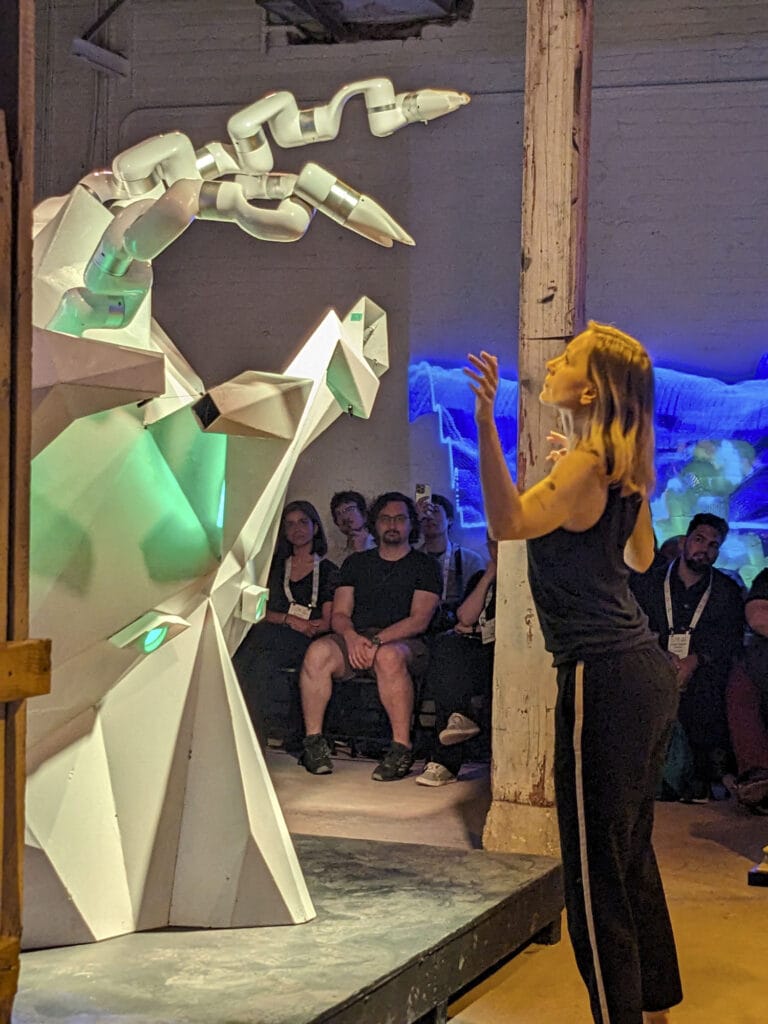 Nadya Zeitlin and medusai at the Goat Farm.
“In the early stages, when she would play a discordant note or otherwise not respond as I expected, I could tell immediately what had happened and how that had been dictated by her programming or construction,” said Weinberg. “As she has accumulated layer upon layer of neural networks, however, such events can no longer be explained away so simply. They appear more and more as choices made by a creative entity.”
Weinberg, PhaeMonae, Zeitlin and the rest of the research team, which includes Tech Ph.D. student Amit Rogel; Kathleen Wessel, senior lecturer in the Department of Dance Performance and Choreography at Spelman College; and local experimental musician Mark Mallory, put medusai through her paces during a workshop performance at Goat Farm Arts Center on May 19.
The event began with medusai, in installation mode, interacting with the audience as we mingled before the show. She was indeed hissing and flashing her lights red, feinting at those who approached too close and too quickly with snake-like “arms” that make up her “hair.”
In this mode, Weinberg said, medusai demonstrates how an embodied AI might teach museum-goers or workplace collaborators how to interact with it by using gestural and sonic cues to which humans respond intuitively. Medusai‘s name, form and behavior all suggest “snake” to our mammal brains, and we therefore react to her hissing and striking by backing away instinctively.
A slower and less aggressively-coded approach, however, garners a more welcoming response from medusai. She waves her arms hypnotically, glows green and reaches out to a participant with a gesture that reads as curiosity.
Many scientists and engineers conduct research focused, like Weinberg’s, on questions associated with acclimating humans to the presence of increasingly autonomous robots. Artists like PhaeMonae, Zeitlin and Mallory have played key roles in that research. In fact, medusai‘s performance put her on the world stage as part of a thread at the 2025 Institute of Electrical and Electronics Engineers (IEEE) International Conference on Robotics and Automation (ICRA), which was dedicated to arts in robotics.
ICRA took place in Atlanta this year, and the co-chairs of the arts in robotics thread — Amy LaViers, dancer, roboticist and founding director of the Robotics, Automation and Dance Lab (RADLab) in Philadelphia, and Jean Oh, associate research professor at the Robotics Institute at Carnegie Mellon University — asked the presenters and participants to consider how robots operate as expressive bodies, even as they perform tasks as functional ones.
“ICRA is the premier conference for robotics researchers,” said LaViers, “And like everyone else, those of us working in arts and robotics are doing fundamental research related to the problem of how to build better robots.”
Consequently, for the past 10 years, ICRA has included an arts in robotics presence, though LaViers said 2025 may be a high-water mark for participation. Overall, this year’s thread emphasized the performing arts, but LaViers said the conference also featured work in sculpture, painting and other fine arts. “It’s a big tent,” she said.
While some of the sessions were open only to conference attendees, the arts in robotics thread at ICRA included several that — like medusai‘s show at Goat Farm — were open to the public. Those included two workshops on Friday and a performance at the Rialto Center for the Arts on Wednesday evening.
During the Rialto event, itinerant professional ballerina and quantum physicist Merritt Moore performed Machine Yearning. In this series of dances, she partnered with a robot, designed and built by Universal Robots, that was embodied as an articulated arm as tall as an NBA basketball player. The first piece featured a guest appearance by Atlanta Ballet dancer Jordan Leeper.
Next, Naomi Fitter, a stand-up comedian and associate professor in the School of Mechanical, Industrial and Manufacturing Engineering at Oregon State University, performed a skit with Jon the Robot. Jon is a pint-sized engineered comic who told computer-science-themed jokes while making remarkably human gestures, including hunched shoulders that signaled dejection or embarrassment, playful sidelong glances and arm waving for emphasis.
The program closed with a work-in-progress showing of Austringer by artist Louisa Pancoast and Nialah Wilson-Small, a robotics researcher, educator and consultant, and current artist-in-residence with New York-based Smashworks Dance Company. In Austringer, two drones and four dancers mapped the evolving relationship among humans and drones, beginning with surveillance by one drone of mostly oblivious humans and ending with choreographic intimacy in which humans and machine shared awareness of one another on the stage and made skin-to-plastic contact.
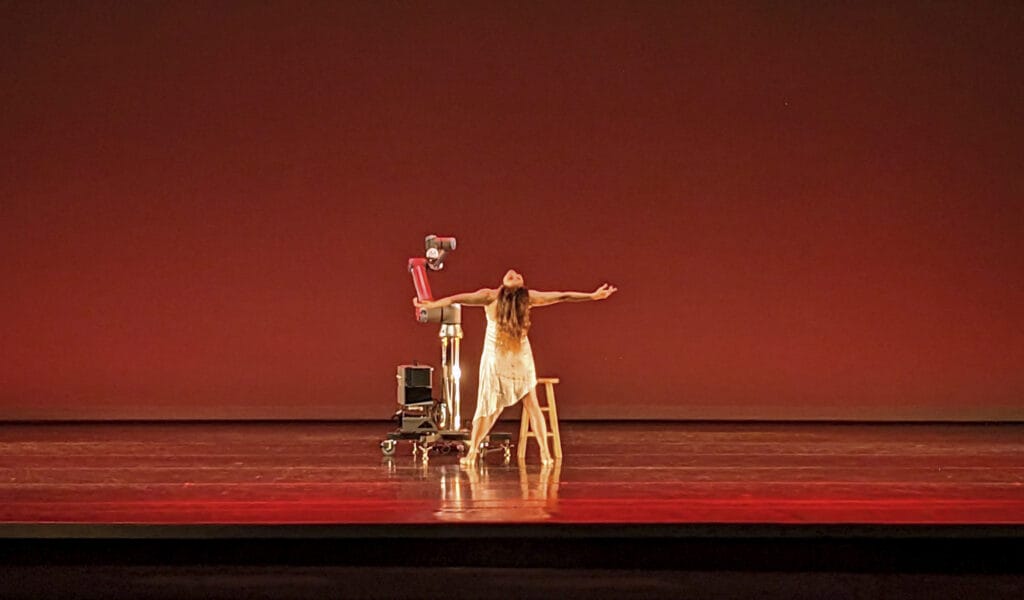
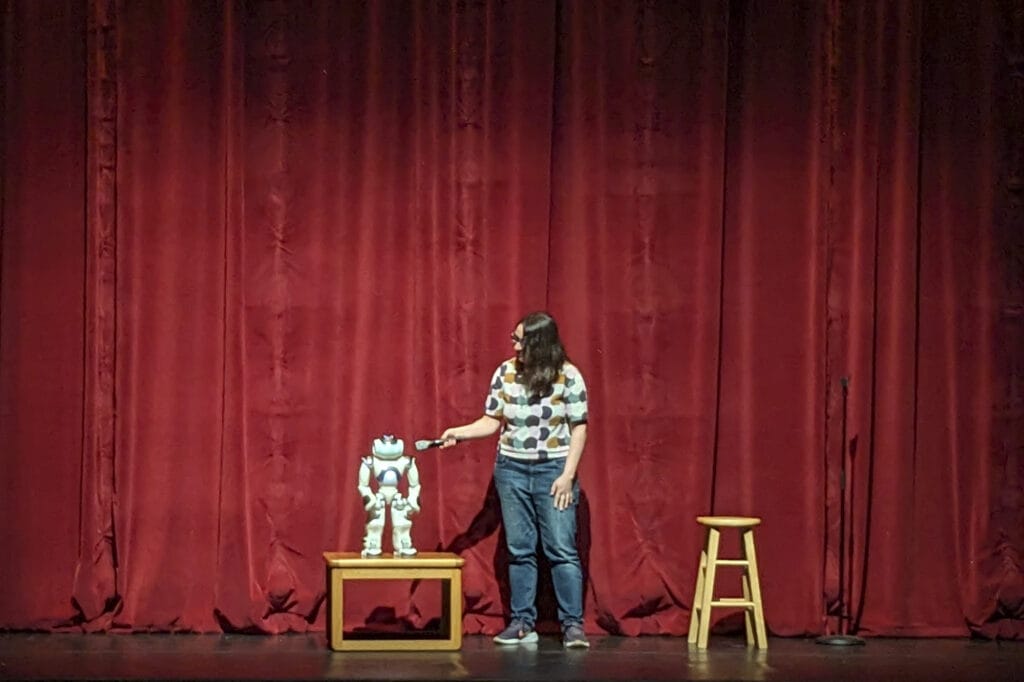
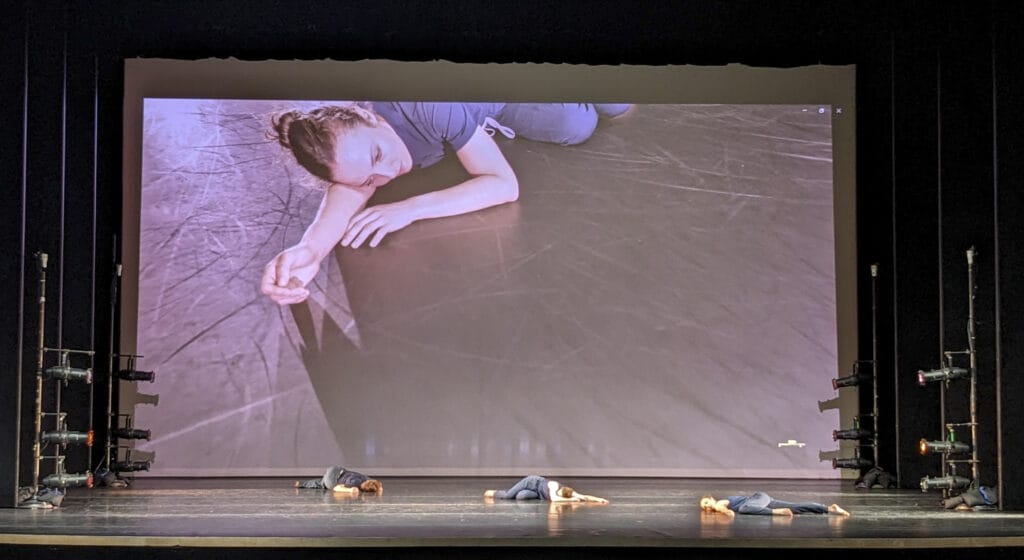
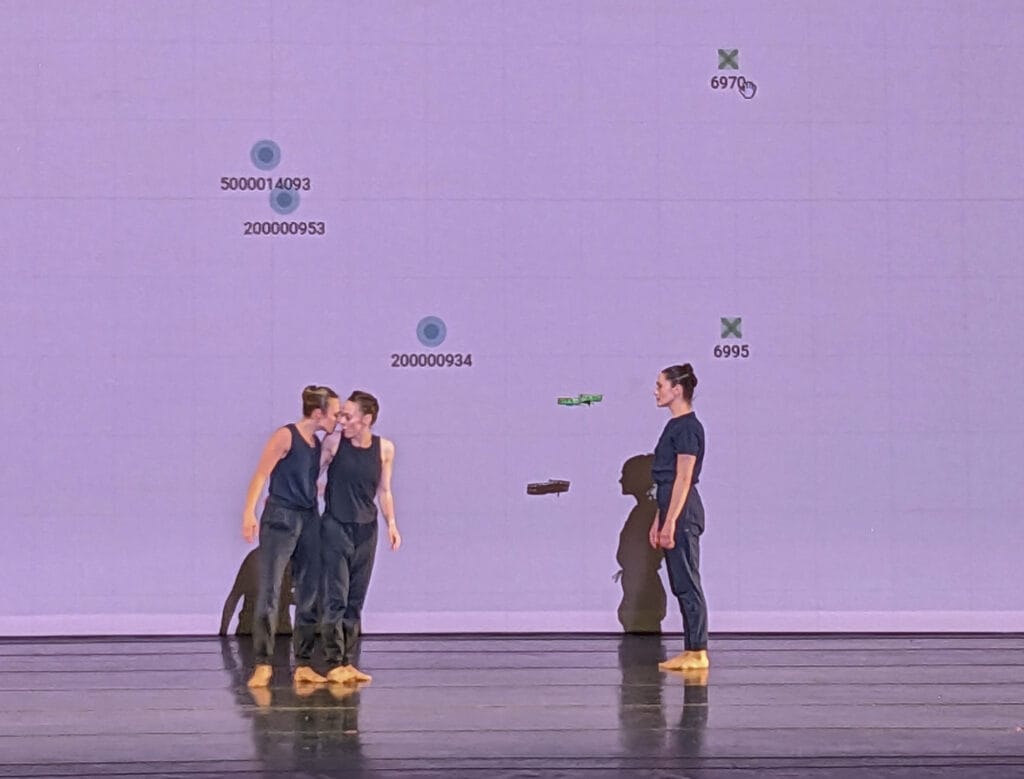
In an interview after the performance, Patrick Martin, assistant professor of computer science at the University of Richmond, spoke about what scientists and engineers can learn from medusai, the work presented at the Rialto and the work he does with collaborator Kate Sicchio, associate professor and graduate program director for kinetic imaging at Virginia Commonwealth University’s School of the Arts. “These projects introduce robots in the wild,” he said.
Sometimes the teams are creating bespoke hardware like medusai, while others such as Martin and Sicchio explore the affordances of off-the-shelf solutions. All of them, though, are looking at how robots perform in human-centered and human-occupied spaces — as opposed to within idealized lab conditions — and observing how humans respond to and collaborate with robots. “We learn how robots succeed and how they fail,” said Martin. Scientists and robots learn from both success and failure.
In medusai‘s case, her performance on Monday could be counted a success, as it showcased both her visually expressive range and her musical abilities. Her body includes strings that she can pluck to create melodies and rhythms. Once the audience had taken its seats, Weinberg sat at a keyboard and began to play.
The sound of medusai‘s plucked strings and Weinberg’s keyboard-generated notes filled the space, and the clack of medusai‘s “pincers” as they caught and released the strings added an additional sonic layer to her contributions to the improvised score.
While primitive compared to the output her processors and algorithms might generate through a purely digital interface, medusai‘s embodied music, Weinberg said, resonates with a human audience because it is the expression of a body moving through three-dimensional space in human-perceivable time. Medusai‘s physical presence transforms abstract mathematics and physics into art.
Before medusai, Weinberg created another music-playing robot — Shimon, an improvising robotic marimba player who has performed with human musicians in dozens of concerts and festivals from DLD in Munich, Germany, to the U.S. Science Festival in Washington, D.C., to the Bumbershoot Festival in Seattle, Washington, and Google IO in San Francisco.
“There are things that Shimon and medusai can do that a human cannot, and there are things that humans can do that the robots cannot,” Weinberg said. He believes, whether they are human or robotic, the artist’s physical limitations are just as essential to art-making as are their abilities.
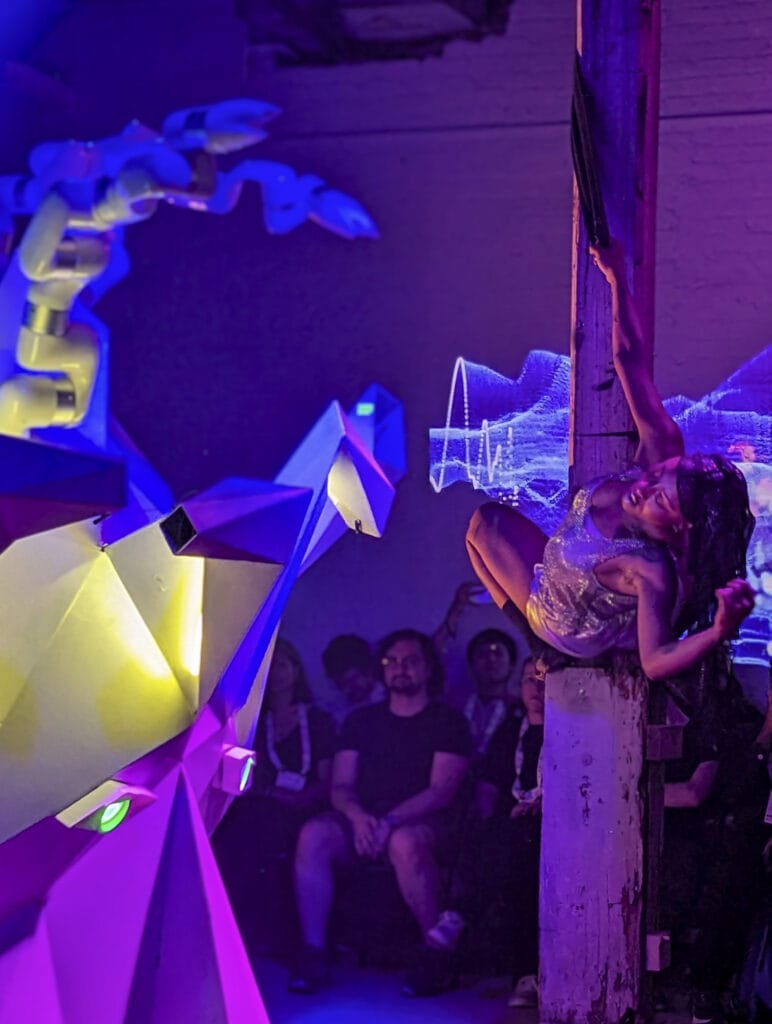 PhaeMonae scaled pillars in order to interact with medusai from a different vantage point.
In the second movement of the performance, Zeitlin danced slowly with medusai, enticing the robot into mimicry with languorously twining arms and slow isolations that rippled through her torso. Medusai mirrored Zeitlin’s gestures with her own appendages, which also seemed to track and follow Zeitlin around the space, even though the camera giving medusai a view of the room was stationary atop a wall behind the audience on that side of the room.
PhaeMonae initiated the third movement by making hissing sounds of their own as they entered the room, while Mallory took over the musical accompaniment. PhaeMonae’s performance was more athletic and involved climbing and swinging from two of the four load-bearing pillars that surrounded medusai.
“As we worked, I became frustrated with always having to be underneath medusai, but I couldn’t climb her without damaging her,” said PhaeMonae, so Weinberg figured out how to attach footholds and straps to the pillars. “And presto, in two days I became an aerialist!” joked PhaeMonae.
In designing and naming medusai, Weinberg deliberately evoked the myth of the gorgon Medusa, a snake-headed monster who could turn men to stone with a single look. “She began her life as a beautiful mortal maiden, but, after Zeus raped her, Athena transformed her into a deadly monster,” said Weinberg. “Medusai‘s name and behavior are meant to remind us of the potential promise and peril of AI.”
PhaeMonae and Zeitlin offered an alternative or additional interpretation of the story: Medusa’s power was transformation. She transformed humanity through death and destruction, and, in the case of Perseus, she catalyzed change by forcing humanity to think around and beyond its physical limitations, opening the door to new ways of perceiving and being.
With regard to how robotics and AI are affecting dance right now, Wessel sees both the integration of new technology and the art form itself as expressions of uniquely human impulses. As a species, she said, we have always been fascinated by alien intelligences and bodies, from gods and monsters to AI and robots. Wessel sees medusai as a “totally new kind of performer” who will join rather than replace humans onstage.
“I don’t see a future in which people will no longer want to see humans dancing,” she said. “Expressing lived experiences, cultural knowledge and embodied memories through the body has been a human practice and necessity throughout history.”
::

Robin Wharton studied dance at the School of American Ballet and the Pacific Northwest Ballet School. As an undergraduate at Tulane University in New Orleans, she was a member of the Newcomb Dance Company. In addition to a bachelor of arts in English from Tulane, Robin holds a law degree and a Ph.D. in English, both from the University of Georgia.








 English (US) ·