
.jpg)
 17 hours ago
13
PROTECT YOUR DNA WITH QUANTUM TECHNOLOGY
Orgo-Life the new way to the future Advertising by Adpathway
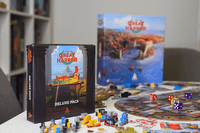
The game originally came to us from designer Matteo de Nardis, under the working title Lubecca. At its core, we immediately saw something we liked: a clever dice-placement system built around constructing your own engine, with plenty of interesting decisions packed into a relatively straightforward structure.
But as we started developing it, we also began seeing just how much further we could take the idea.
From Lubecca to Carthage
One of the first major changes was the setting.
Around the same time, we were looking to expand the world we had created with Magna Roma, and it felt natural to explore another part of the ancient Mediterranean through a very different type of game. This felt even more fitting because Matteo is also the designer of Magna Roma, making the connection between the two projects feel very organic.
That eventually brought us to Carthage and its incredible harbor.
The Great Harbor of Carthage was one of the most impressive engineering and commercial achievements of the ancient world. It gave us exactly the setting we were looking for: merchants, ships, colonies, trade, construction, and a city whose power was deeply connected to the sea.
And once we made that decision, the game started changing with it.
This wasn't simply a case of changing the artwork and names. The setting inspired new systems, new interactions, and new ways of connecting the different parts of the game.
Simplifying Without Making It Simpler
A big part of our development philosophy was to make the game easier to understand without reducing the number of interesting decisions.
One example was the way dice interacted with harbor tiles.
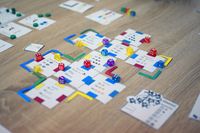
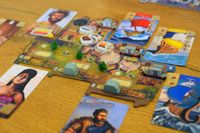
Originally, dice were placed at the corners where four different tiles could meet. In addition, in order to place a die, you were required to match its number. This created plenty of possibilities, but it also meant that every placement required players to process quite a lot of information.
During development, we changed this so that dice are placed along the edges between two tiles instead, and that you were free to place a die with any number - the number would just affect how much you gain from the placement.
It sounds like a few small changes, but these changes had a surprisingly large effect. The board became easier to read, turns became quicker, and the decision of where to place the die remained just as important.
And these were exactly the kinds of changes we wanted to make. Fewer rules to process, without losing the decisions behind them.
Building More Than a Harbor
As development continued, the game gradually expanded beyond the Great Harbor itself.
The placement of dice in the Great Harbor board remain at the center of everything you do, but they now connect to a much larger economic machine.
You draft dice. You place them in the harbor and gain resources and cards. You develop your colony. You construct buildings. You attract useful people. You build and crew ships. You trade valuable goods. You prepare voyages and send those ships into the Mediterranean, sometimes having to deal with pirates along the way.
All of these systems feed back into each other, and that interconnectedness became one of our favorite parts of the game.
The Icing on the Cake - Trading
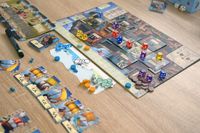
During the final stages of development, we introduced a push-your-luck trading mechanic, and this ended up being the icing on the cake for us.
It added something we don't see very often in Euro games: a moment where careful planning suddenly turns into tension, risk, and everyone around the table watching to see what happens.
Do you take the current successful trade and walk away, or do you push for something better and risk losing the opportunity? It sounds simple, but it created some of the most memorable moments during development.
We had so much fun playtesting this in the office that we were literally screaming whenever someone pulled off a successful trade at the far edges of the Mediterranean! Every time somebody decided to push their luck one step further, everyone stopped what they were doing to see how it would end.
For a game with so much planning and strategy, having these sudden bursts of excitement gave The Great Harbor a personality we really loved!
Keeping the Game Moving
We also paid a lot of attention to pacing.
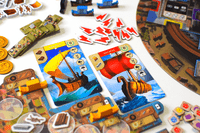
The Great Harbor contains plenty of strategic possibilities, but we didn't want it to feel slow or overly procedural. The game lasts only five rounds, so you rarely have enough time to do everything.
Do you develop the colony? Build more ships? Push trade? Prepare voyages? Focus on prestige? Or try to build an engine connecting several of those things together?
And because the dice available to you are never exactly the same, you constantly have to adjust.
That tension between building something long-term and reacting to what is available right now became one of the defining parts of the game.
A Game That Changed a Lot
Looking at The Great Harbor today and comparing it to the first prototype of Lubecca is quite fascinating.
The foundation is still there. You can still see the original idea that made us interested in the game in the first place.
But around it, almost everything has been examined, questioned, adjusted, simplified, expanded, or rebuilt at some point during development.
And these are only a few examples. There were many other changes along the way, from ships and voyages to the colony, economy, and the different ways players can build prestige.
For now, we are incredibly happy with where the journey has taken the game.
What started as a clever dice-placement prototype has gradually become The Great Harbor, a strategic Euro game with its fair share of planning, building, and engine creation, but also those wonderful moments when somebody decides to risk everything on one more trade and the entire table suddenly erupts.
Thanks for reading this!
- Milan, Archona Games






 English (US) ·