
.jpg)
PROTECT YOUR DNA WITH QUANTUM TECHNOLOGY
Orgo-Life the new way to the future Advertising by Adpathway My first experience with Nazi zombies was in a Call of Duty video game, but that broad concept is actually a well-established niche of the horror genre, dating all the way back to World War II. That won’t be a surprise to many–the allegory of a military superpower treating humans as puppets for the purpose of world domination is almost too on-the-nose–but when I first encountered it, I thought it was an incredibly novel take on the zombie genre.
In hindsight, Call of Duty’s take on the genre was not particularly interesting, but Escape from Projekt Riese has a little more spice to it, a sprawling campaign game about fighting your way through a Nazi laboratory full of undead horrors and discovering the secrets within. It has branching paths, a notebook filled with dozens of scenarios, and all the creepy-crawlies your heart could desire.
Escape from Projekt Riese is a tactical combat game for 1-2 players. Each scenario plays in about 30 minutes, and the full campaign could last a dozen or more scenarios.
Gameplay Overview:
Escape from Projekt Riese is a campaign game, played out over a number of scenarios. After a lengthy set of tutorial missions, each scenario sees you controlling a team of two characters on a map (set up within the game’s spiral notebook of encounters), with some number of mandatory and optional objectives to complete. Some scenarios and objectives also see you reading entries from the game’s campaign log, which provides additional story beats and consequences.
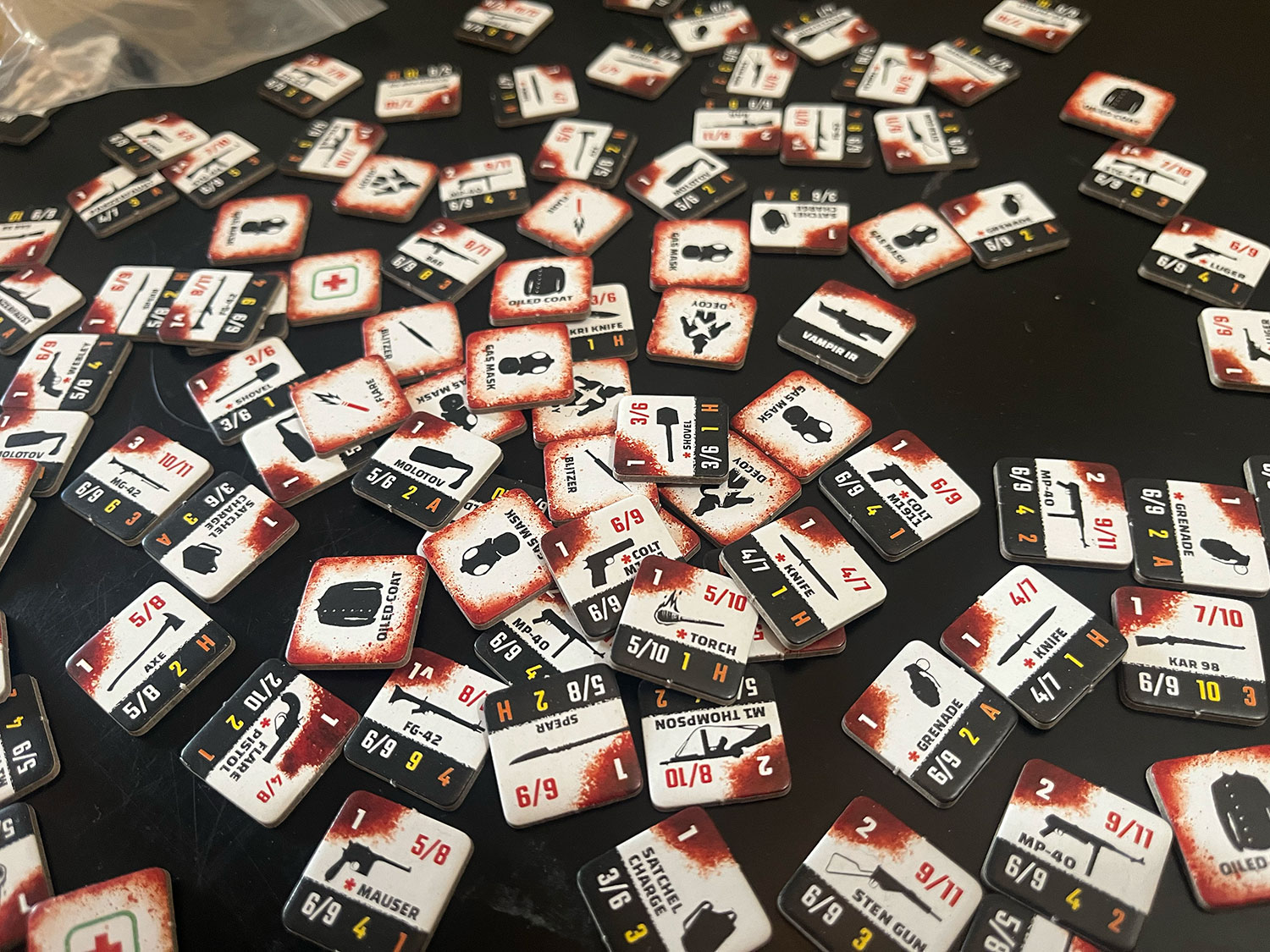 The game comes with dozens of tiny wargame-esque tokens, most of which are used for the various weapons you can find. The tokens are easy to parse and keep the play space minimal, but it means a lot of specific weapon information is relegated to the rulebook.
Each round comprises a player turn and a zombie turn. On the player turn, you have a set number of movement points based on how fast you choose to move, and can take a single attack action at any point during that character’s activation. Attacks are resolved by rolling a twelve-sided die and trying to roll above the chosen weapon’s attack value, modified by a variety of factors. On the zombie turn, all zombies move towards the closest character and attack them if close enough, and new zombies will spawn at the end of the turn.
Completing a scenario generates a threat, which makes each subsequent scenario harder the higher it rises, and provides some branching paths for the next scenario to set up. Characters can level up and exchange equipment in between scenarios, and occasionally the game will offer a “threat reduction scenario,” a semi-randomized mission that can help lower the threat level and make things easier.
As you progress through the campaign, your characters can die and be replaced by backup characters on your team. You win the campaign by completing the last scenario and escaping Projekt Riese, but you fail if all characters die before you can accomplish that goal.
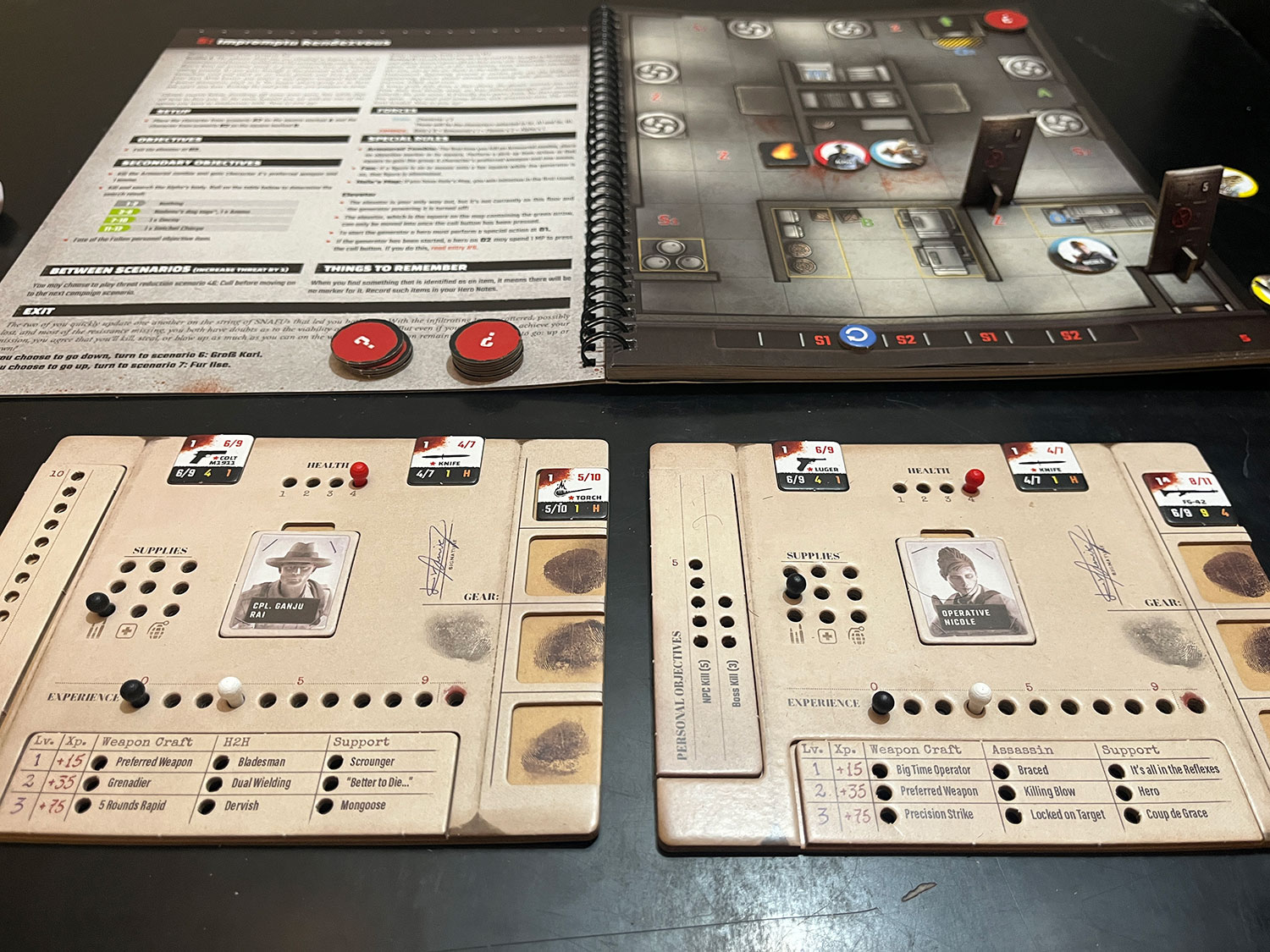 All scenarios are kept in a single spiral-bound notebook, which makes scenario setup a breeze and makes it easier to run multiple scenarios in a single sitting.
Game Experience:
Escape from Projekt Riese makes a rough first impression. The tutorial scenarios are overlong and don’t teach you much of the game, and the rules are extremely frustrating. Important information is scattered across several different appendices and books; there are no reference cards for important minutiae like accuracy modifiers or MP costs, and there is a litany of game-halting typos that sent me online desperately searching for answers. However, if you manage to claw your way through the infuriating ruleset, you will find a fun and moreish combat game on the other side.
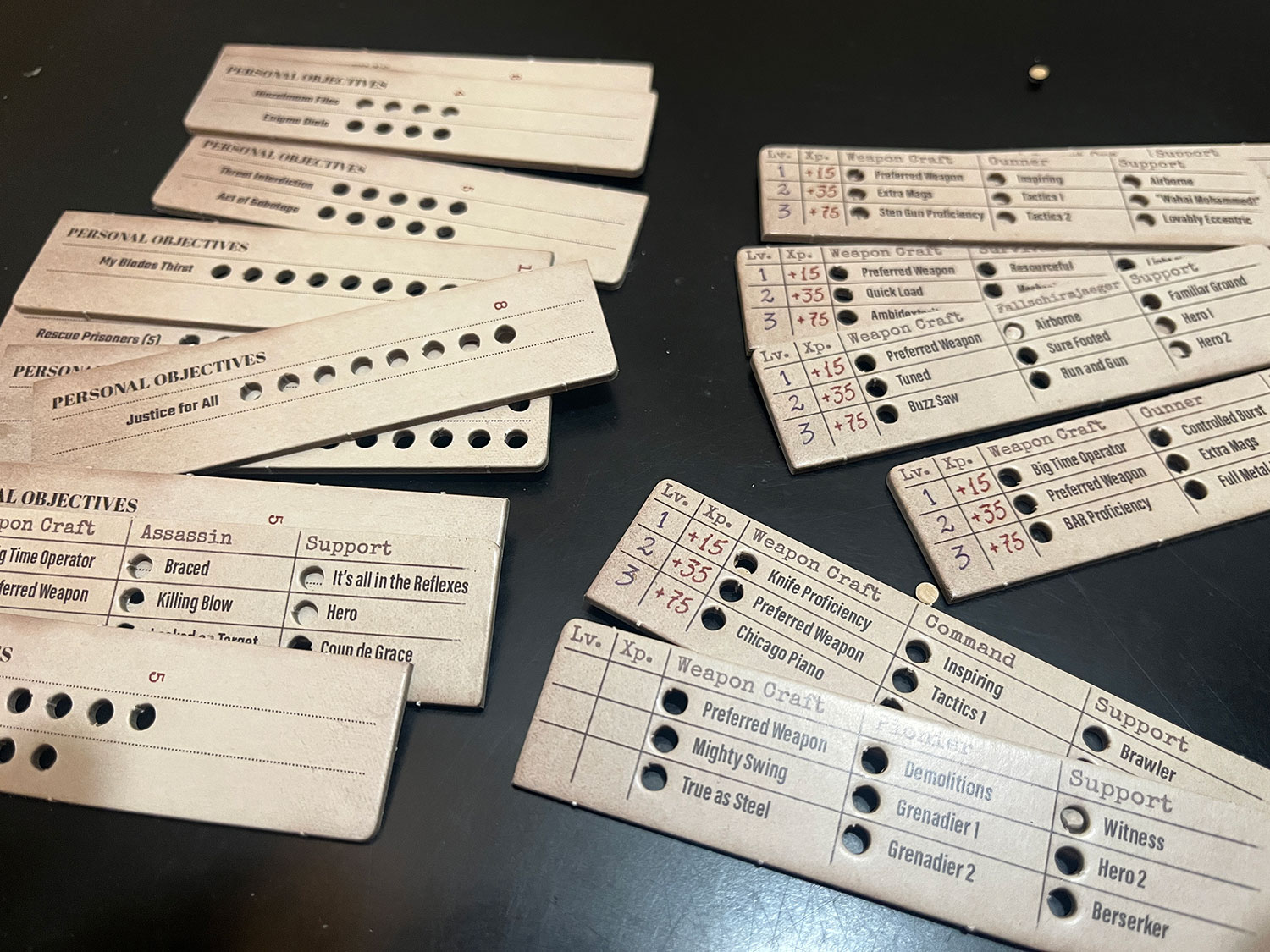 Each character has their own personal objective and upgrade boards, which slot into the generic player boards. The upgrade boards don’t feel tremendously distinct, but the personal objectives do a great job of giving each character something different to do across the course of a campaign.
Mechanically, nothing Escape does is particularly new—you move, you shoot, and repeat—but there are some flourishes here that help streamline the experience. Ammo only gets spent on a critically failed shot, which perfectly replicates the tension of a resource-scarce zombie shooter, and zombies are only fully revealed when a character can see them, which is a nice touch. The individual scenarios are both creative and varied, with a myriad of different objectives, maps, and overall vibes that keep things from getting stale.
Combat feels like fighting zombies should. Individual zombies are weak and easy to take out, but more spawn than you can reasonably kill each round, so you’re always incentivized to move fast and leave the undead behind. However, scenarios usually provide optional objectives off the critical path, which pushes you to take risks and wander into the fray.
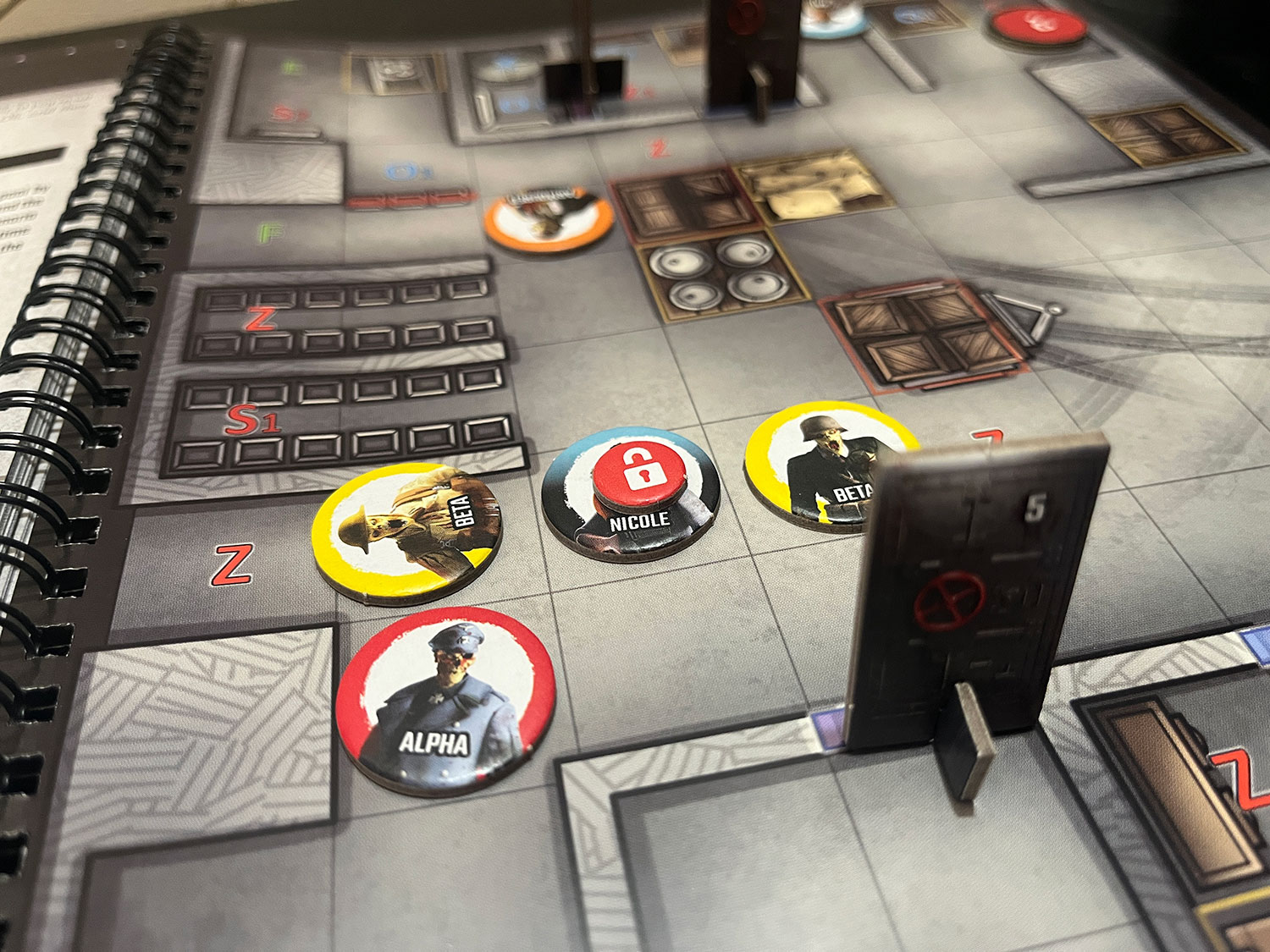 Maps feel open enough not to railroad players through objectives, but claustrophobic enough that getting surrounded is an ever-present risk. Nicole here might be able to get away with some lucky dice roles, but she certainly won’t get away unharmed…
I was also impressed with the campaign structure. The actual campaign mechanisms are light but effective, the story is reasonably well-done (if more than a bit schlocky), and there are enough branching paths to encourage repeat playthroughs. You’re also engaged in your character throughout the campaign, as each character has a personal objective that takes long periods of time to complete. Repetition does set in after a while, especially if you run too many threat reduction scenarios in short succession, but the replay value here is still tremendous.
That initial learning curve is a huge obstacle, though, and remains a problem long after you complete the tutorial. Even five games in, I was still reaching for the rulebook to check a specific terrain interaction or obscure rule, only to spend the next several minutes flipping between glossaries, appendices, and online forums to parse the necessary information. It’s a pretty damning blemish on what is otherwise a really good and fairly simple tactics game.
Final Thoughts:
Escape from Projekt Riese should be a good introduction to campaign skirmish games. There aren’t too many fiddly mechanisms, each scenario is quick to set up and play, and there is a ton of content for you to explore, even in just a single campaign. The simplistic rules can get repetitive, but the scenario design and character-specific objectives help mitigate that to a huge degree. Unfortunately, the game’s bumpy on-ramp and abysmal rulebooks drag it down and make it much harder to recommend.
Final Score: 3 Stars – A fun, schlocky zombie campaign that shoots itself in the foot with its unfortunate rulebook.
 Hits:
Hits:
• Nails the vibe of a zombie shooter
• Scenarios are varied and well-designed
• Engaging story
• Tons of content and replay value
Misses:
• Terrible tutorial and rulebook almost derail the whole experience
• Scenarios can get repetitive
• Uninspired core mechanisms










 English (US) ·