
.jpg)
PROTECT YOUR DNA WITH QUANTUM TECHNOLOGY
Orgo-Life the new way to the future Advertising by Adpathway Fantasy Realms holds the distinction of the most played game in my collection. This is partly because it’s a go-to travel game; I have played it on trains, and I have played it on planes. I’ve played it in many a house, though never with a mouse. Fantasy Realms is also an adaptable filler, satisfactorily accommodating 2-6 players and loaded with surprisingly interesting decisions given the 1-minute teach. Most importantly, it’s an addictively fun push-your-luck experience with endless replay value.
So, I was obviously intrigued when I heard of the follow-up title: Fantasy Realms: Greek Legends by the same designer, Bruce Glassco. It’s still a card-based game where 2-6 players attempt to tactically optimize a hand of 7 cards over 10-20 minutes. This rendition of the game, however, features new artwork, a larger deck, and a couple of new mechanics. Is the gameplay as Godly as the theme?
Gameplay Overview:
Fantasy Realms: Greek Legends starts with every player being dealt a hand of 7 cards. Each card contains the following features:
- One of 6 suits (God, Hero, Quest, Monster, Item, or Location)
- 0-4 “tags” among 13 possibilities
- A base point value
- A possible scoring bonus
- A possible scoring penalty
- A possible end-game effect
On your turn, you must draw a card either blindly from the deck or openly from the common discard marketplace.
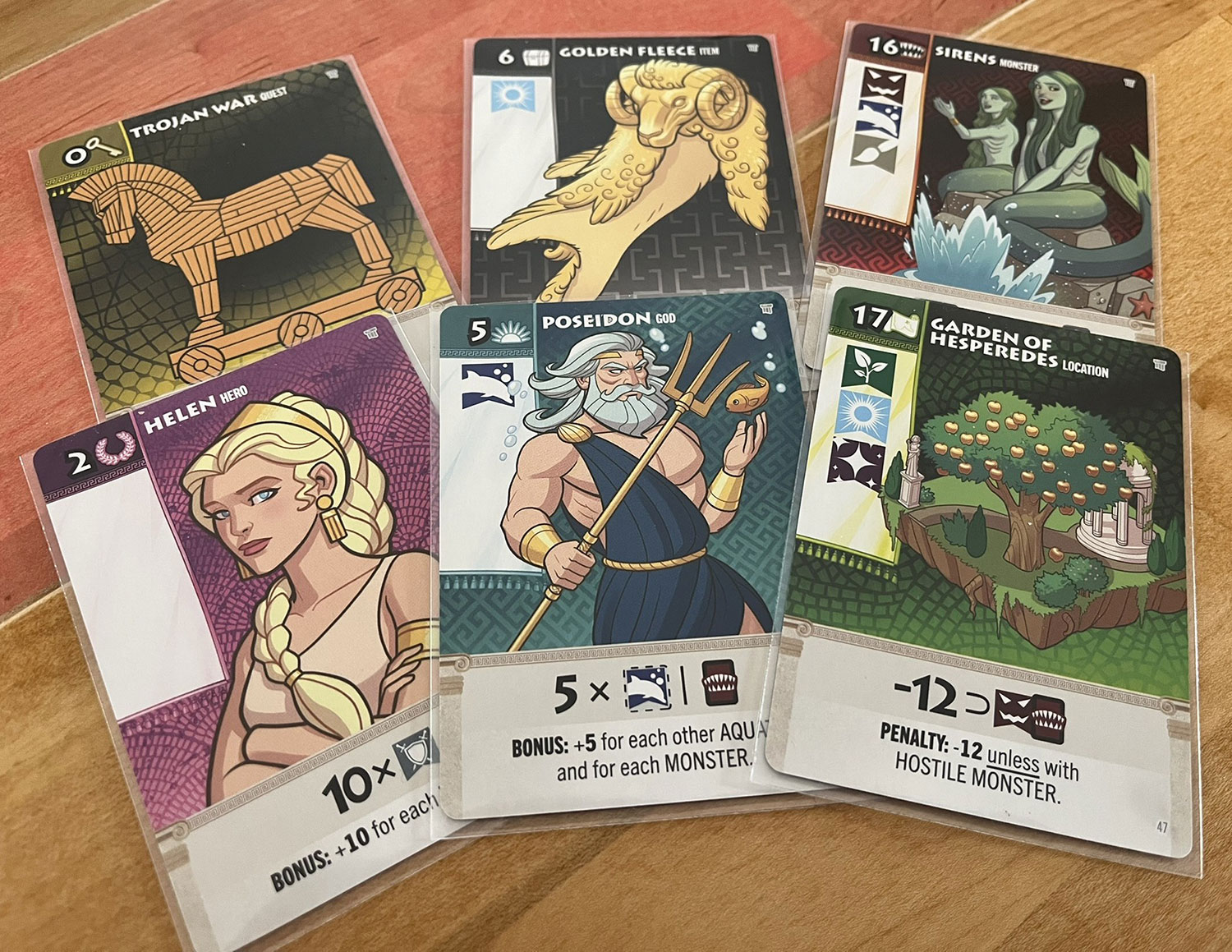 A sampling of cards from each of the six suits, as indicated both by background color as well as symbology in the upper left corner is shown here.
Afterwards, you must discard back down to 7 cards, usually to the common discard marketplace.
New to Greek Legends, certain cards may be discarded to your personal “afterlife” area, which effectively expands your hand limit beyond 7. If this happens, a random card is drawn from the deck and added to the common discard marketplace.
The game immediately ends when there are 10 cards in the common discard marketplace.
End-game penalties, bonuses, and special effects are evaluated, which may lead to additional cards going to the afterlife. Every afterlife card results in a 10-point deduction.
Sum up base points on all cards in your hand and afterlife, accounting for relevant bonuses and penalties. The highest score wins.
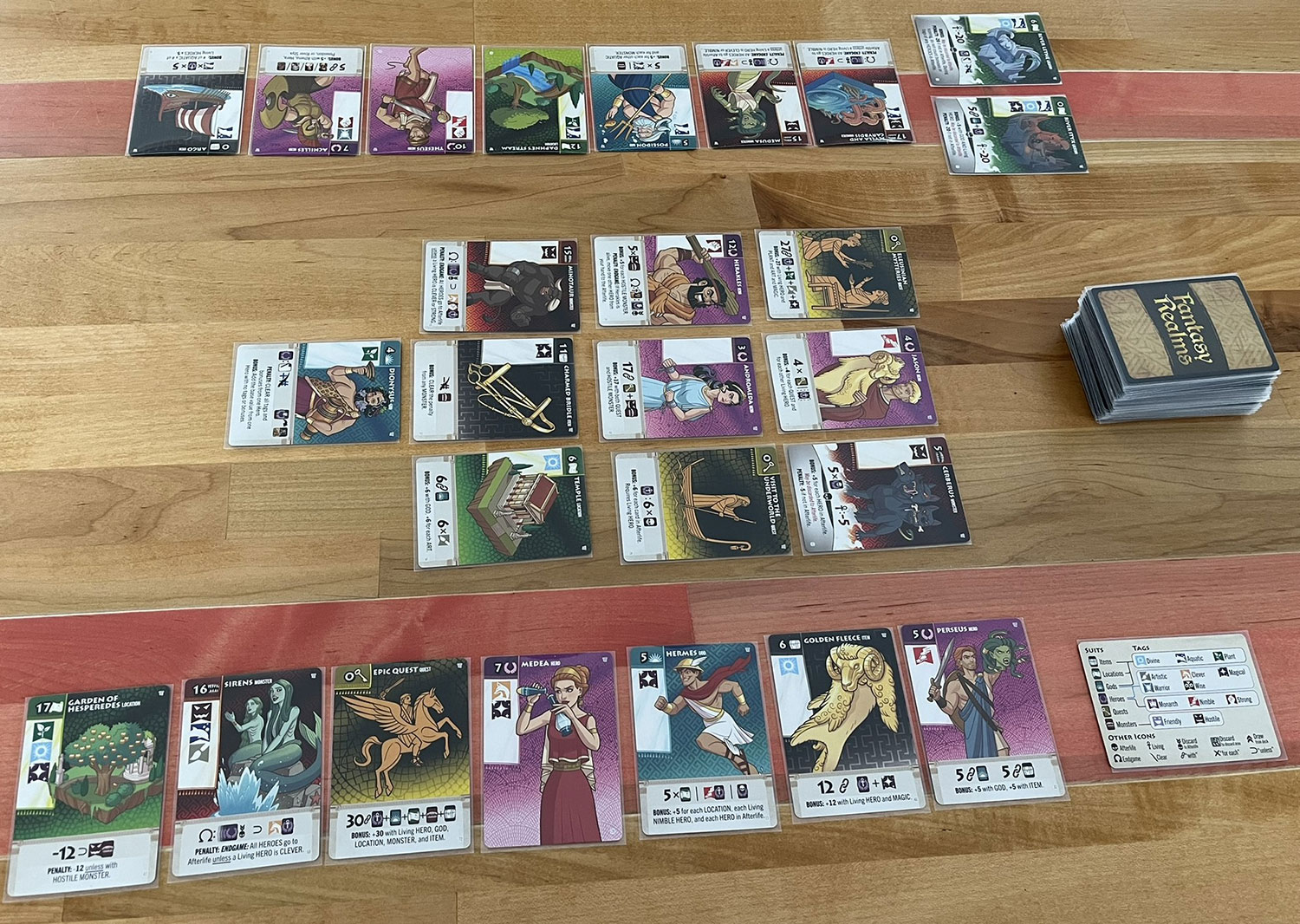 The table presence at the end of a 2-player game is shown here. The upper player has two cards in their afterlife in addition to the 7 cards in-hand.
Game Experience:
The first feature of Fantasy Realms: Greek Legends that jumps out is the new artwork, which has transitioned from generic and flat, to vibrant and thematic. Each suit is represented by both a color and a pattern evoking a distinct mosaic and/or art deco pattern, which provides depth. Every card is unique and depicts generally well-known people, places, and items from the Greek Legends, including Hermes, the Trojan Horse, and Mount Olympus. While art is subjective, I think most would agree that this is a vast improvement over that in OG Fantasy Realms. The theme is also well applied to these cards: Herakles is worth 12 base points. Poseidon scores for Aquatic tags. The Sirens send all your heroes to the Afterlife unless one has the Clever tag. It should also be noted that the bonus/penalty conditions on each card are described both symbolically and with text.
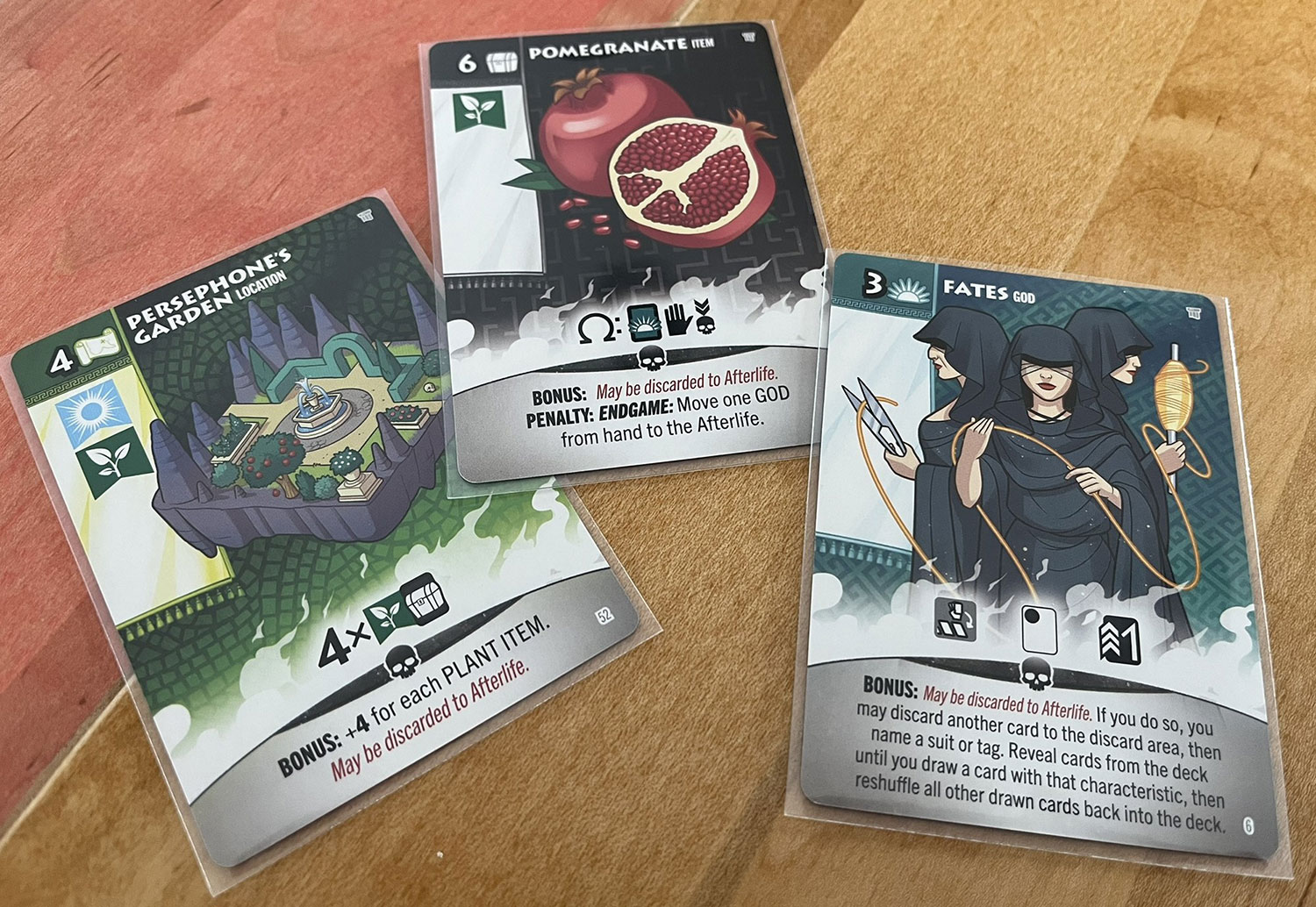 A sampling of cards that may be discarded to the afterlife are shown here.
As for gameplay, Fantasy Realms: Greek Legends feels very similar to Fantasy Realms, which is to say that it is still an addictively fun push-you-luck experience with a simple teach and challenging decisions. There are still plenty of moments where multiple fantastic cards, if paired together, become available in the common marketplace, and you must decide if it’s worth trying to take both over multiple turns; if another player takes one, or the game ends abruptly, there’s risk of making your hand worse.
The main mechanistically novel element is the afterlife, although this does not change the game overly much. The 10-point penalty for each afterlife card is quite harsh, meaning players need to have a good mathematical incentive to put cards there on purpose. I found players frequently ended the game with zero cards in their afterlife. But ooh, if you can manage to find a card with the right tag or suit that acts a point multiplier for several other cards in your hand, it feels rather satisfying to add it to your afterlife as an expanded part of your hand. This rarely happens with more than 1-2 cards. It’s also possible for someone to push their luck too hard and accidentally have several heroes perish in battle at end-game, netting them mostly negative points in the afterlife. I have yet to see any player successfully pull off a purposeful afterlife-dominated strategy using more than 3 cards.
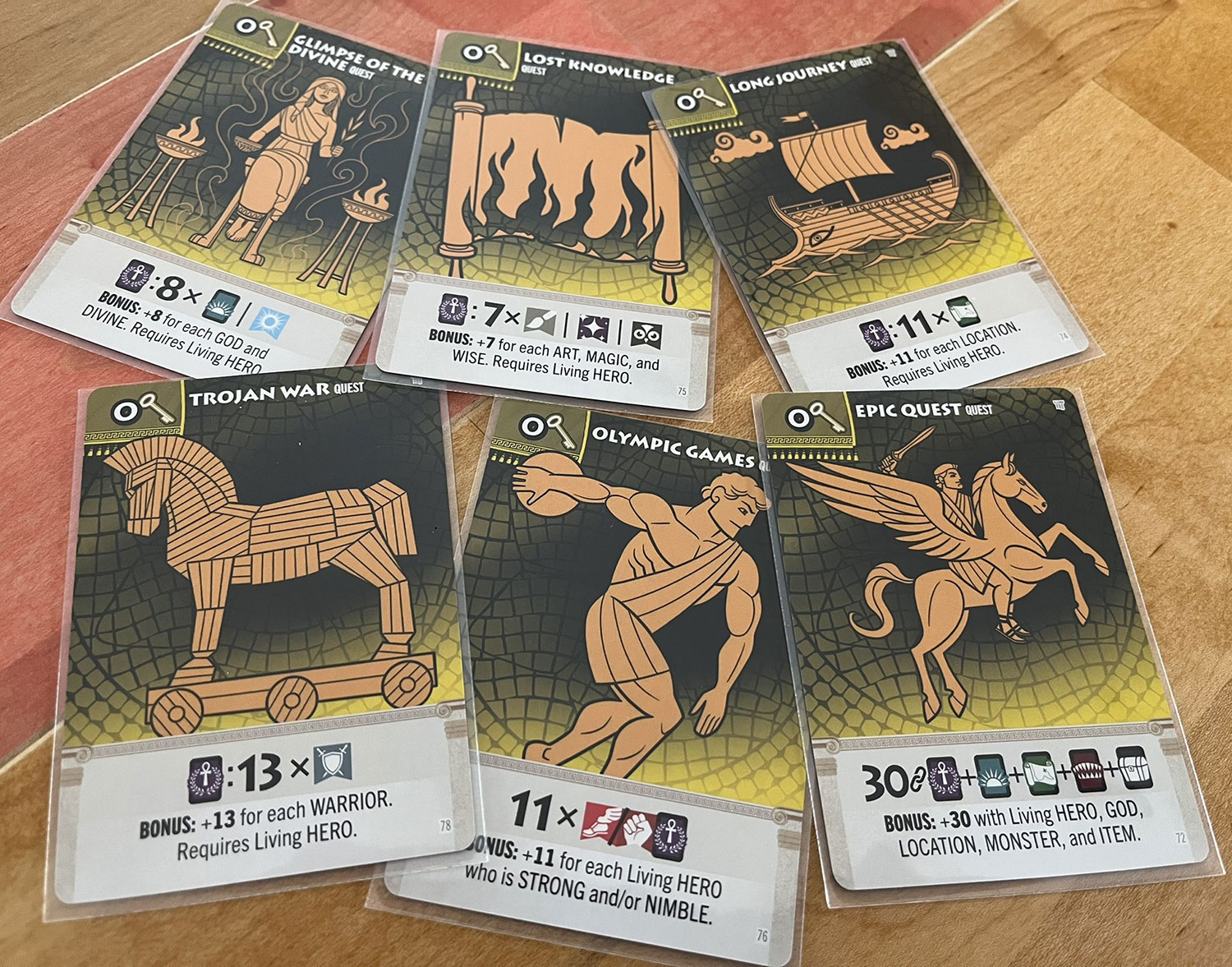 A sampling of quest cards is shown here.
Another aspect to note is that scores in Greek Legends tend to be less swingy overall. Gone are cards like “Candle” and “Gem of Order” that award 100 or 150 points if you can assemble the proper hand. There are 12 cards (of 53) in OG Fantasy Realms that demand at least one specific other card in-hand for maximal scoring. Cards like these require significant luck, although some players may love this high-risk, high-reward play style.
Greek Legends contains only 2 cards (of 73) that require specifically-named cards for maximal scoring. Instead, there are 11 Quest cards that are worth 0 base-points but can achieve greater value with set collection of certain suits and/or tags. For example, the “Olympic Games Quest” scores 11 points for each living Hero with a Strong and/or Nimble tag. The “Epic Quest” scores 30 points if you also have one of each of the other suits in hand. There are also plenty of other cards that confer smaller point multipliers, such as the Muses, which give 8 points per Art tag, or Ares with 7 points per Warrior tag.
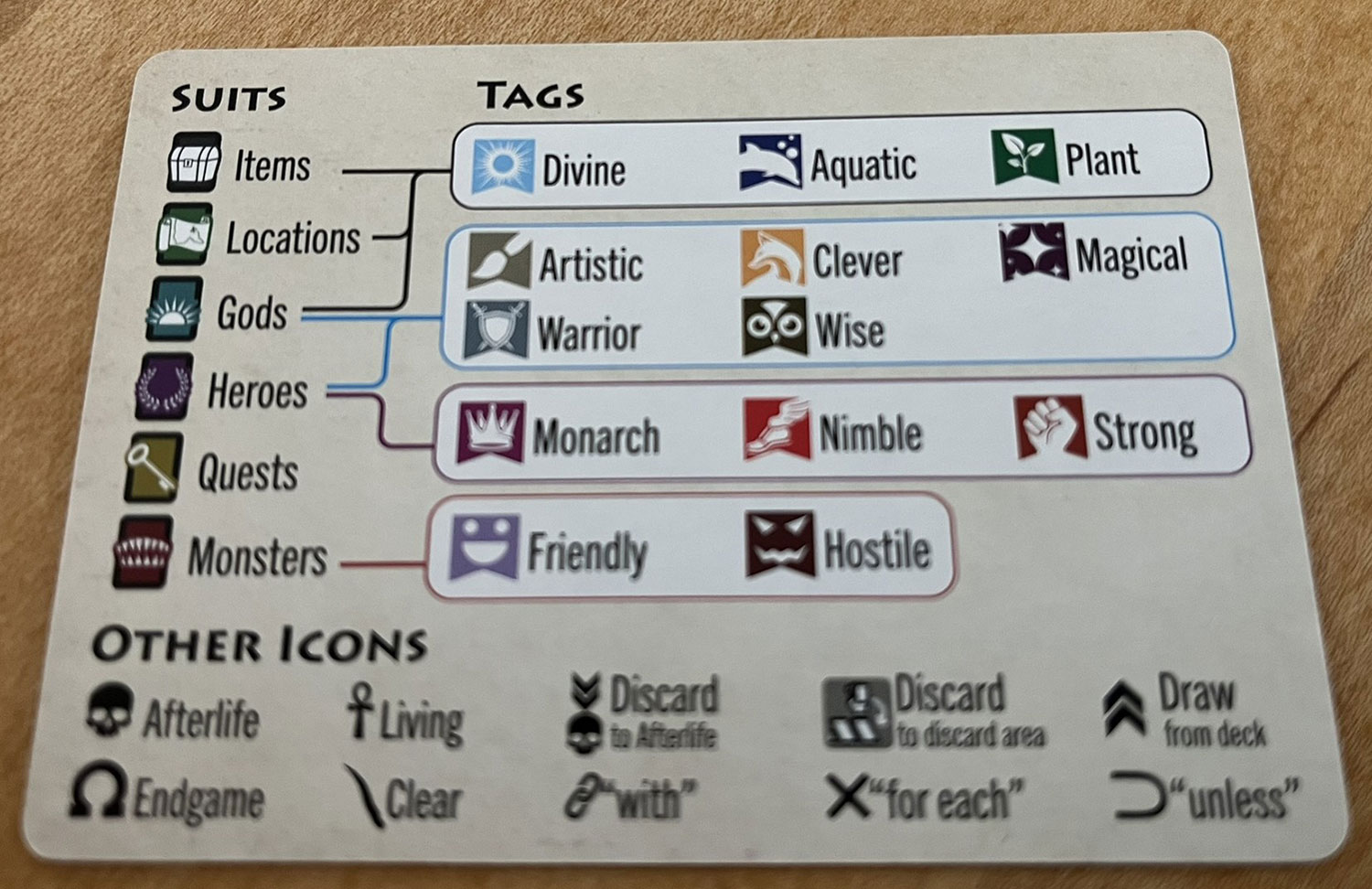 The player aids provide helpful reminders of iconography for the various suits and tags.
Are there downsides? Some may find it too mathy. Also, if you loathe luck in strategy games, you may dislike the somewhat random nature of the card draw. At higher player counts, you are likely to see more of the deck overall compared to lower player counts, so it may be easier to optimize your hand, but there is still a chance when playing at 4+ players, if everyone draws from the deck (rather than the discard pile), that the game can end rather abruptly. With 2-players, the timing of the end-game is more obvious.
Overall, I personally prefer Fantasy Realms: Greek Legends owing to the improved artwork, theming, and less swingy nature of scoring compared to base Fantasy Realms. Granted, this is a slight preference. The core gameplay of both games is fantastic, so if you’re looking for a filler for less experienced gamers, the slightly more complex ruleset of Greek Legends may not be worth it over the original.
Final Thoughts:
Fantasy Realms: Greek Legends is a card-driven filler game where players must mathematically and tactically optimize a hand of 7 cards by hoping for a lucky draw or the ability to pick up another player’s synergistic discards, before the game-end is suddenly triggered. With 73 unique cards, containing 6 suits, 13 unique distinct tags, and an opportunity to expand your hand into the afterlife, Greek Legends has seemingly endless card combos to cobble together.
The gameplay feels quite similar to the original Fantasy Realms, but the artwork and theming are much more exciting, the scoring is less swingy, and the complexity is a tad greater. Whether you’re already a fan of the Fantasy Realms series or someone looking for your next great travel-sized filler game, Fantasy Realms: Greek Legends brings a fun factor of mythic proportions.
Final Score: 4.5 Stars—this push-your-luck card-based strategy game has simple rules, crunchy decisions, and legendary fun
 Hits:
Hits:
• Elegant design: simple teach with interesting decisions
• Endless replay value
• Easily transportable
Misses:
• Cardstock is lacking for a game with frequent shuffling
• Scoring can take a while









 English (US) ·