
.jpg)
PROTECT YOUR DNA WITH QUANTUM TECHNOLOGY
Orgo-Life the new way to the future Advertising by Adpathway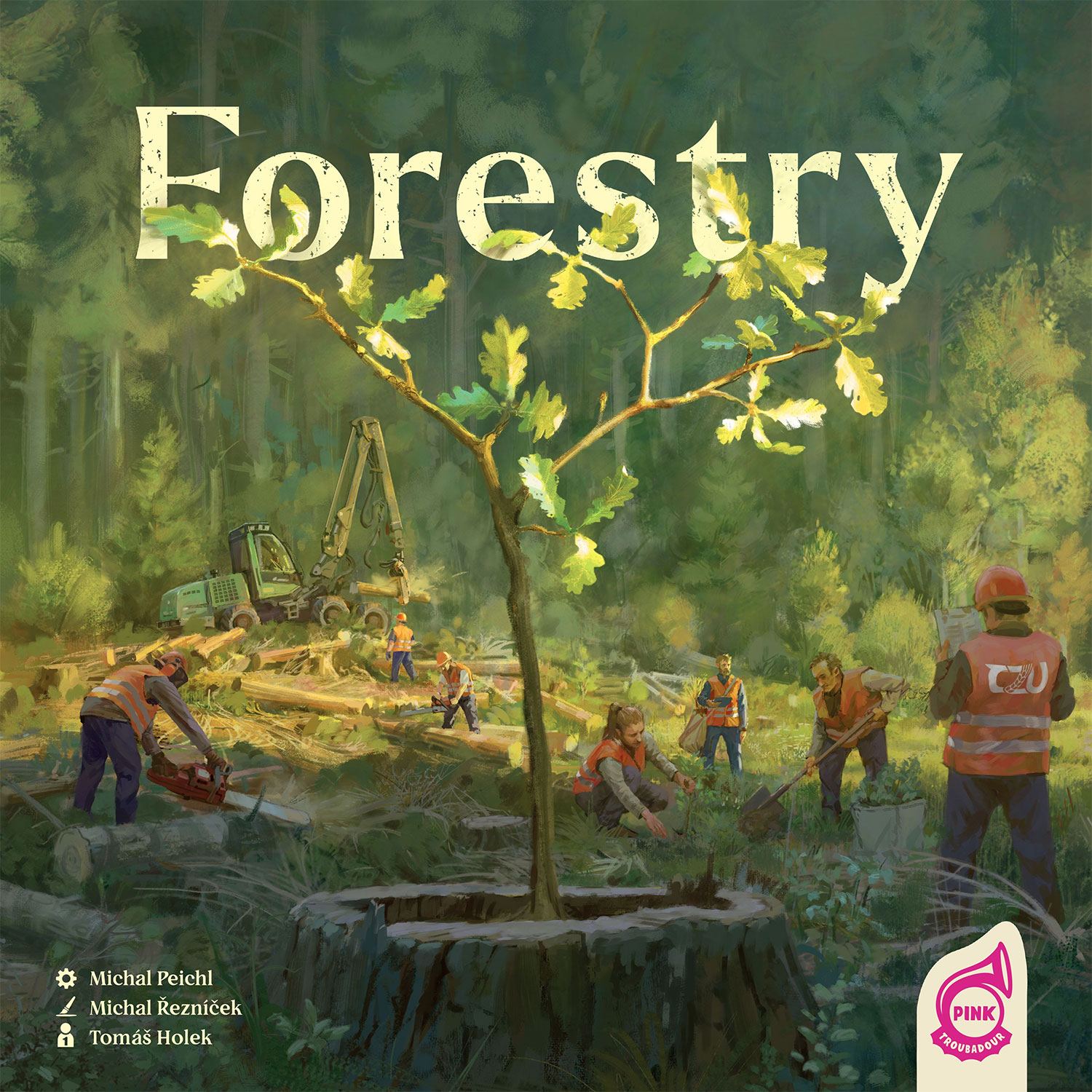 Wood is a common resource input in board games, whether it’s for building fences, buildings, or any of a number of wooden trinkets. There are even some games with wood-centric theming, like Woodcraft and Lignum, which delve into some detail about processing and manipulating wood to attain final products. These games typically treat wood as a mere resource, used unidirectionally to create some greater finished product, without care for how it was obtained. Heck, Glass Road literally contains a “slash and burn farmer” card to help players obtain wood.
This is where Forestry is different. Forestry is a medium-heavy contract fulfillment point salad Eurogame where 1-4 players compete over 70-120 minutes to not only complete wood-related contracts, but just as importantly, to act as forest stewards by replanting trees and tending to the various needs of the forest.
Gameplay Overview:
Forestry is played over 9 or 10 rounds, depending on whether players use the asymmetric characters.
Every round, players will use 3 action points (or more if earned) to accomplish a variety of tasks, each costing between 1 and 2 action points.
Tasks required to complete a contract include:
- Acquiring new contracts
- Harvesting trees
- Processing wood in up to 3 different manners
- Fulfilling contracts
Tasks related to forestry stewardship include:
- Obtaining seedlings
- Replanting trees
- Tending to the forest (in 3 different ways)
- Constructing reservoirs and meanders
- Constructing forest structures (observation posts, protective fencing, etc.)
Additional basic actions include:
- Moving around the forest or sawmill to accomplish the above tasks in the requisite regions
- Obtaining resources
- Obtaining task cards
At game-end, the most points accumulated from contracts, forest buildings, water-structures, task-cards, tending supremacy, and leftover resources wins.
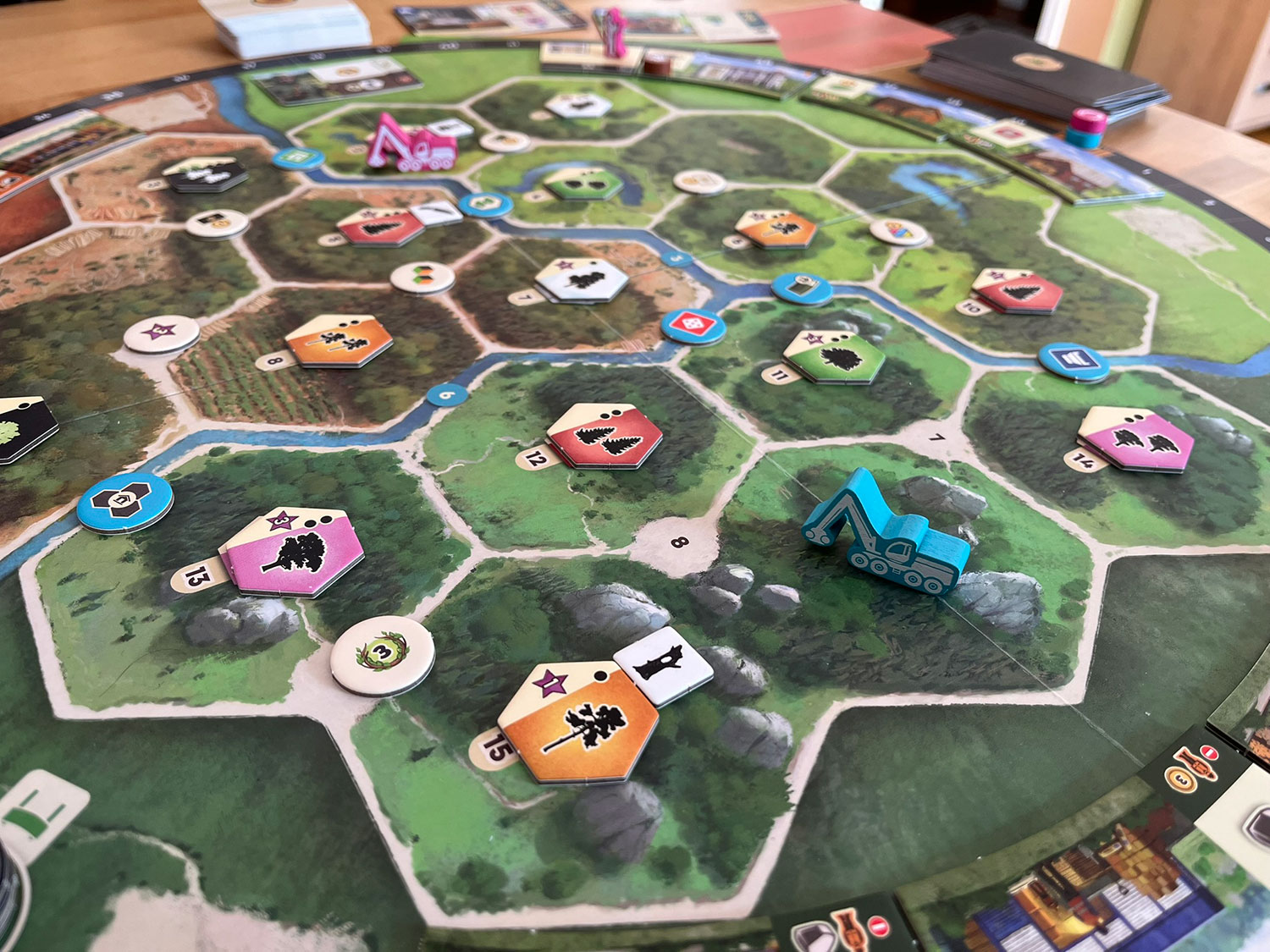 The central board at game-start shows at least some patches of availability for all 5 species of trees in the game.
Game Experience:
The first thing players will realize upon playing Forestry is how tight the game is on both resources and action economy. Over 10 rounds, players are guaranteed just 30 action points total, or possibly a bit more depending on when they can upgrade their player board. Notably, up to two additional action points can be purchased by players each round, using money. If your goal is to fulfill an advanced contract requiring four trees total belonging to three different species and subjected to 3 different processes, this could use up quite a few action points as follows:
- One point to obtain the contract.
- For each of three tree species, you’ll need to move your harvester to parts of the forest where those trees are located (3 action points for 3 movements total).
- Harvesting 4 trees will cost 4 action points total.
- Processing in 3 different manners (pickling, planing, and drying) will cost 3 more actions.
- Moving your sawmill manager to the appropriate sawmill room to undertake these processes is an additional 2 actions.
- Finally, fulfilling the contract requires one action point.
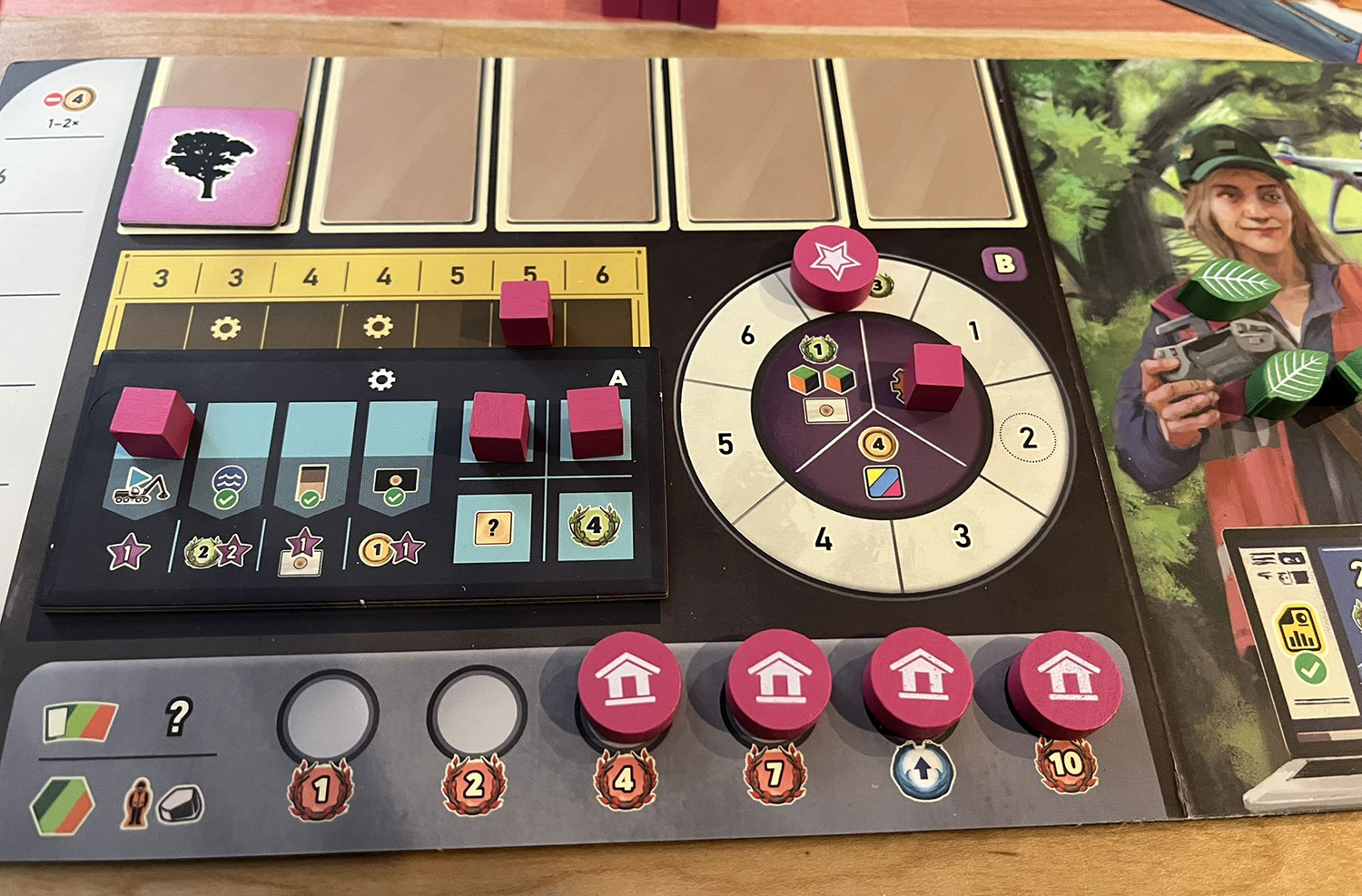 Part of a player board is shown here near end-game. They’ve managed to upgrade to 5-action points per turn, unlock 3 technologies, and construct 2 buildings.
That’s a potential 14 action points total for one contract, almost half of your guaranteed base action points. Of course, depending on the board-state and proper planning, this total could be adjusted higher or lower.
For instance, the trees you need may not always be available, so you may need to spend action points acquiring a seedling and planting it before you can harvest a desired tree. The timing of your actions is also important, since you cannot begin drying a spruce tree before you have cut it down. The final factor to consider is that there are multiple actions specific to each forest location and sawmill room that can be accomplished, so while you may have moved to a certain forest hex for the express purpose of acquiring 2 pine trees, while you’re there you may also want to tend to the forest and construct a certain building and/or water structure before moving on so as to conserve movement action points.
The good news is that while there are a lot of action points required to accomplish any given contract, there are also lots of ways to get some of these tasks done using built-in bonus actions found throughout the game, both on your personal player boards and on the main board. Many of these are single-use, however, so a key part of playing well is deciding when to trigger which bonuses for maximal effect. If triggered effectively, these bonuses can allow some great combo-tastic turns and completing 4+ contracts in a game. Of course, it helps that many contracts provide in-game bonuses like resources and money once fulfilled (in addition to points) that can save you some crucial action points. It often makes strategic sense to focus on simpler low-point contracts (like your starter single-tree contract) early-game and use their rewards to boost your resource reserves.
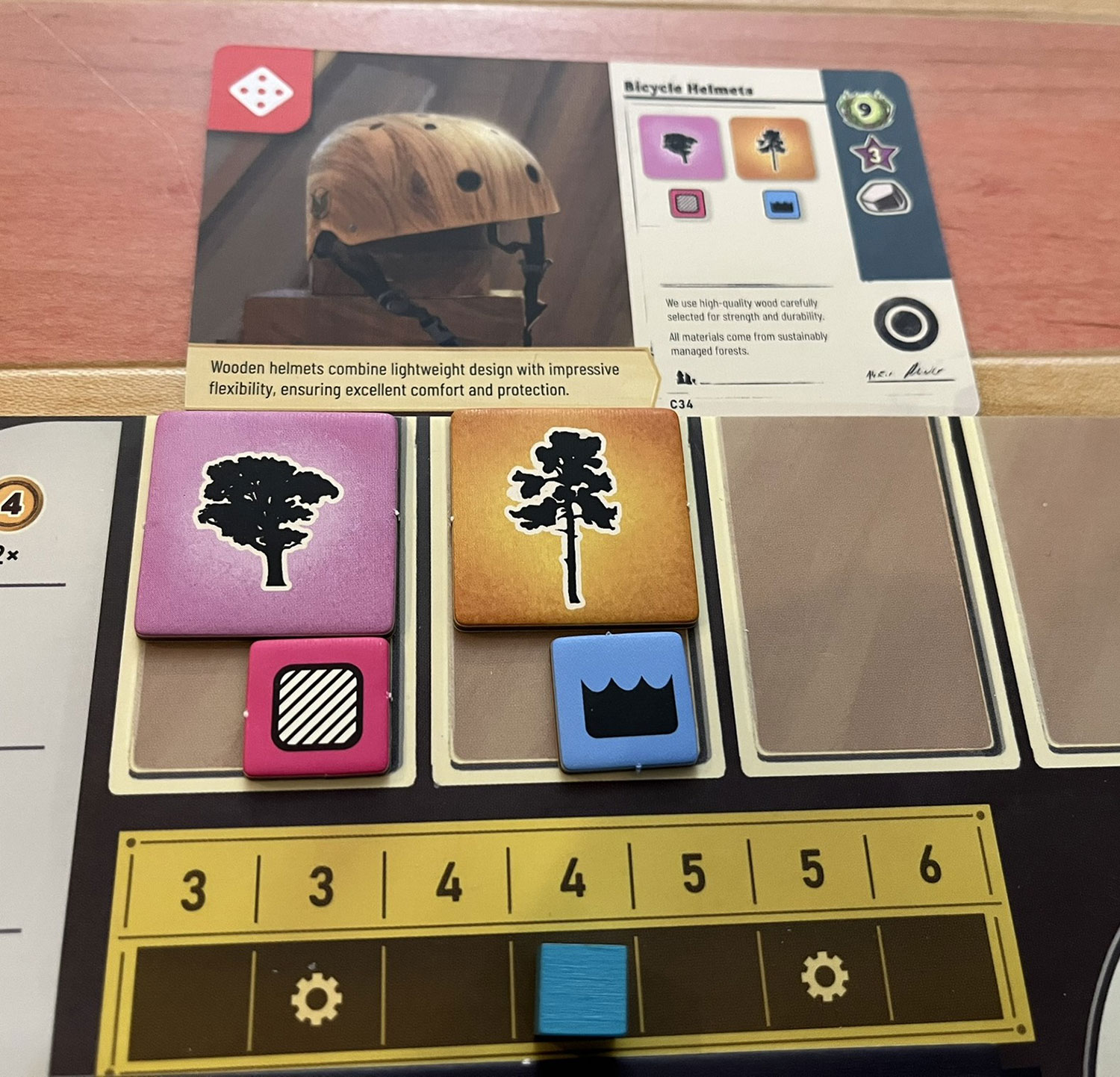 To fulfill this relatively easy contract for a bicycle helmet, both planed oak wood and pickled pine wood are required.
The game is not just about fulfilling contracts, though. Two other game elements that provide major points are water structures and task cards. Both of these award points for fulfilling various types of tasks throughout the game, ranging from constructing buildings in specific locations, planting trees in certain forest regions, and performing certain amounts of tending operations. This is the type of game where you do need to do a little bit of everything to gain those timely in-game bonuses, but long-term strategy is often dictated by scoring opportunities you’ve reserved on contracts, task cards, and water structures, so prioritization of actions becomes more and more clear as the game progresses.
As for player count, Forestry is a mildly player-interactive experience. Occasionally, an opponent will cut down the tree I wanted or claim a contract or token I wanted from the board. More players mostly add more downtime, though it is a thinky enough game with so much forward-planning that it still doesn’t feel too slow at 3-players.
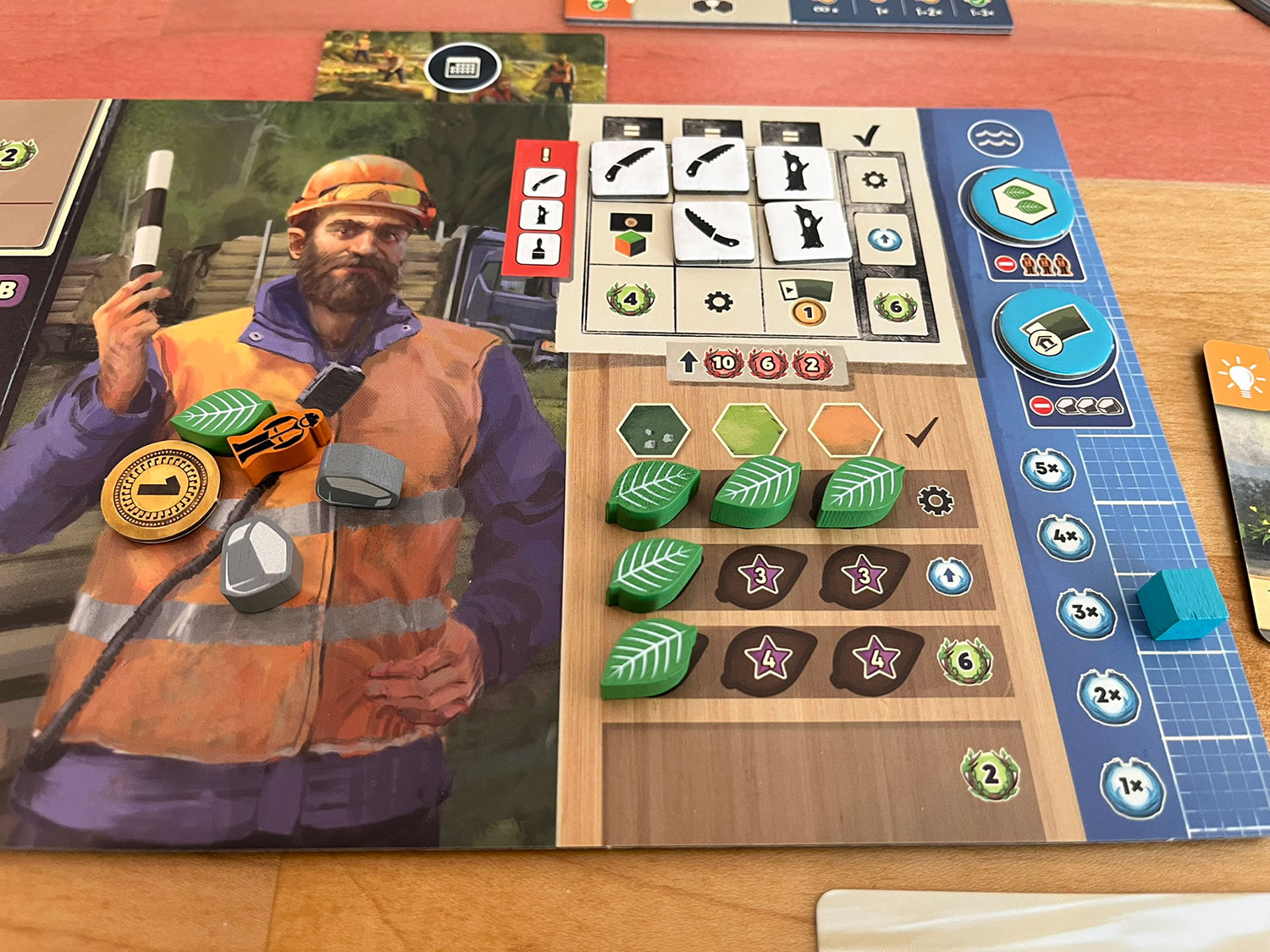 The right portion of this playerboard near end-game shows progress towards tending the forest, reseeding trees, and creating water-structures.
As for replay value, the various contract requirements, task card objectives, and randomized locations of water and building tokens in each game create a different puzzle with each play. Additionally, there are two different options for technology overlays that alter options for in-game bonuses. There are also 4 asymmetric factions that change the game experience and push players in various directions. They mostly seem to be balanced, though some are easier to play, and some provide rewards earlier than the others.
Any quibbles? In a game so tight, my tolerance for luck goes down, so I wish players had more options when taking task cards, possibly as a larger shared market. Finally, if it hasn’t sunk in yet, this is a very tight game with respect to both actions and resources, and some players will find that frustrating.
As a final note, the design team should be applauded for creating such an immersive thematic game centered on the idea of maintaining ecological balance. The rule book and cards are supplemented with text from forestry and wood sciences experts throughout, allowing players to fully understand the importance of the theme.
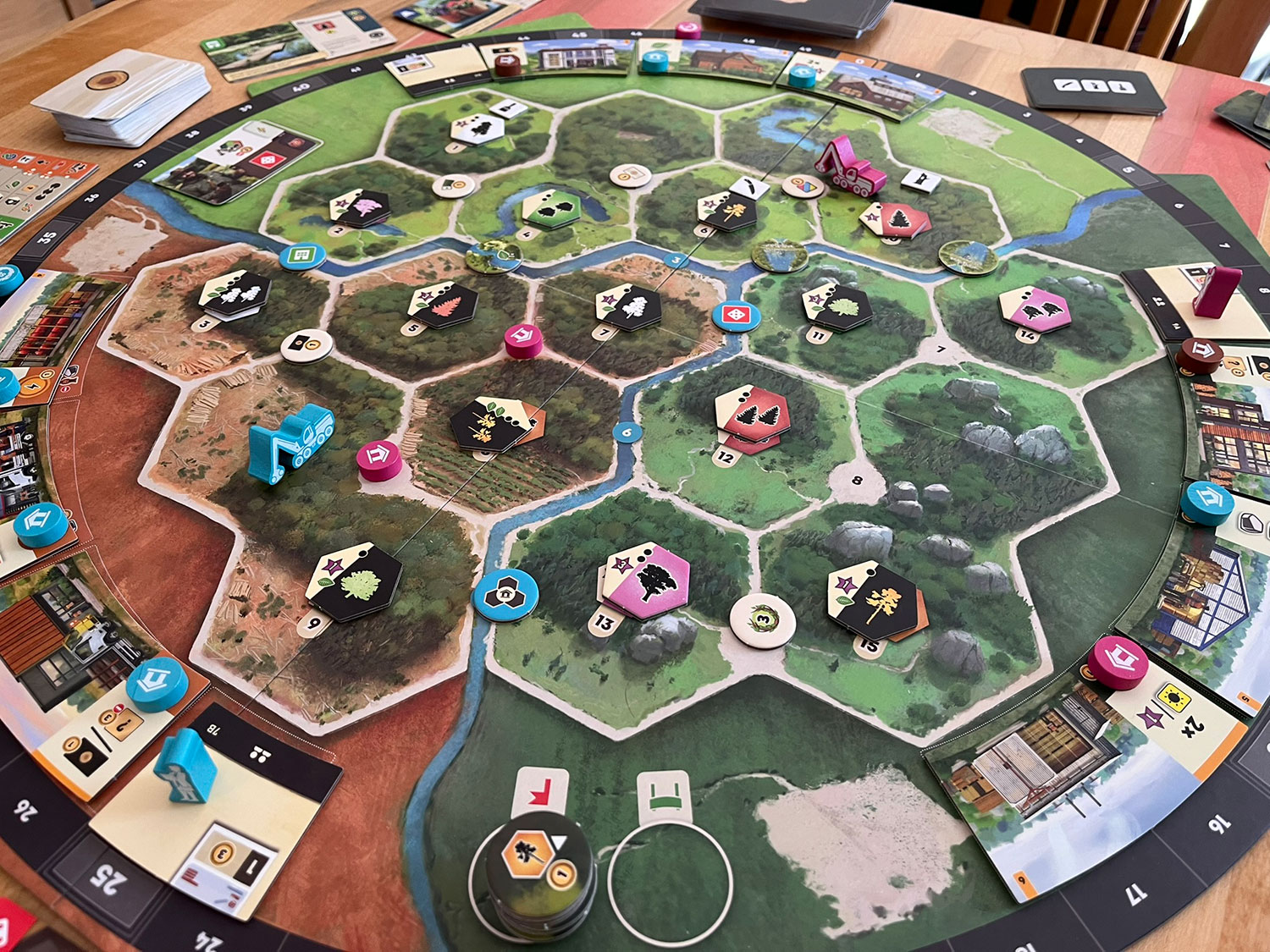 The central board at game-end for 2-players shows depletion of many forest regions (black-background hex tiles), as well as many upgraded sawmill rooms, and several newly constructed forest and water structures.
Final Thoughts:
Forestry is an excellent medium-heavy Eurogame where players harvest trees and process their wood to fulfill contracts while also working to preserve the ecological balance of the forest. It beautifully exemplifies how forests function as a renewable resource by intertwining mechanics associated with forest maintenance and growth with those of wood industrialization processes. The gameplay is incredibly tight in terms of both action economy and resources, so ample planning ahead is required and can be rewarded with some combo-tastic turns. Variable board set-up, asymmetric roles, and 2 player board technology overlays provide a challenging new puzzle for each game. The AP-inducing nature of turns and minimal player-interaction make this one better at lower player counts. For Eurogamers comfortable with tight gameplay, I don’t have to go out on a limb to recommend Forestry.
Final Score: 4 Stars — Balancing wood harvesting and forest stewardship in this immersively thematic medium-heavy Eurogame is a great seed for fun
 Hits:
Hits:
• Theme and mechanics are exquisitely interconnected
• Solid, occasionally combotastic Euro-style gameplay
• Nicely didactic production
Misses:
• Minimal player interaction makes higher playercounts suboptimal
• Some may find gameplay overly tight
• Somewhat fiddly set-up

/pic9148407.jpg)








 English (US) ·