
.jpg)
PROTECT YOUR DNA WITH QUANTUM TECHNOLOGY
Orgo-Life the new way to the future Advertising by Adpathway 2016’s Inis, designed by Christian Martinez, is easily one of my favorite games of all time, and my favorite drafting game ever made. Upon hearing that he was designing the second title in the “Political Trilogy”, except this time it was set in space, I was immediately interested; however, due to some concerns I had during the Kickstarter, I didn’t end up backing it. Were those concerns founded, or is Galactic Renaissance an overlooked gem?
Gameplay Overview:
In Galactic Renaissance, players aim to reach 30 Victory Points by completing Objective Cards, as set by “The Assembly” (aka a deck of randomly drawn Objective Cards). Players work towards these objectives on an ever-expanding board of planets they can visit and begin to occupy. Actions in the game are completed by playing Advisor Cards (their starting deck) and Specialist Cards (more powerful cards that are acquired through other means throughout the game). These cards’ abilities range from gaining more Emissaries (effectively control markers), moving Emissaries, building Institutes (which allow players to have more cards in their hand), scoring the Objective Cards, and more.
 Each Specialist cards has new, different abilities.
A unique twist found in Galactic Renaissance’s deckbuilding mechanic is that players place played cards at the bottom of their deck, instead of creating and then shuffling a discard pile. This prevents players from repeating the same action over and over again, leading to actions being generally more spread out throughout the course of the game. The other unique wrinkle to the game is that once a player hits 20 Victory Points, they cannot “gain” Victory Points unless they gain 10 in one turn: this means that players must gain the last third of their Victory Points in one explosive turn. While this may sound frustrating, because of the ever-expanding landscape of planets players can explore and influence, it’s not uncommon to see 15 or more points gained in one turn, if the other players aren’t paying close enough attention!
Program your Advisor and Specialist cards in your deck appropriately, gain Victory Points at the precise right time, and keep a close eye on other players to appease The Assembly all the way to your victory.
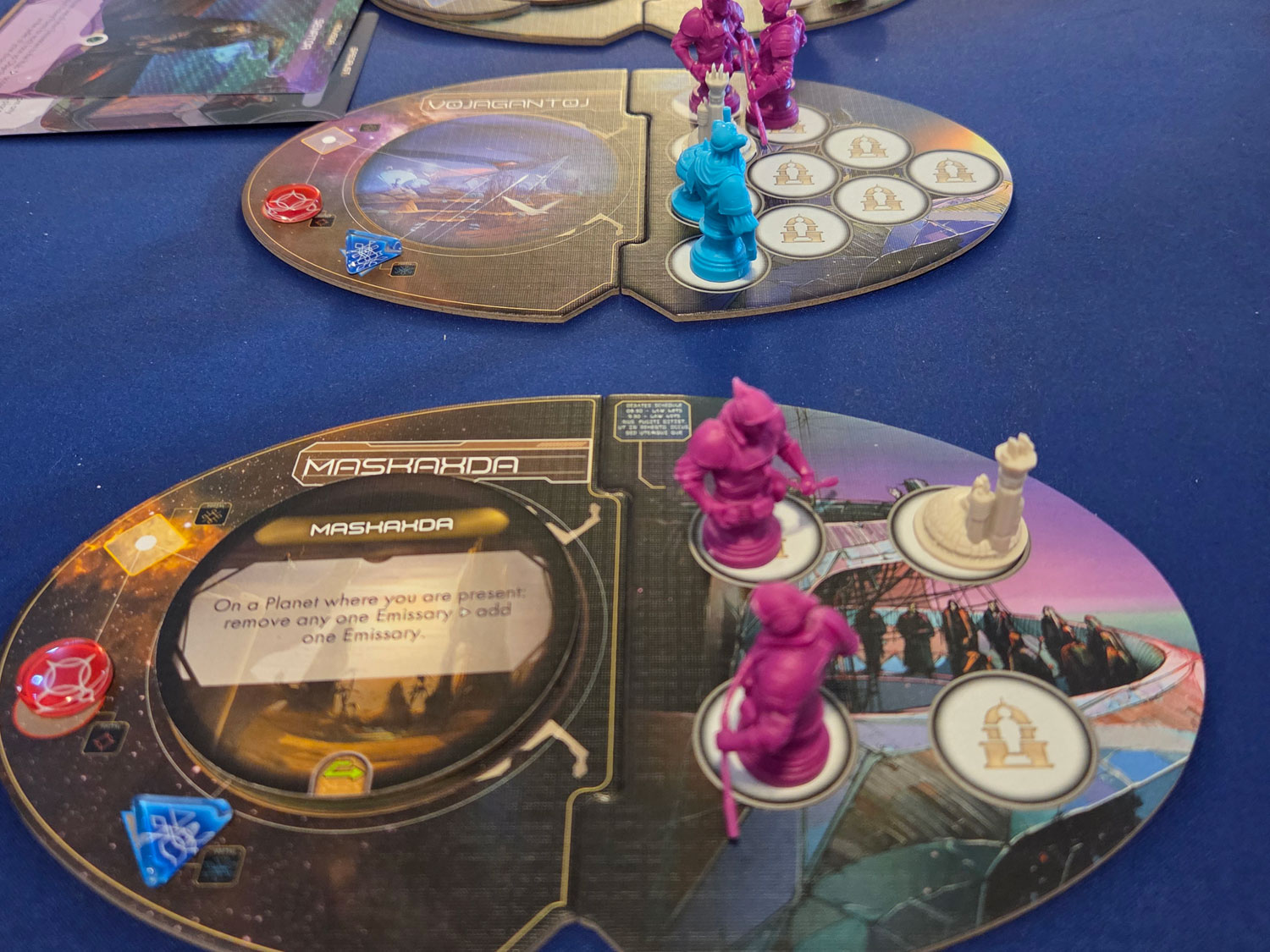 Each planet has different abilities and different sized influence zones.
Game Experience:
Galactic Renaissance is one of the few games I’ve played where the individual ideas presented are actually better than the combined final picture. Let’s start with the game’s Area Control mechanics. Most Area Control games seem to only care about the player who has the most control of a particular region, but Galactic Renaissance adds quite a few wrinkles to this formula. There are six different conditions that can matter on each planet regarding control: these vary from having at least two control markers present, to being tied for control, to simply having presence on the planet.
 The starting Advisors all players get.
Pair the nuances of the Area Control with the variety presented in the Objective Cards, and the game can really shine. Pairing an objective where players need to have two control markers with an objective where players get points for each pair of planets where they are present can lead to a quickly expanding, docile game. On the contrary, pairing an objective where players get a point for each planet where they are leading with an objective where they get two points for each planet they’re leading and another player is present can lead to exciting, tense battles and crucial timing windows for players to play their scoring cards.
However, the beauty of this scoring system, paired with the overall simplicity of the rules, means absolutely nothing to me because of the deckbuilding mechanic of the game. The fact that this is a deckbuilding game instead of a drafting game irks me to my core. Consider this: I see another player make a big play at several planets in one turn, ramping up to score. It is up to me or the other players at the table to stop them from scoring buckets of points… but neither of us has the singular card out of our eight in our hand to deal with this looming crisis, and they get to score their points uncontested. I could go on, but for a game that claims to be “political”, there seems to be almost no ability to negotiate or plan around other players because of the cyclical nature of our cards.
 Each planet is randomized with different influence sizes.
And to be quite honest, the 7 starting cards each player has seem to have defined points in the game in which they are objectively better to play. In two of the games that I’ve played, there was a player who literally couldn’t play either card in their hand because the one card needed to move their control markers to planets wasn’t in their hand. On the contrary, if another player had the cards in a much better order, then they could get an early start on scoring, get access to better cards more quickly, and lay claim to planets quicker, granting them even more actions and options on their future turns.
Finally, I need to address the production of this game. First, as with Inis, nearly every mechanic and idea of this game is some silly proper noun. I need to internalize what Emissary, Institute, Foundation, Strong, Present, etc… all need in order to even play the game, more or less succeed.
Also, this was a Kickstarter product from Matagot, which means there’s tons of bloated, uninteresting mechanics and ideas that go against the thesis of the game simply to add more “stretch goals”. And to top it all off, this may be one of the most frustrating rulebooks I’ve ever tried to learn a game from. On top of having no Index for the game’s dense lexicon, and not including any of the Kickstarter stretch goals component listing or mechanic explanation anywhere, the rulebook takes no time to explain core ideas or mechanics, instead leaving it up to “the rules are on the card”.
Final Thoughts:
Galactic Renaissance is the most frustrating type of game, because it could be brilliant. Most of the ideas presented are either brand new to this space, or underutilized by other games. However, because of the lackluster card play, boring card design, and random card draw, a game allegedly about politics comes down to absolute luck.
Final Score: 2 Stars – Please return this to the Renaissance Era.
 Hits:
Hits:
• Fascinating Area Control mechanics
• Snowball scoring keeps players engaged
• Fantastic artwork
Misses:
• Horrid production & rulebook
• Uninteresting, unengaging card play
• Stretch goal bloat











 English (US) ·