
.jpg)
PROTECT YOUR DNA WITH QUANTUM TECHNOLOGY
Orgo-Life the new way to the future Advertising by Adpathway When I play a board game, I like to pair it with a playlist. Forest Shuffle? There’s a playlist for that (bless you, whoever made it). But, Grand Central Skyport? I’m stumped. Do I go full retro-futuristic? Throw on some Around the World in 80 Days vibes? Still figuring it out. And, honestly, that ambivalence extends to my feelings about the game itself. Don’t get me wrong, I enjoyed the design by Dan Germain and the amazing artwork by Andrew Bosley. But will Grand Central Skyport make it back to the table? It’s complicated.
Gameplay Overview:
You’re running a major international Skyport, which sounds way cooler than it should. Your goal is to manage the arrival of new airships, build out new stations to increase capacity, and attract tycoons to support your venture. You’re racking up points through some nicely layered mechanics. Drop a card into your skyport, following some set collection rules, move around a rondel based on the card’s value, then take an airship, a station, or a tycoon from where you land. Some spots provide additional bonus points or card movement.
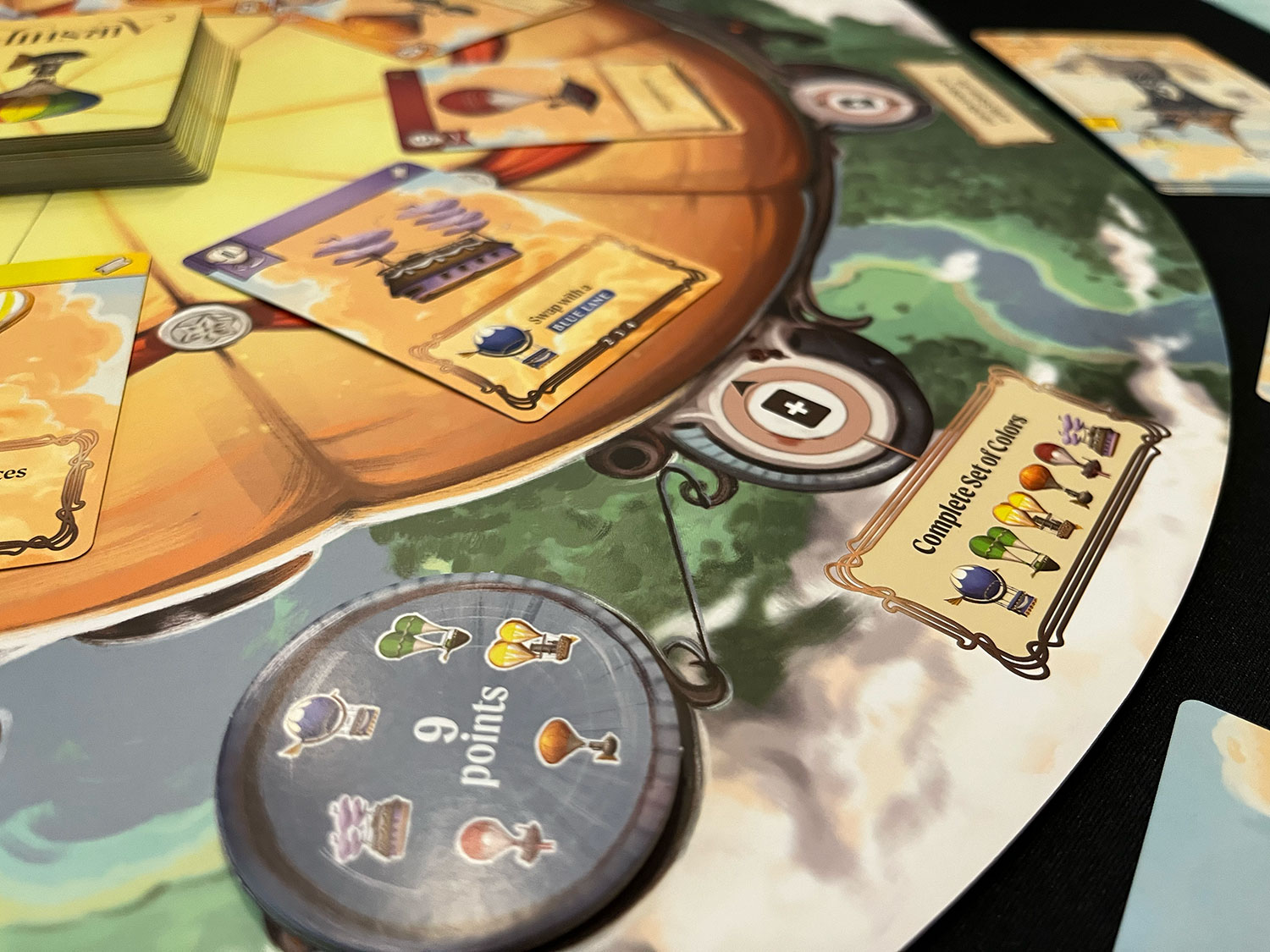 A ship of every color is worth 9 bonus points to the lucky first player to accomplish this goal
Your skyport has dual-colored stations that score when airships of the same color land in a corresponding lane next to the station. Getting a couple of tycoons to help boost your score or change the placement abilities doesn’t hurt. But, there’s a catch. Each airship card’s ability rarely allows for getting an airship next to the intended station on the first go. Your success relies on choosing the best card at the best time to best organize the busy airship traffic around your stations.
Play ends when someone reveals the station closing card and triggers a final turn. Players then multiply stars by airships, catch some Tycoon bonuses, and it’s the final tally.
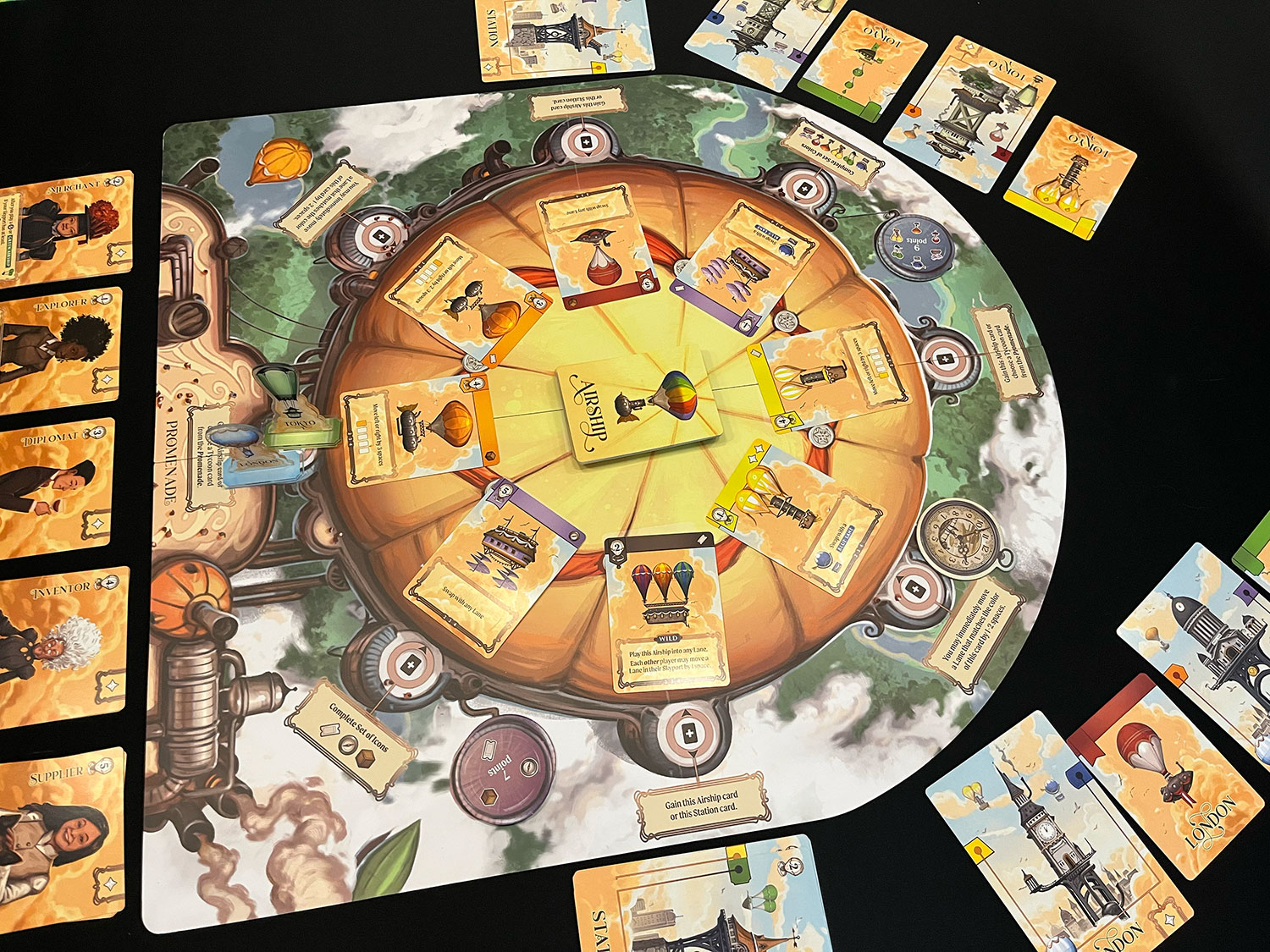 The theme comes alive with great art and design
Gameplay Experience:
Full disclosure: I’ve enjoyed every game of Grand Central Skyport I’ve played, whether at 2 or 4 players. My gameplay companions? Not so much.
Grand Central Skyport is puzzly. But it’s also got a light measure of chance and chaos built in. Sometimes cards vanish into opponents’ hands right when you need them. That perfect station you were eyeing? Gone. I find this tactic-switching a fun challenge. My “plan three moves ahead” friends find it more frustrating than fun.
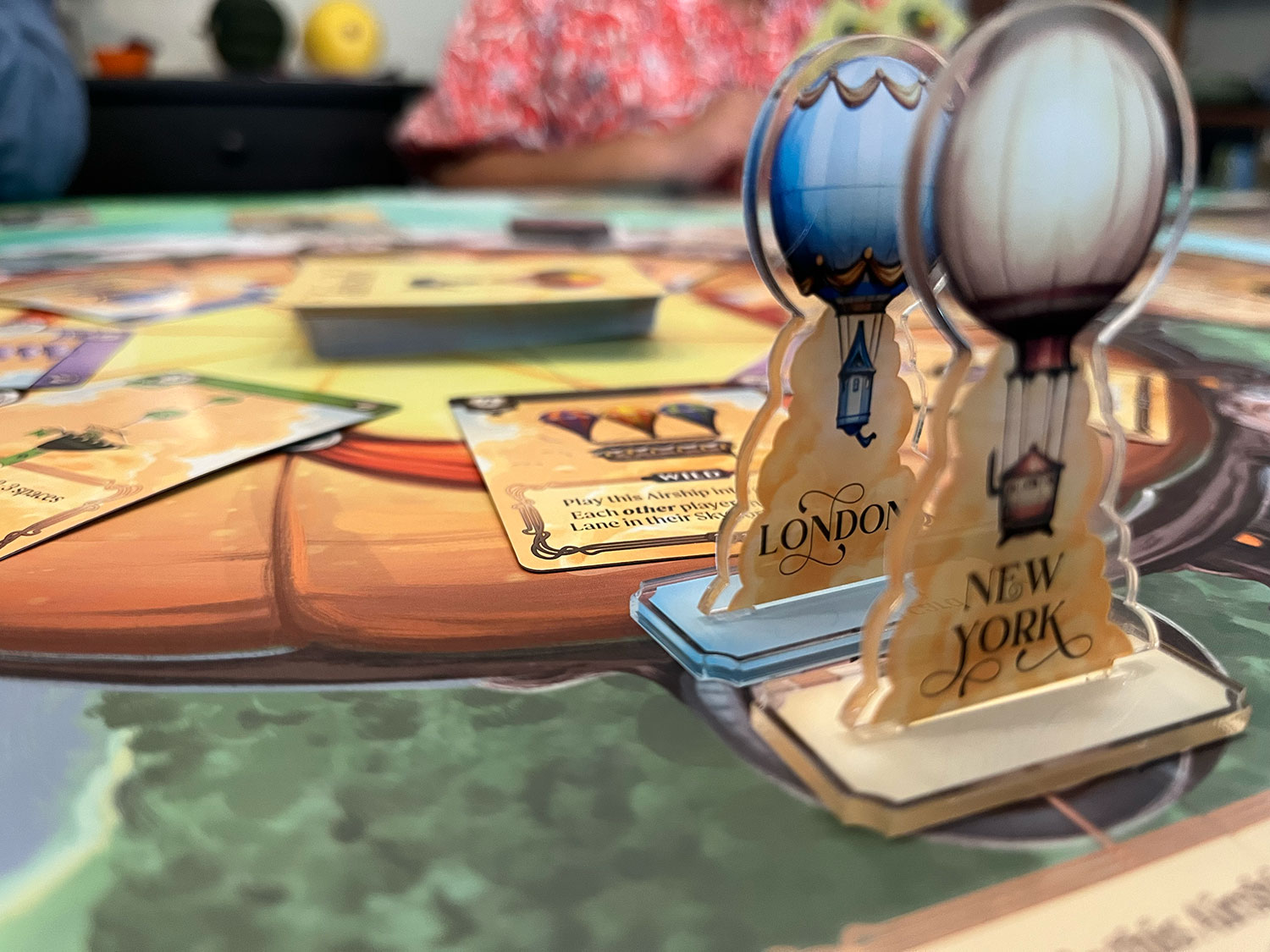 Two player can occupy the same spot preserving choices at higher player counts
The airship cards are doing four jobs at once. The bottom of the card tells you how to land (enter right or left, move the airship 2-3 spaces, maybe swap lanes). The upper left shows your rondel movement. The upper right has end-of-game scoring (some icons also allow you to trigger Tycoon abilities). Oh, and there’s also the color of the card. New players take a couple of rounds to take it all in. Airships are pictured with stylistic differences for those who experience difficulty identifying card colors. Overall, the rulebook does a fantastic job of laying this all out for new players.
For comparison, as I was pulling together my thoughts about Grand Central Skyport, my partner and I happened to be playing Dune Imperium. He insisted that its cards are “way clearer.” But I’m not seeing the difference.
I also appreciate the design choice of Germain to limit the hand size to two (there’s a Tycoon who provides a third). This limiting factor really leans into those tactical choices. Sometimes you’re going to have to blow up your plans, and the fun is in putting your skyport right again, knowing that the station closing card might be turning up.
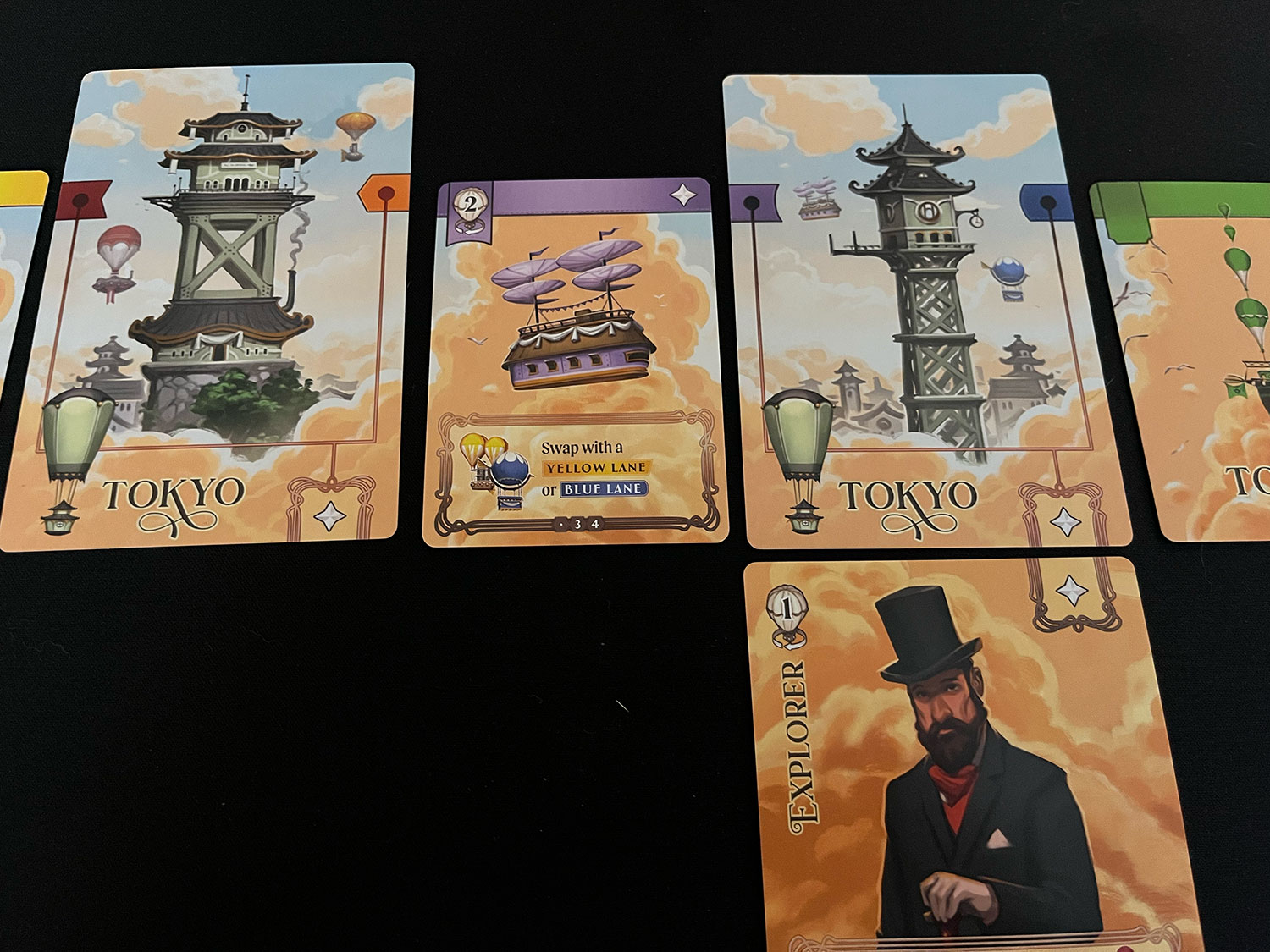 A puzzly set of airships and tycoons
Two-player games feel more like open skies. There’s less elbowing for position, and resources don’t feel as scarce. At four players, call air traffic control. Suddenly, everyone’s in a race for bonus points and Tycoons, and table space. That’s part of the fun at four, actually. With only three of each type of Tycoon, it’s pretty common to have an unlucky 4th player.
Grand Central Skyport’s table presence is stellar. Bosley’s art conjures an alternative timeline where blimps cruise the skies and airplanes are relegated to history books. Each starting city station evokes iconic architectural styles. Fair warning: Grand Central Skyport is dining room table-sized, not coffee-table-sized. I stood up several times a game to see cards hiding across the rondel.
Games clipped along nicely at 30-60 minutes play time. I always wanted two or three more turns when the station closing card appeared. I get the same feeling with Lost Ruins of Arnak. My scores rivaled or bettered the rulebook example, which I’m counting as a smooth landing.
Final Thoughts:
Grand Central Skyport is best for game players who prefer a quick, puzzly set collection. Its light interaction and tactical gameplay may not appeal to groups whose game nights are filled with uproarious interaction or deep strategic planning. Game-design limits push you to make choices you’d rather not and watch for the right opportunity to put it all right again. I enjoy 30-60 minutes with appealing artwork and design, a little less head-to-head take that, and a placement-points puzzle. Grand Central Skyport offers this experience. I still haven’t worked out the playlist (looking forward to some good comments on this). Ask me to play Grand Central Skyport and I’ll say yes. Ask me what I want to play, I’ll say, “Tir na nOg, anyone? There’s a great playlist for it.”
Final Score: 3.5 Stars – Grand Central Skyport offers solid gameplay for puzzle lovers and tactical thinkers. At four players the game is lively and engaging; two players will find more space for optimization. I enjoyed the game, but I’m not sure it will fly off my shelf, especially if my group isn’t keen to play.
 Hits:
Hits:
• Puzzly set collection
• Gameplay design choices and artwork
• Light tactical chaos
Misses:
• Tactical game play may not suit some players.
• Not a gripping game experience
• Requires a big table space

/pic9148407.jpg)








 English (US) ·