
.jpg)
PROTECT YOUR DNA WITH QUANTUM TECHNOLOGY
Orgo-Life the new way to the future Advertising by Adpathway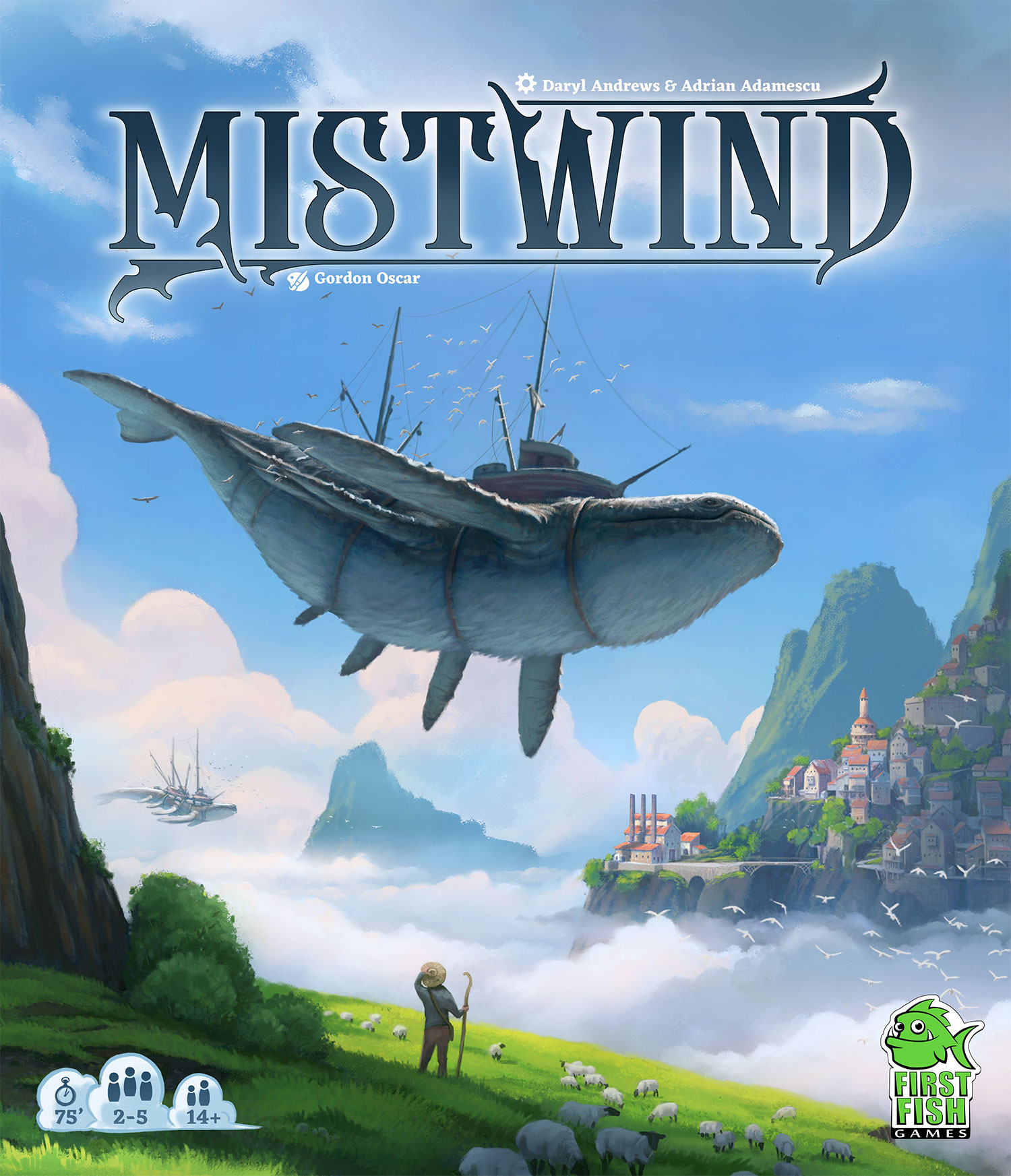 In the farthest reaches of the world lie the Mistwind Islands—floating isles above a sea of fog mist. Whales soar above that fog mist, diving down to feast upon abundant krill. Fungus farmers in dive suits harvest mushrooms in the gray gloom. Towns sprout up on every landmass with a sliver of sunlight.
What’s that you smell? The scent of money, ripe for the taking? That’s right, baby, strap a saddle on that flighted whale, we’re exploiting it for dollarbucks!
Mistwind, from Adrian Adamescu and Daryl Andrews, with art by Gordon Oscar, and published by First Fish Games, is a 1-5 player pickup-and-deliver game that takes about two-and-a-half hours to play. It is heavily reliant on player blocking, and plays best at three or four.
Gameplay Overview:
In Mistwind, you take the role of Head of A Trading Company. You are tasked with training whales, building outposts, and gathering and delivering trade goods to happy customers all across the mystical Islands. To do so, you’ll need to carefully manage your resources and plan your delivery network.
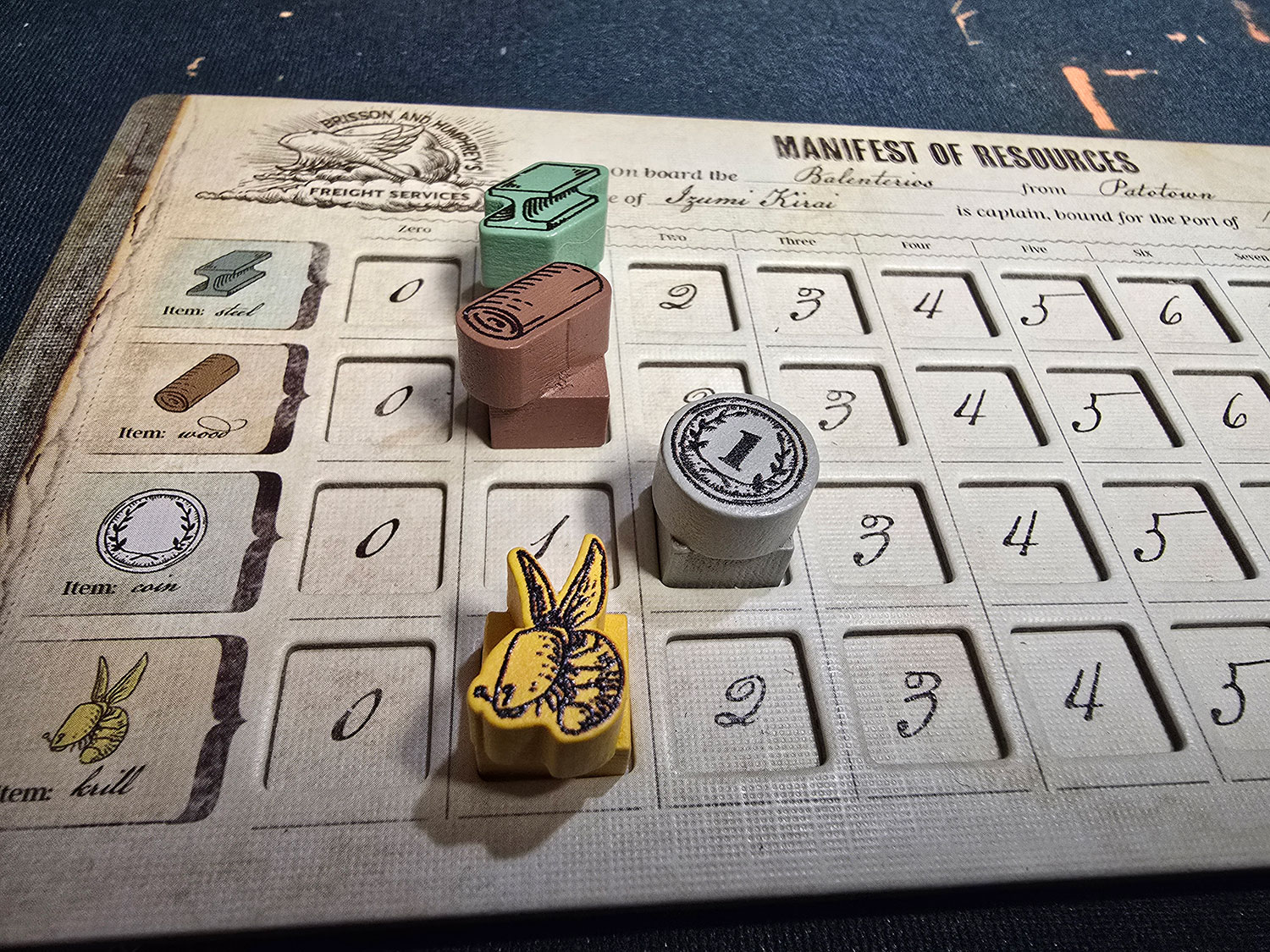 Deluxe resource tokens on the dual-layer player board. Each player board features a unique company name and whale boat title.
Players take turns placing Action Discs (numbered 1-5) on one of the four action selection areas. There are two fixed side boards (the Resource board and the Labo(u)r board) where actions don’t change, and two areas for card actions (Character and Port decks), which refresh each round.
Each action area has spaces numbered 1 to 5, with the higher numbered spaces corresponding to more powerful actions. Each Player’s Disc and the action space selected must match.
Each round begins with the players selecting one Action Disk to discard into a communal pile, out of play for that round. Then, beginning with the first player and proceeding clockwise, each player will select a numbered Disc and place it on the action they desire.
Actions include collecting resources, buying new patrons for your company, performing work (like building outposts, or stealing the first player token), to visiting Ports for special bonuses.
After placing a Disc and performing the action, players may then Move their whale transports, Load/Unload goods, and Claim rewards. Turns proceed clockwise until all players have used all four available Discs.
 Transports and outposts on the game board
Game Experience:
Have you ever played a worker placement game where you desperately needed an action space, only to be beaten to that spot by everyone else? Did they sneak glances over their shoulders at you and snicker about it? Was that your favorite part of the game? Mistwind may be just the game for you.
The tension at the start of each action selection phase is the best part of the game. Trying to guess what your opponents will target, and either blocking them or going for your optimal move, is a fun choice.
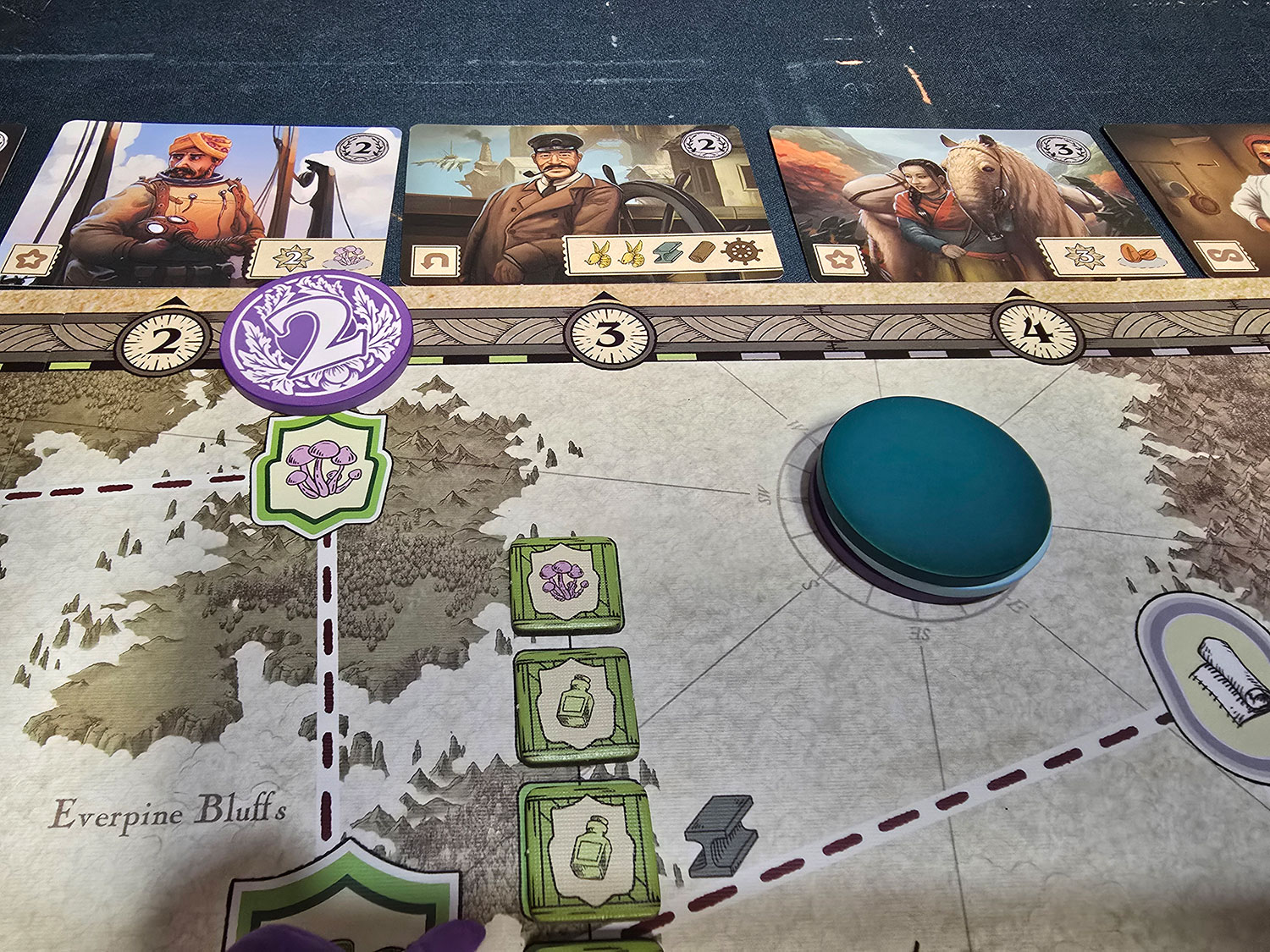 Some available Patrons for purchase
Mistwind has 20 available actions, 15 of which cannot be shared. During gameplay, there is a rush to grab action spaces that can only be used by a single player. Each round fizzles out somewhat with begrudging Port action placement, because those are the only spaces that can hold more than one player disc on a single spot.
There is a slight incentive to wait to place your disc in the Port as well, because the player who placed last on a space there (top disc in a stack, if there is one) gets a Port Bonus, which can be a nice boost to your game.
Mistwind is a network builder. You’re incentivized to build a large trade network for points, and there are interesting decisions to be made to get there. However, your first placement can really influence your game depending on whether you’ve left yourself enough access to customers and resources.
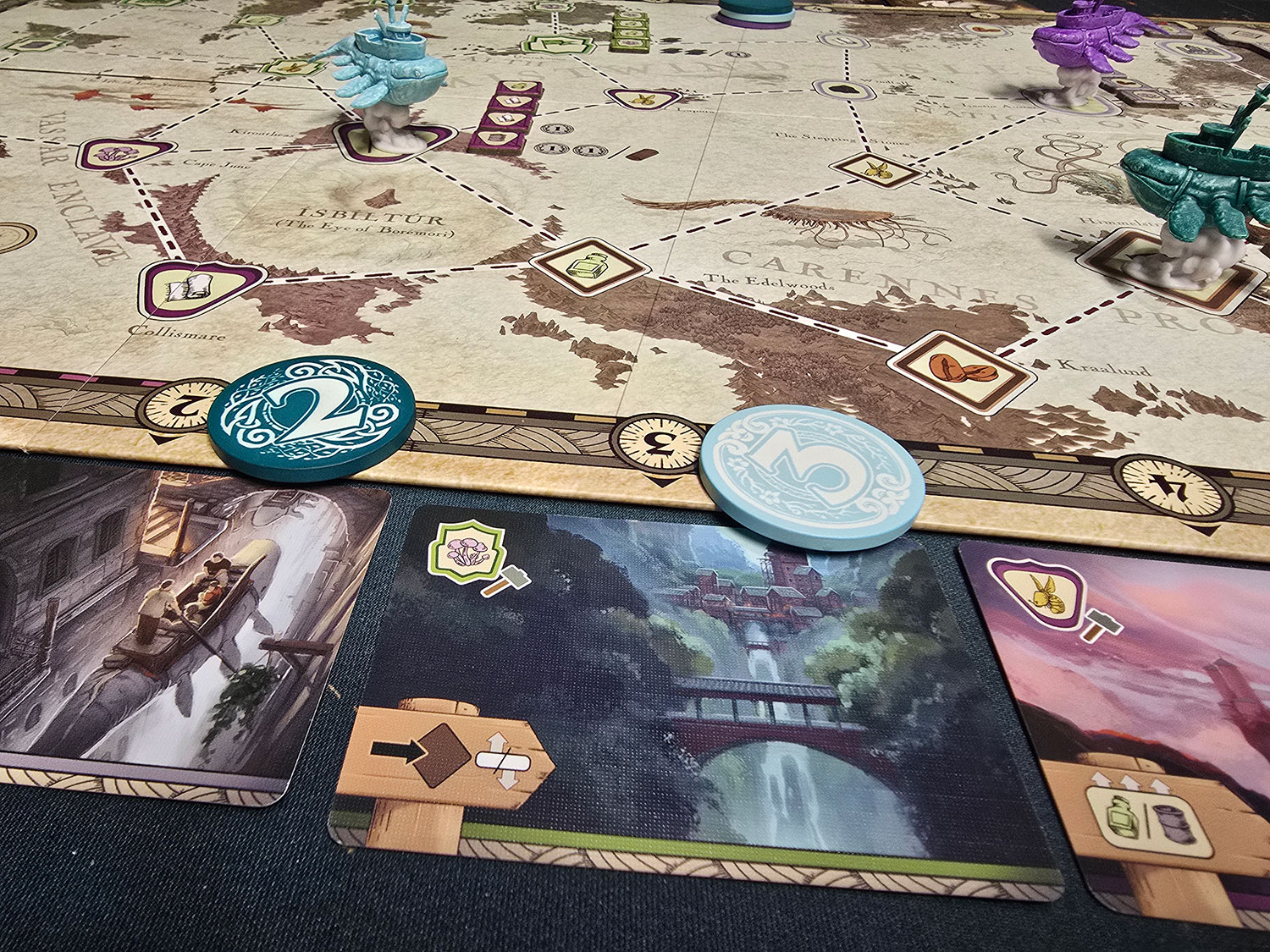 Port cards give extra action abilities, and useful bonuses if your Disc is on top at rounds end.
Moving your flying beasts of burden costs krill, and you can stunt the growth of your Company if you don’t have good access to that fuel food. There are ways around this. Each space where you build an outpost comes with a Krill’s Junior franchise where your whales can chow down on their way to the next stop.
You can build outposts and train new whales by spending resources, either coin or steel+wood. The more you build, the larger your network is, and the easier it gets to move your whales.
Your game is driven by attempting to fulfill both public Achievement and Network goals, and private Network goals. These provide a chunk of endgame points. Additionally, Territory Ports and Capitals will have goods requests that, when fulfilled, grant small amounts of points.
The game is fiddly. There are some port card bonuses and patron abilities that would be indecipherable if not for the included glossary. Knowing when you have to pay krill for moving and when you don’t can be difficult to track.
At the end of the game, you tally points for all that you’ve accomplished, and the winner is the one with the most points.
Solo Experience
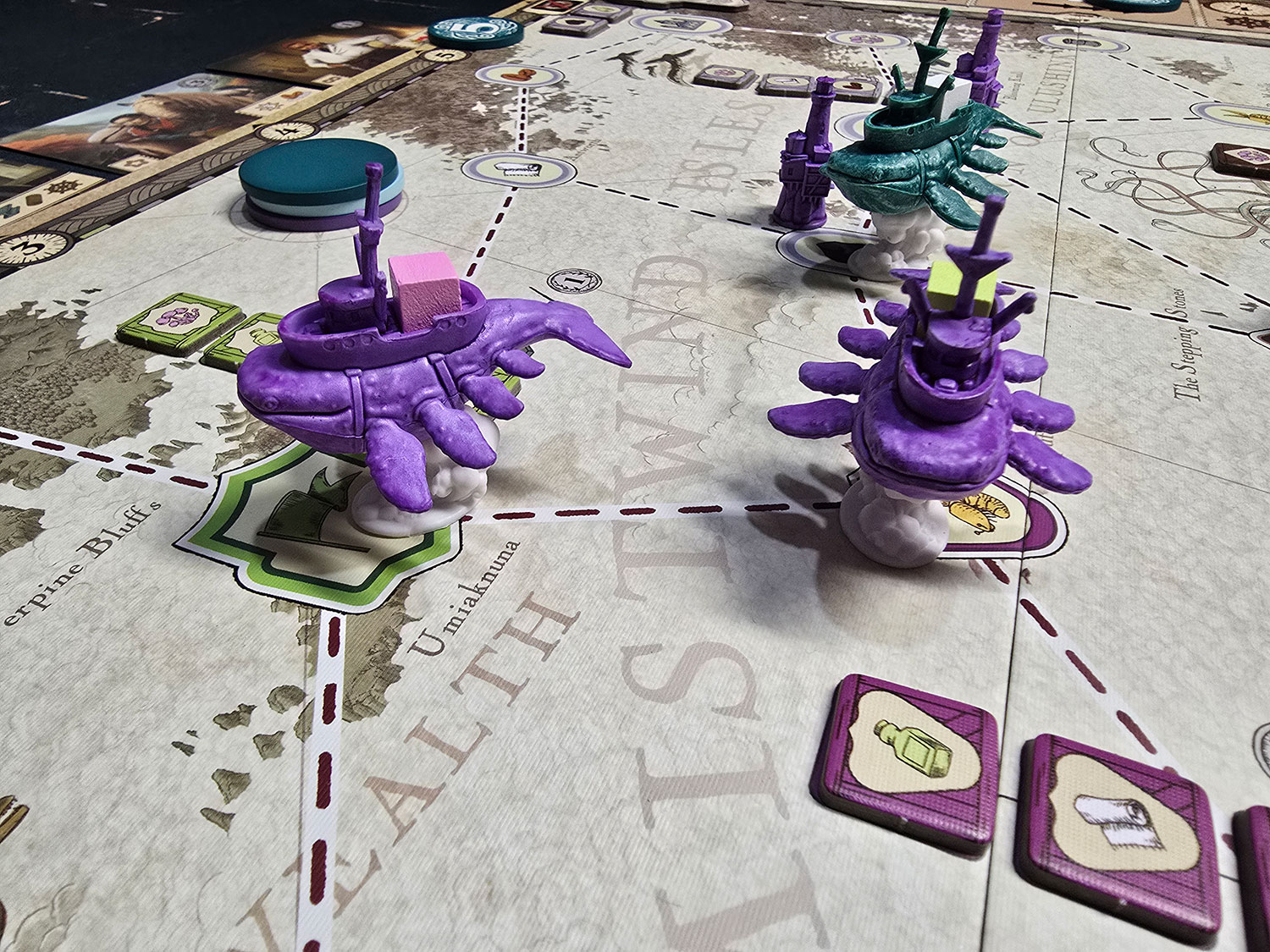 Transport whales loaded with goods to deliver
In the solo game, you take three sets of discs to simulate Automated Players (APs). You randomly discard one disc blindly to the communal discard, shuffling the remaining and then placing a disc on the matching numbered space. This placement starts on the Resource board, and proceeds clockwise if the spaces are blocked.
All three APs will do this. Only then will you get to take your turn. But hey, you get to start with extra krill as the last player.
It is painful. The best part of the multiplayer game is the tension of making a silent bet that your opponents don’t want the critical space you are gunning for. This solo mode removes that entirely, and instead makes the game a slog of mitigating the damage inflicted by the idiot robot(s).
Final Thoughts:
Mistwind is an interesting blend of action drafting and pickup-and-deliver. The tension that’s created during the action selection phase is the best part of the game, and can lead to some fun in-game drama.
That drama, however, is ripped away in the solo game. Whereas in multiplayer you can blame a friend who clearly needs krill, in the solo game, your only solace from the soulless bot-blocking is trying to puzzle your way out of that quagmire. It is more frustrating than rewarding.
This game suffers from Kickstarter syndrome. The components and production quality are wonderful, but the game itself is not special. I found myself wondering if it would be as enjoyable with cardboard bits, and the answer is no.
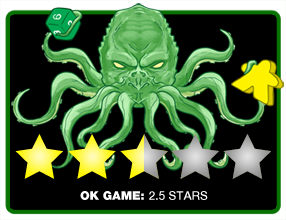
Final Score: 2.5 Stars – Mistwind is an unremarkable take on pickup-and-deliver, with gorgeous production.
 Hits:
Hits:
• Artwork and table presence
• Take that! tension, with bluffing
Misses:
• Fiddly
• Unremarkable gameplay
• Solo mode is painful


/pic8723428.jpg)







 English (US) ·