
.jpg)
PROTECT YOUR DNA WITH QUANTUM TECHNOLOGY
Orgo-Life the new way to the future Advertising by Adpathway There have been several hit automobile-based racing games these past few years, and while the gameplay for these is usually fine, the theming does absolutely nothing for me. I’m the type of person who if asked, “What kind of vehicle was the culprit driving?” would answer, “A white one.”
Enter Orbit, a racing game without a linear track, in which players must strategize to get their spaceships to visit each of eight constantly moving planets, often exploiting these planets’ movements to offset their own limited propulsion capabilities. Designed by the master of elegant game design, Dr. Reiner Knizia, Orbit accommodates 2-4 players over 30-60 minutes, offering both pure competitive mode and 2 v 2 competitive team mode.
Gameplay Overview:
Orbit does not have a set number of rounds; rather, it is a race to see who will be first to visit every planet and make it back to their home planet.
On their turn, players will play a card from their hand that will cause one or multiple planets of specific colors (as dictated by the card) to zoom one or two steps along their somewhat
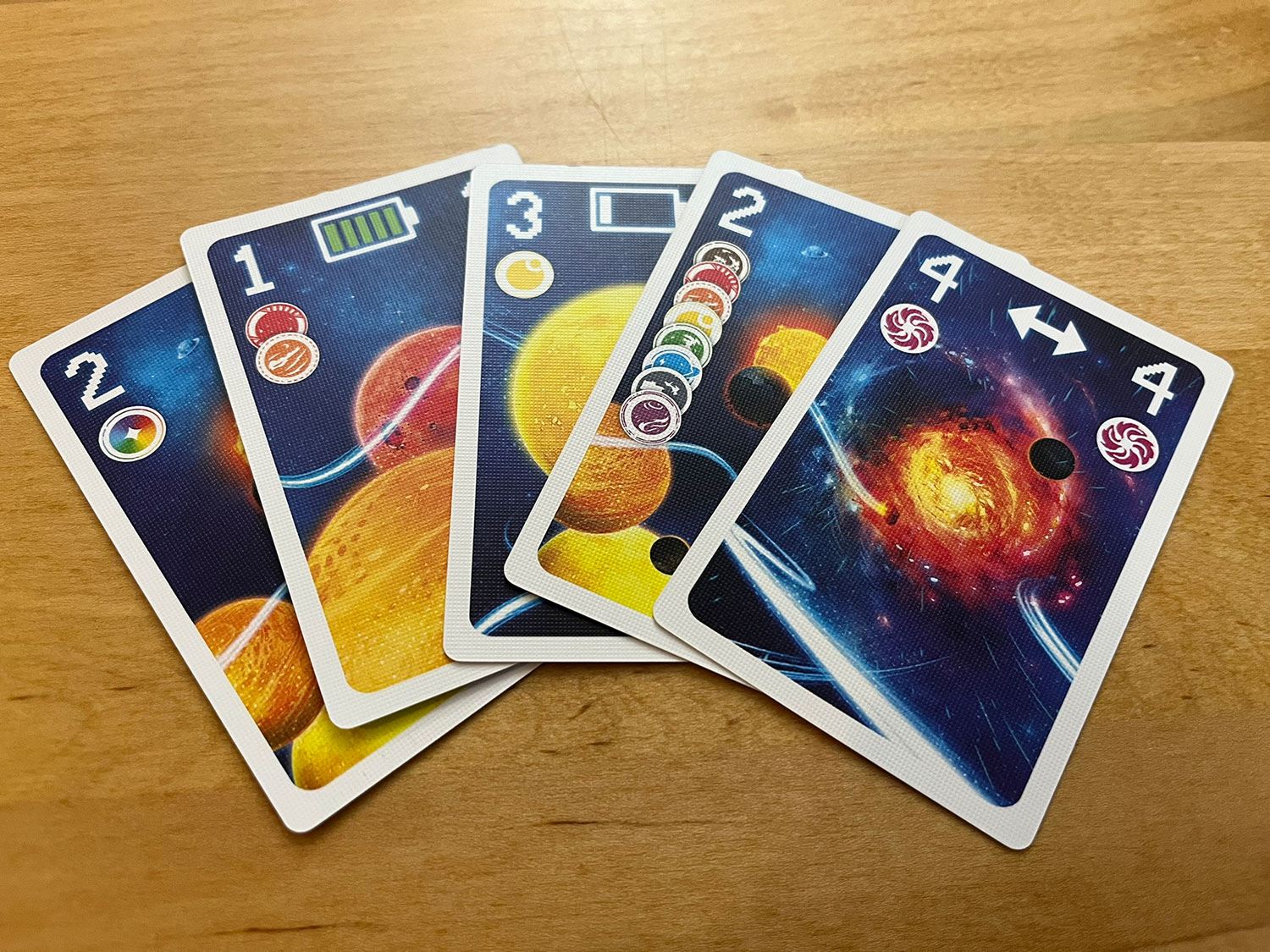 Representative cards allow players to move anywhere from one eight planets on their turn, or alternatively, to change the direction of one planet.
zany-looking criss-crossed “orbits.” Any spaceships on planets get to zoom along with the planets. Players additionally have the option to self-propel their spaceships a number of steps along the space grid, possibly boosting this number by energy in their reserve. They can refresh this energy reserve if the card lets them.
These three actions of moving planets, propelling the spaceship, and refreshing energy reserves can be performed in any order, with the latter two being optional.
Notably, spots in the space grid along which players can self-propel are each a fraction of the distance of a single planet orbital step; thus,
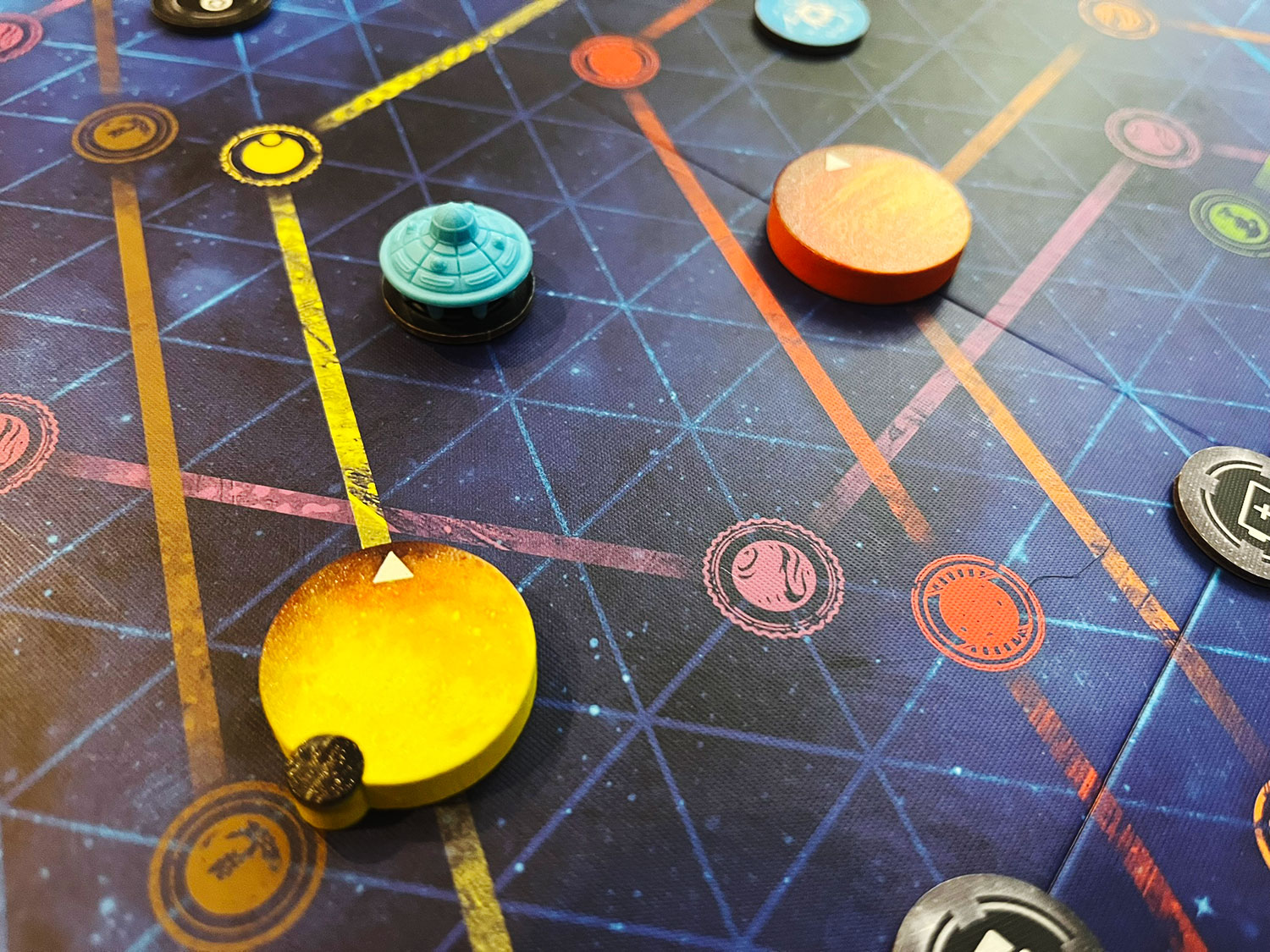 The blue spaceship has just visited a space station and must now move along the triangular space grid vertices via self-propulsion until it reconnects with a planet.
players are incentivized to hitch a ride along planets, which can be accomplished by moving directly onto a planet or positioning themselves along its orbit and waiting for it to pick them up next time it moves.
Aside from visiting planets, space stations scattered throughout the board offer juicy incentives for visiting them:
- Fuel depots increase your energy storage from the initial 2
- Card tokens increase your hand size from the initial 3, providing more forward-planning flexibility
- Hyperloops allow you to instantly teleport to other hyperloops
- Space cannons let you slingshot as far as you want in a single direction
Four of the planets provide benefits identical to these satellite bonuses when visited.
The first player to visit all 8 planets and return home wins.
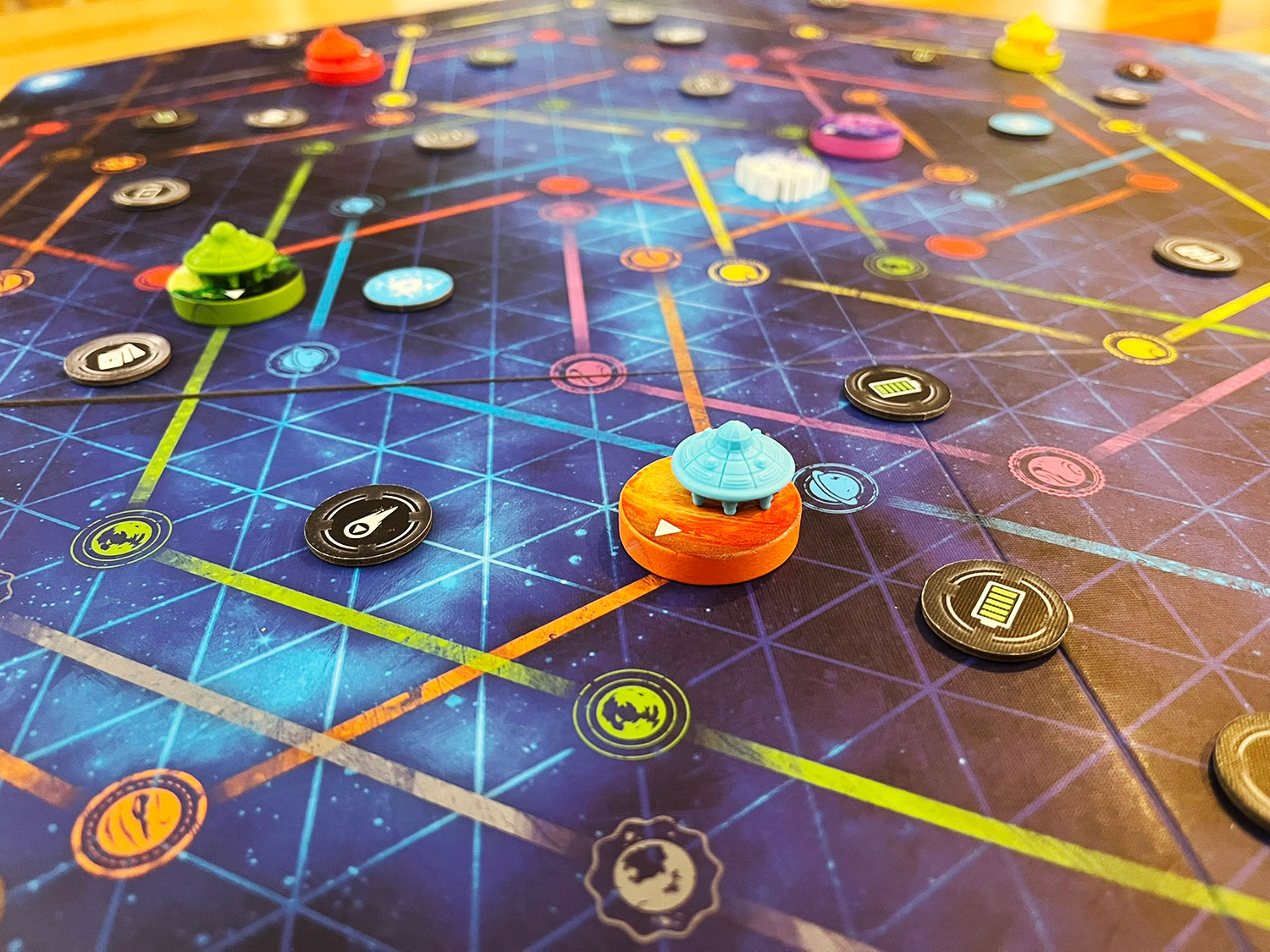 The colorful orbit of each planet is zany and overlaps with the orbit of each other planet at multiple locations.
Game Experience:
In true Reiner Knizia fashion, Orbit manages to be an easy teach with many interesting decisions. Overall, it’s a tactical game, as the card play influencing planet movements introduces significant randomness to the board state, such that players must constantly reassess their best move. The main decision space is often between trying to hitch a ride on faster-moving planets or attempting to self-propel towards one of the space station spots that may boost energy storage, hand size, or allow teleportation to a more attractive portion of the map.
Early game, players may feel that the 3-card limit doesn’t allow them to move planets in a manner that benefits their spaceship’s position. Increasing hand size thus provides some much-needed flexibility. At the same time, enhanced energy storage allows you to accomplish more through self-propulsion, so you’re less reliant on the planet movements. Doing well often requires a combination of quickly leveling up in hand size and/or energy storage, taking advantage of certain planets when they’re nearby, and moving certain planets away from your opponents when they might benefit too much. The tricky part is deciding when to prioritize each of these three aspects.
I have enjoyed the game at all player counts, but will note that it does feel different. With just 2 players, there tends to be a bit of “take-that,” but
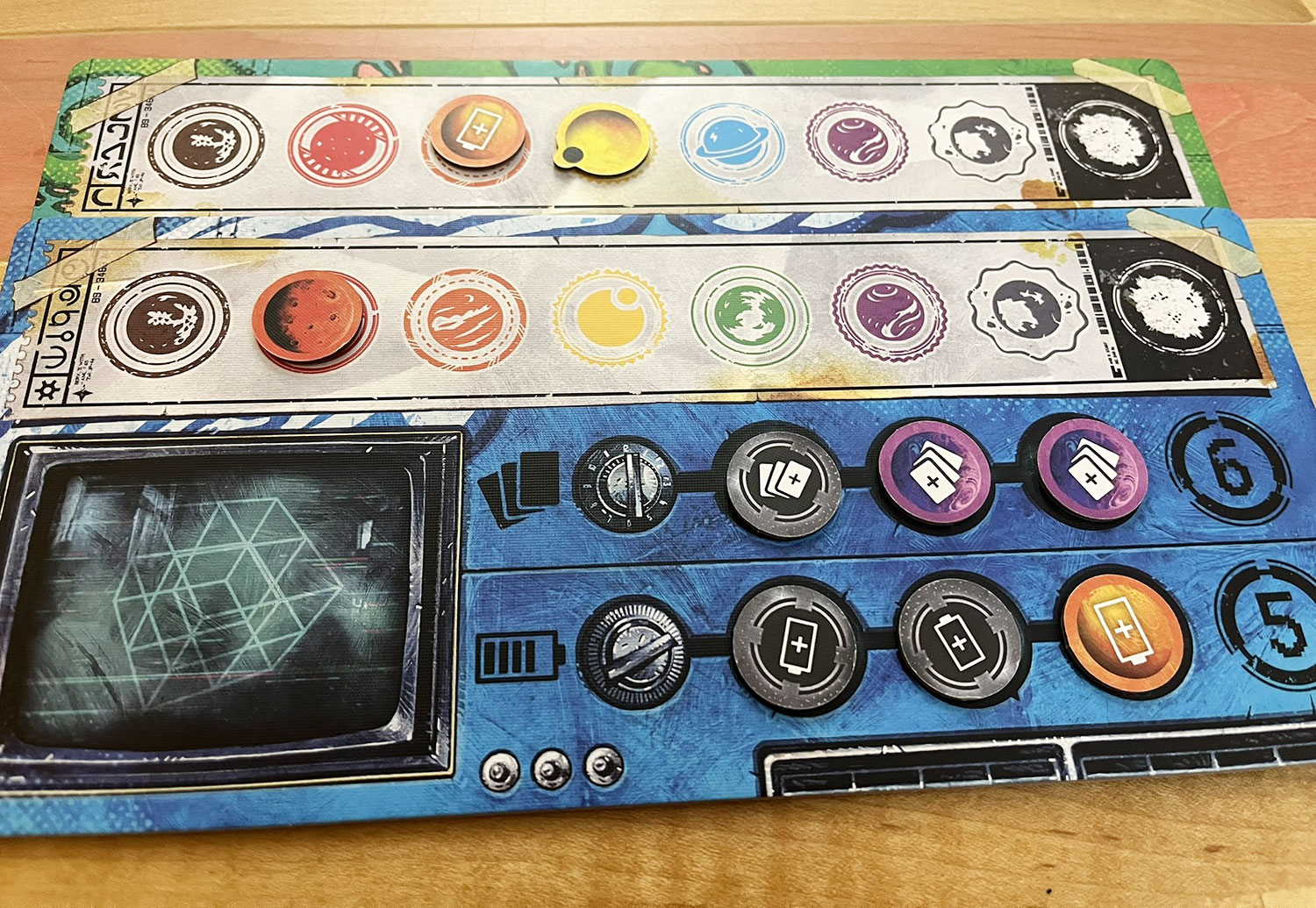 Two overlapped playerboards are shown mid-game for a 2-player 2-handed advanced variant. Hand size and energy storage have both been maximally upgraded to 6 and 5, respectively. The green spaceship (upper board) still needs to visit the orange and yellow planets. The blue spaceship (lower board) still needs to visit the red planet.
generally the board state is more predictable from turn to turn. At 4 players, the planet movements feel more randomly chaotic since at least three of them will move in between each of your turns. Granted, if one person is about to win, it’s not uncommon for all others to pile on to ensure they can’t finish the race. The 2v2 partnership mode and 2-player dual spaceship variants might be my favorite options, as each player is now concerned with racing TWO different spaceships, which means twice the decision space. One-time abilities to swap the locations of the spaceships or to teleport one ship to the other’s location also change up the gameplay a bit.
The component quality is great with chunky wooden planets, stack-able plastic spaceships, and easy-to-read linen-finish cards. My only complaint here is that the planets are a bit too big for the space grid, and in the rare instance where they land on adjacent board spaces, they don’t quite fit. The art is perfectly functional, though not memorable.
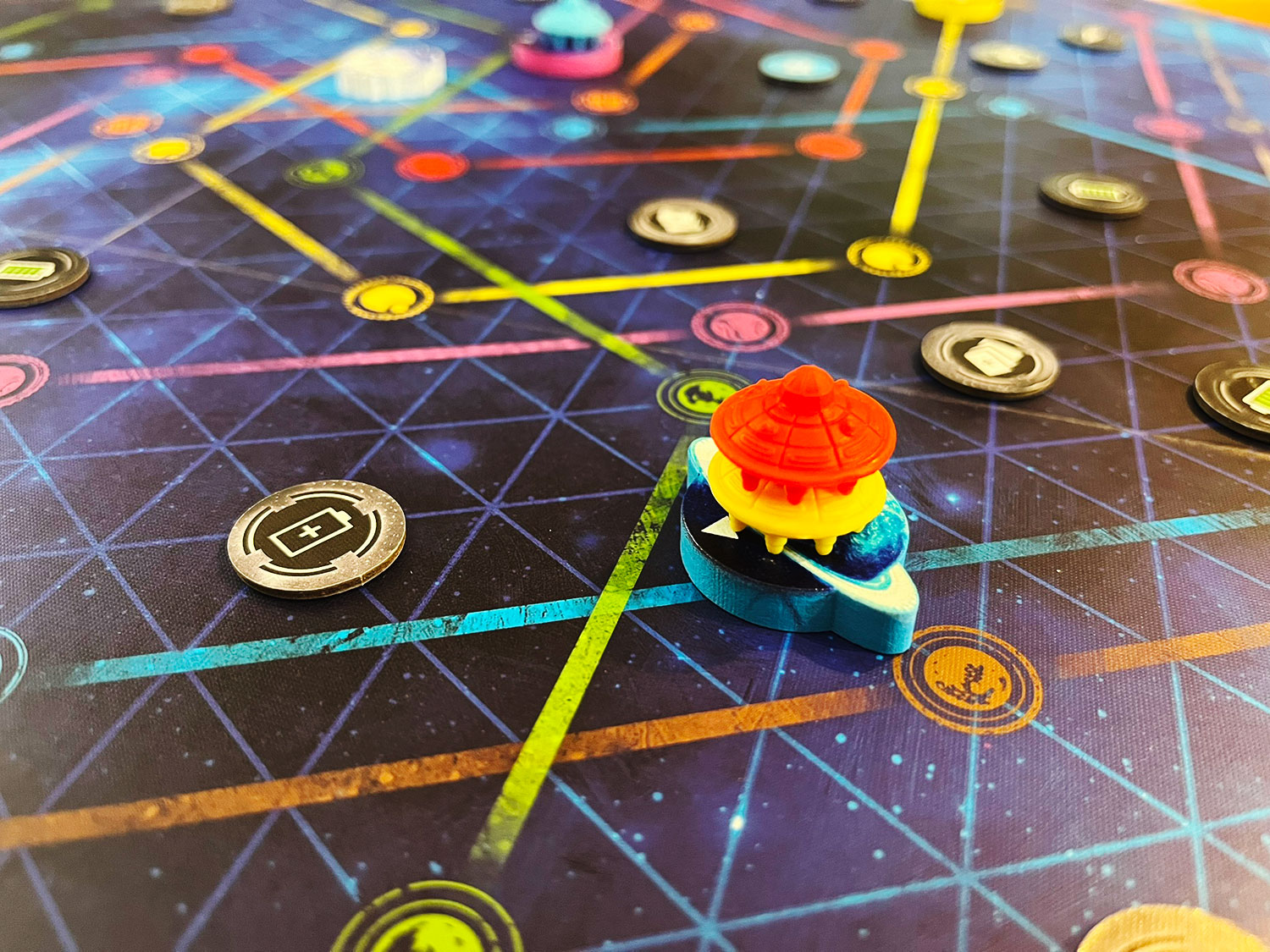 Multiple stackable spaceships can hitch a ride together on the same planet.
Replay value is decent, as there are two sides of the board with different planet orbits. The initial layout of planets and space stations is also randomized at setup, and this, combined with the randomness of card draw, means that no two games will see the same sequence of moves. Nonetheless, the game still feels a bit “samey” from play to play.
Despite the tactical nature, there’s only so much depth to the strategy. Two expansion modules do help this quite a bit. Nebulas change planet orbits as the game progresses. Hyper accelerator engines are my absolute favorite as they further incentivize players to quickly upgrade their energy storage so that self-propulsion capabilities can be vastly improved, completely changing the nature of gameplay and speeding up the endgame. Both modules make the game more interesting, and considering the minimal additional component overhead, they really should have been included in the base game. I found it rather frustrating that the base game uses the nebula cards, except that without being able to place nebula tokens, they usually feel relatively weak.
Final Thoughts:
Orbit is an elegant game design that breaks the typical “racing game” paradigm of a linear track and instead asks players to tactically race to visit 8 different moving targets in the form of planets. The fact that every player has some level of control in terms of how these planets move means it’s an inherently interactive experience that may include some take-that as well as random chaos. Random set-up, random card-draw, options for fully competitive or 2 v 2 team mode, and two different orbital boards do make every game play differently, and this will probably be a hit for families and those who enjoy lighter strategy games. Fans of heavier games may find that successive plays feel somewhat “samey.” The nebula and hyper accelerator engine expansion modules provide a more robust game arc and are recommended for those desiring elevated gameplay.
Final Score: 3.5 stars – An elegantly designed tactical interplanetary race that has players zipping spaceships in zany orbits to prove their space supremacy
 Hits:
Hits:
• Simple rules
• Fun interactive gameplay
• Expansions and advanced variants offer customized experience
Misses:
• Base game may feel “samey” after a few plays
• Expansion content should have been included in the base game

/pic9516264.jpg)
/pic9148407.jpg)








 English (US) ·