
.jpg)
PROTECT YOUR DNA WITH QUANTUM TECHNOLOGY
Orgo-Life the new way to the future Advertising by Adpathway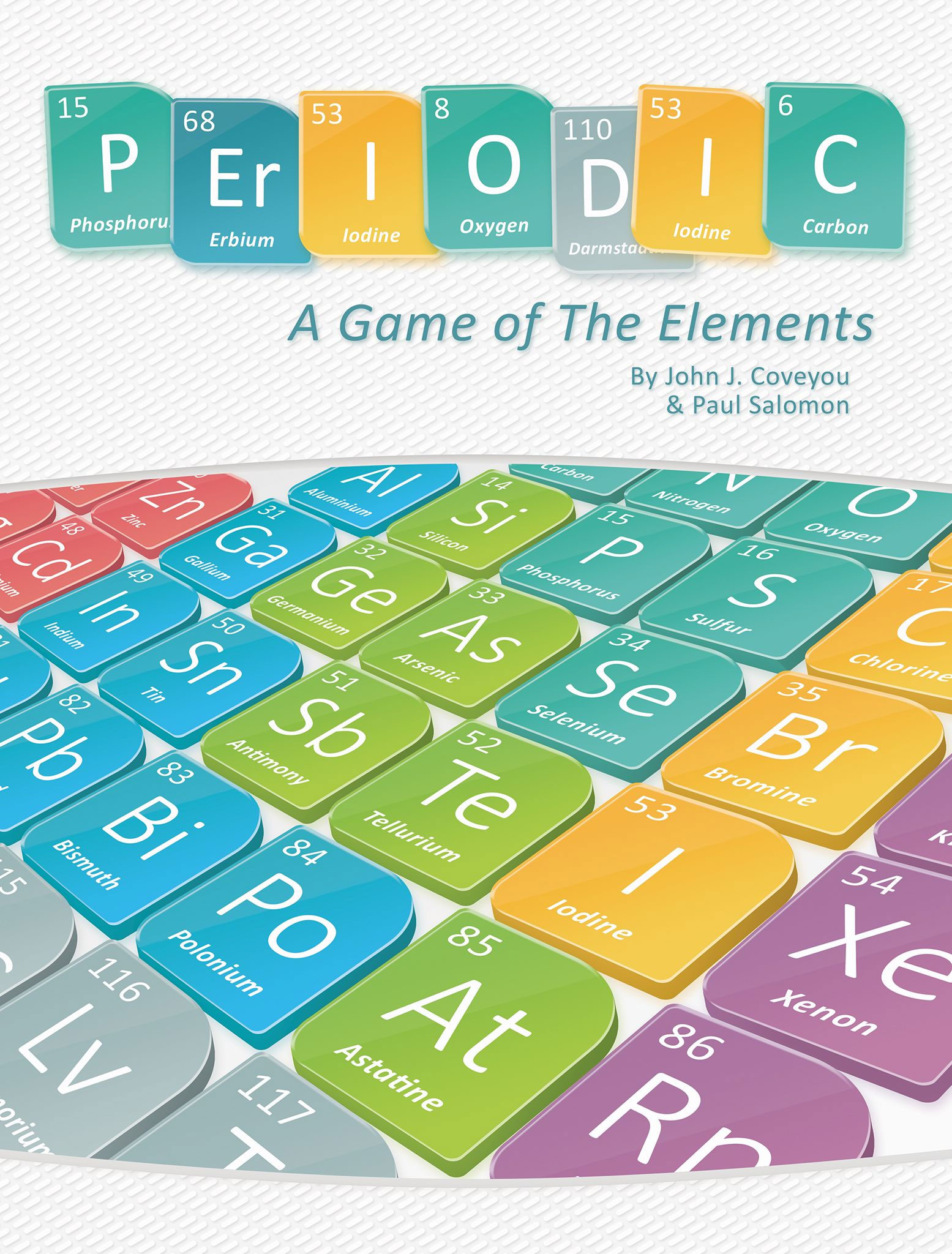 The job that takes me out of the house every morning (and funds my board gaming hobby) is ‘analytical chemist’. This means I spend my day running fancily named instruments and explaining to other people what the numbers or graphs they spit out mean. In order to understand this stuff myself, a pretty significant chunk of my life from college onwards has involved using or referencing a periodic table. Reciting the noble gases in order of atomic number is not a very lame party trick I use to embarrass my husband. It was a question on a freshman chemistry quiz.
Periodic: A Game of the Elements is the literal melding of my job and hobby. How could I resist? The game plays 2-5, and I am predominantly a solo player. Lucky for me, one of my colleagues also couldn’t resist. So what happened when an analytical chemist, a PhD metallurgist, and her husband sat down to research the elements?
You have to read on to find out.
Gameplay Overview:
Periodic is, at its heart, a grid movement game using the periodic table as the grid. There are five movement options, and each movement can be 1 to 5 spaces. You move by increasing or decreasing the atomic number (horizontal movement), increasing ionization energy (up and to the right), increasing atomic radii (down and right), increasing atomic mass (down and left), or decreasing atomic mass (up and left). In order to move, you spend or gain energy. For the record, these are all scientifically accurate trends on the periodic table.
 Progressing along the academic track with the microscope meeple
There are four stacks of goal cards; the top-most in each deck is open for play. Each goal card displays elements to research. These are then marked on the board with goal tokens (little molecule markers). You research an element by moving your game marker (a flask) onto the element supporting a goal token. Once you land on the element of interest, you place a research cube on the goal card. The first player to get a research token on all elements on the goal card collects that card for points at the end of the game. The next card in the deck is revealed, and the goal tokens are moved to new elements.
The final way to gain points is the Academic track. You progress down the academic track by advancing a tracker token (a microscope) across a series of cards distributed around the board. You must move in order and progress from one to the next by ending your turn in the indicated family of elements on the periodic table.
The game ends when one goal deck is empty or two players are in the last two spots of the Academic track.
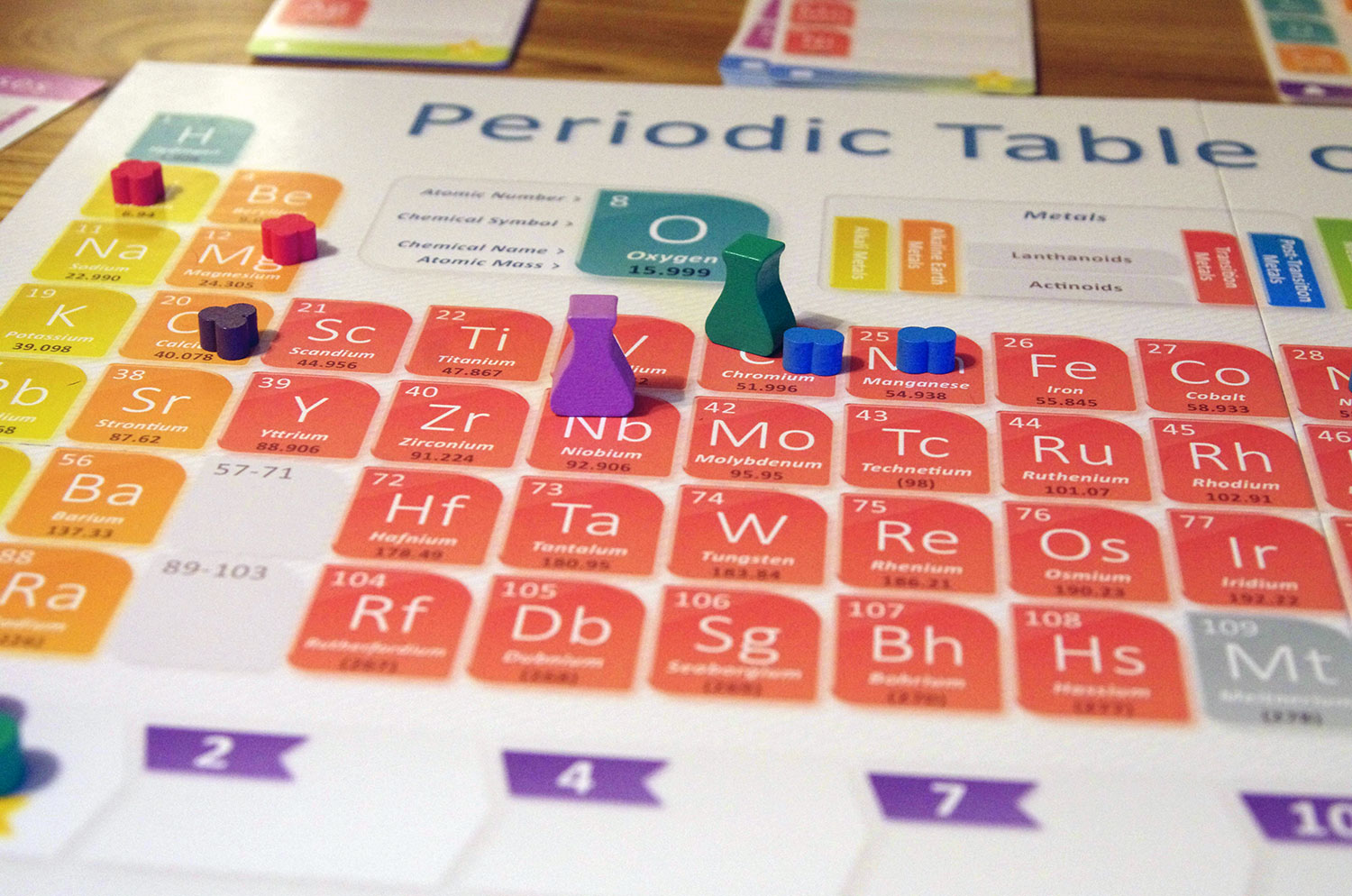 Beaker markers on the board, green claimed chromium first, but I can snag it next turn
Game Experience:
I legitimately did not know the periodic table could be this entertaining. The rule set is fairly straightforward, and even if you haven’t spent an unreasonable amount of hours with a periodic table, it’s quick to pick up the restrictions. All the terminology is scientifically accurate—yes, atomic radii really does increase in a roughly down to the left fashion across the table. All the element groupings on the goal cards are also accurate; bromine and mercury really are liquid at room temperature. For all that, though the jargon never gets overwhelming, it’s easy to navigate without a degree in chemistry or even a particular interest in it.
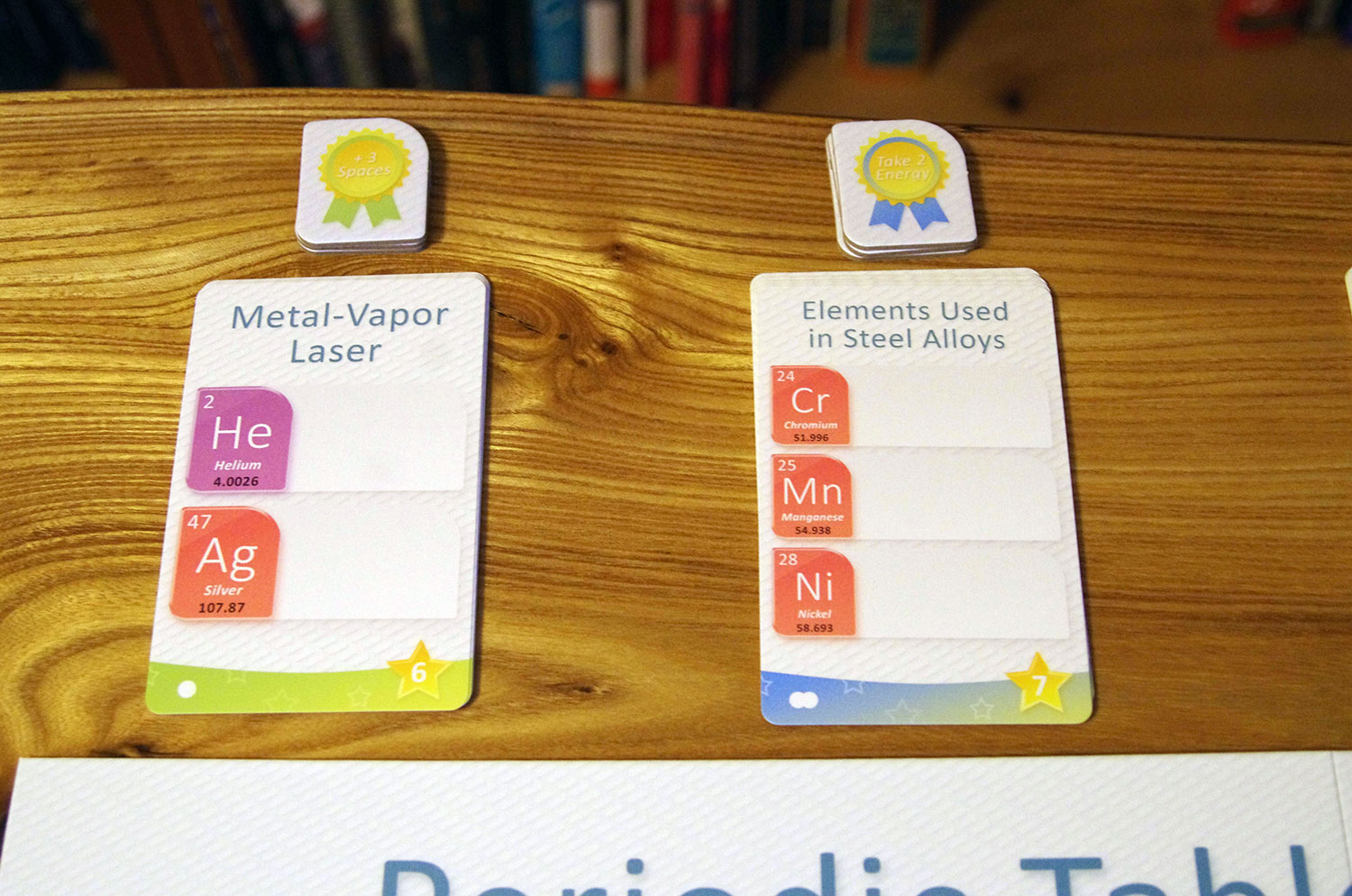 Example goal cards with rewards
The Academic track adds another interesting feature and can help you garner points from a turn that may or may not have held a lot of promise at the beginning. It’s also really easy to get focused on either the element research of goal cards or progressing along the Academic track. You play a better game when you pay attention to both.
The ever-changing goals mean that it’s hard for one person to run away with the game from the goal cards alone. You might find yourself pretty far away from all the needed elements, only to have a card flip and put a new round of them in reach. It’s easier to shoot ahead on the Academic track. Which is what happened when we played. One player really took advantage of the Academic track and managed to shoot ahead to the end, while the others were kind of stalled out at the beginning of the track. Someone had to catch up fast or deplete a stack of goal cards. We managed, but the last couple rounds felt like they were dragging.
 There is no trend straight down a family, this will need some clever actions to collect all those elements
Final Thoughts:
I had my reservations about Periodic: A Game of the Elements. This could have used the periodic table as a gimmick without any real chemistry, or it could have leaned too far into the scientific aspect and turned a ‘game’ into a thinly veiled chemistry class.
It hit the perfect balance. It is scientifically accurate, while remaining an engaging game. Neither scientist won. This doesn’t surprise me. We were marveling over the science ‘hey all those elements really are poisonous!’ while he was paying attention to rules and racking up points without a particular care for whether or not the elements he just researched really are in sugar. So, scientific accuracy can be considered both a pro and a con, really.
Simple rules and straightforward scoring make this a light game. It is both enjoyable and interesting. Wins extra points with me because the microscope token is the cutest thing I have seen in a while. The only real complaint is that it runs a little long for the weight of the game. I think losing one or two spaces on the Academic track, or decreasing the goal deck sizes, would make me more inclined to ask ‘go again?’ once the game is over.
Final Score: 3.5 – Good game, solid foundation, just runs a little too long.
 Hits:
Hits:
• Scientific accuracy
• Microscope and flask tokens
• Easy rule set
Misses:
• Longer than a light game should be











 English (US) ·