
.jpg)
PROTECT YOUR DNA WITH QUANTUM TECHNOLOGY
Orgo-Life the new way to the future Advertising by Adpathway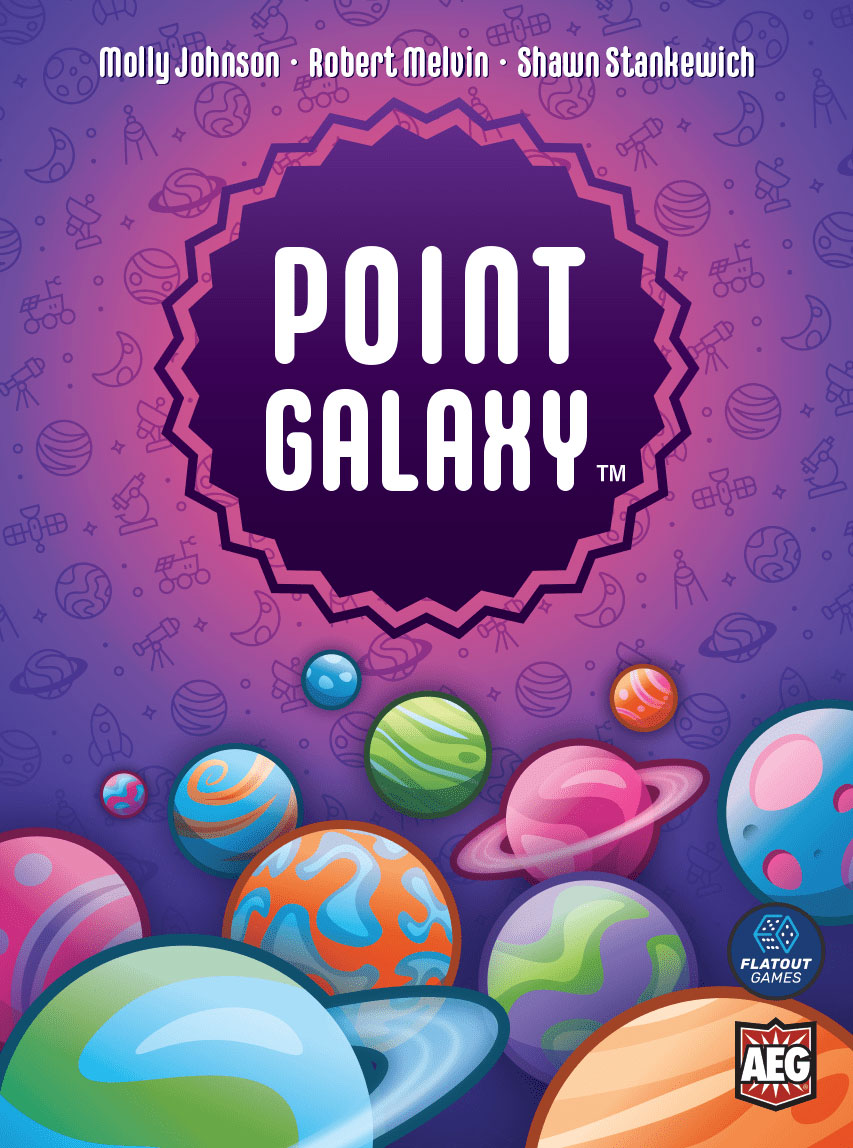 First, there was a Point Salad. But after a Freak Accident, that salad became Point City. Tragically, a Frique Axident occurred while attempting to revert the aforementioned Freak Accident, and that City has become a Galaxy. Cue that last scene from Men in Black with Inception Music.
Point Galaxy, from Molly Johnson, Robert Melvin, and Shawn Stankewich, with art from Dylan Mangini, and published by Flatout Games/AEG, is a 1-4 player game that takes about 40 minutes to play.
Gameplay Overview:
Each player is trying to build the Pointiest Galaxy. No. The Galactic Point Engine. Erm. The Point of the Galaxy is to score the most Points. Capisce?
Point Galaxy is a tableau builder. Each turn, you will take 2 cards from the card offer and place them into your play area. You’ll build Galaxies (lanes) with various scoring setups.
Each Galaxy has its own scoring condition, some of which can combo across other galaxies for maximum points.
The twist here is that each card added to your Galaxy must be in ascending or descending numerical order, and no duplicate numbers are allowed. This takes this from a procedural lane-filler to an interesting Galactic puzzle.
The game ends when there are 7 cards left in the offer. Points are tallied, and the player with the most points is the winner.
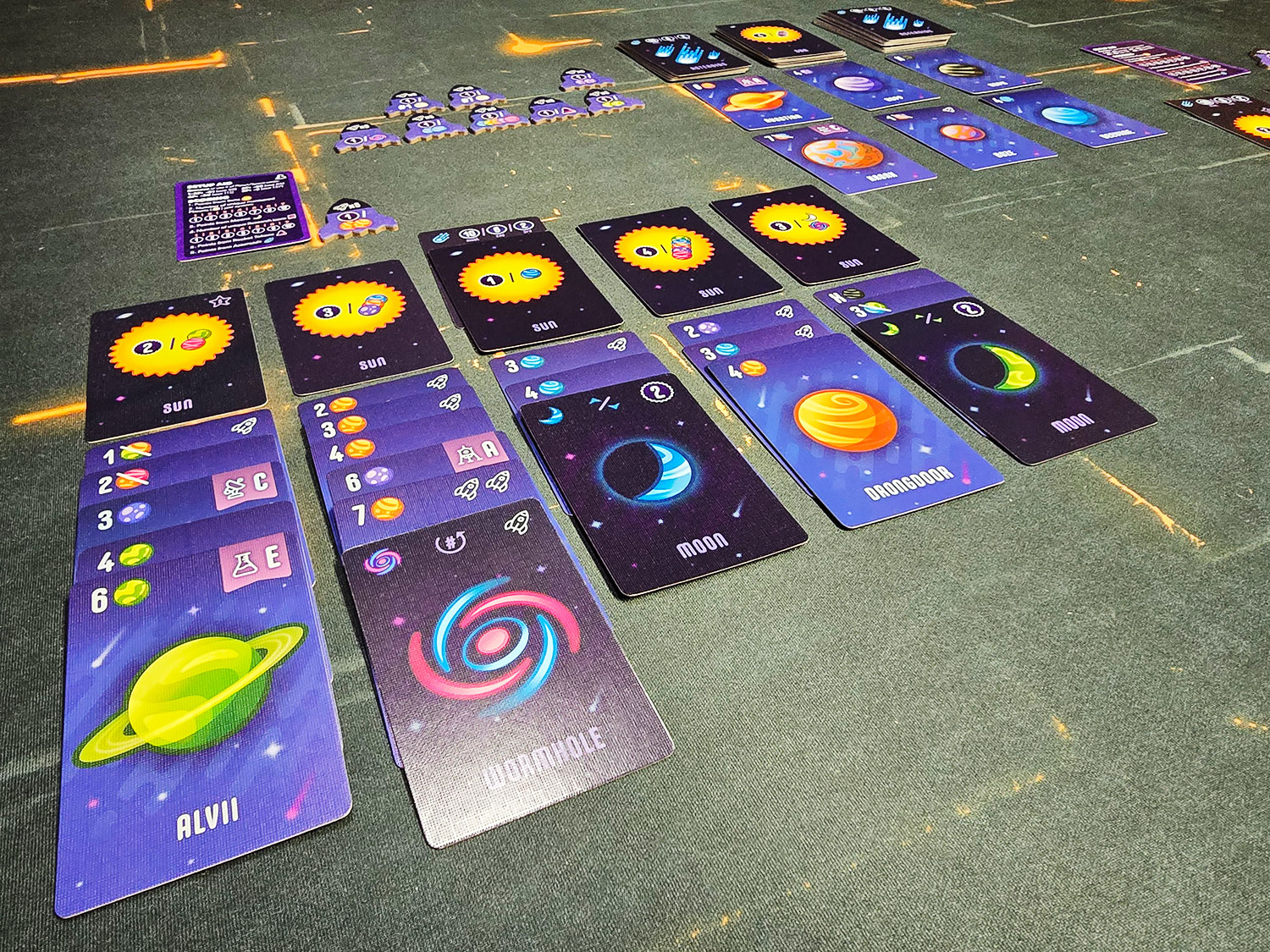 Mid-game Galaxies laid out, the older and wiser Galaxies on the left and the whippersnapper star systems on the right.
Game Experience:
There are two things in Point Galaxy. Cards and Rocket Ships. And a Rule Book. And some Player Aids.
There are four things in Point Galaxy.
And still, the setup is kind of painful. The first thing you have to do is shuffle 140 cards. Except that as soon as they are all shuffled, you consult a chart and remove a ton of cards so that the number of cards in the offer is exactly the right amount to give each player 13 turns.
Except, damnit, you forgot to pull out the Starting Suns, so you have to fumble through the deck to track those down. Reshuffle. Did I add back in the cards so the count isn’t off? No? Count ‘em again.
Well. This is off to a bad start. Setup isn’t even done, and I’m already annoyed.
Anyways, now count out the number of Rocket Ships you should use for your game, and you’re done.
Hey, did you remember to deal out the right player aids? PLAYER AIDS??? I have to remember a special-
Beverage break. Deep breaths. Come on back and touch the cardboard. It’ll be fun!
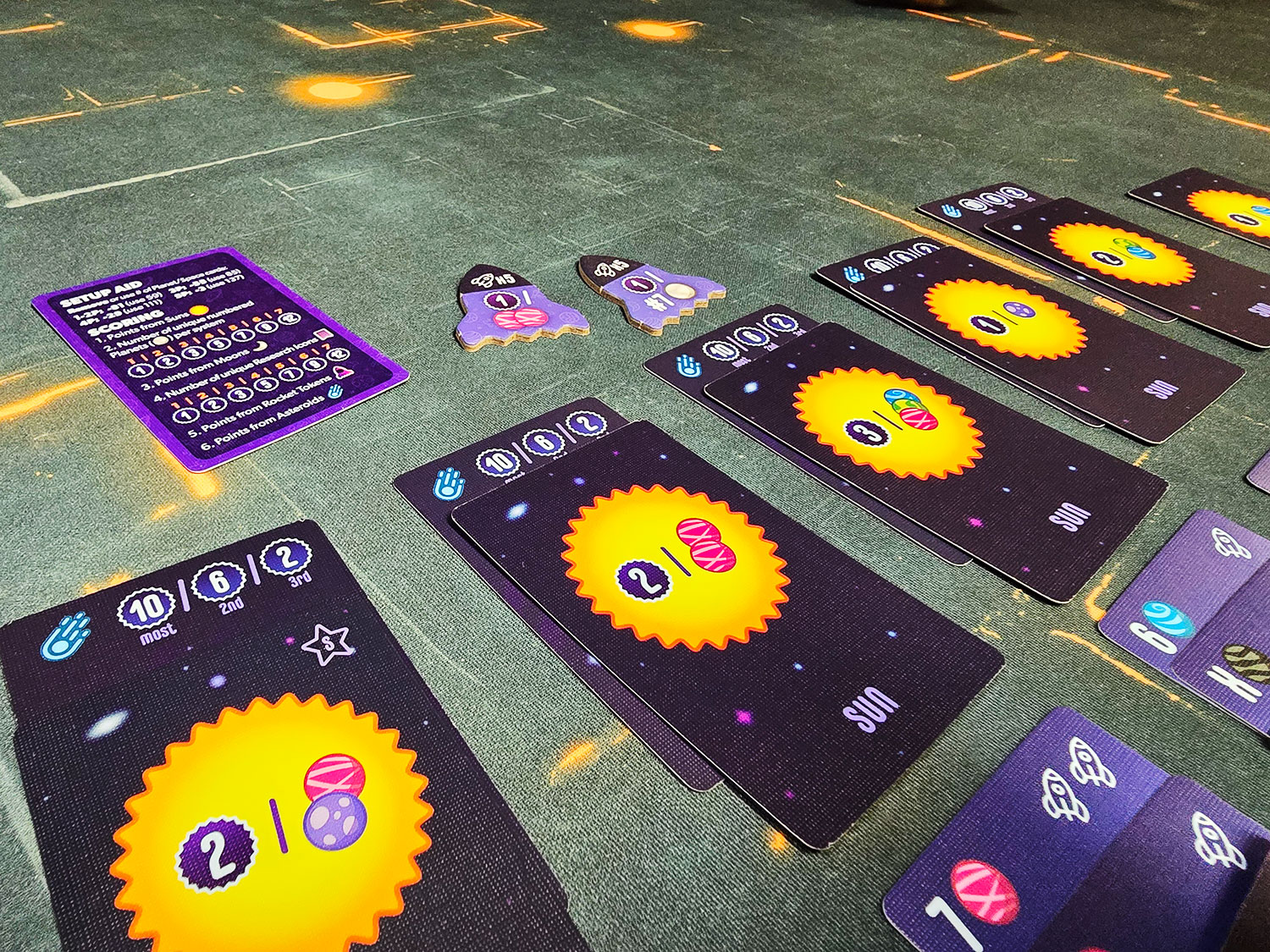 Suns, showing a variety of scoring conditions.
Game Experience After Someone Else Sets Up
Once you can actually get playing, Point Galaxy is really simple. Draw cards, place cards, score points. Easy peasy! You score those points by creating lanes of cards (Galaxies), with a Sun and a bunch of planets, moons, wormholes, and maybe an asteroid or four.
Suns have specific scoring conditions on them. 1 point per every 2 pink planets, 4 points for a set of 5 unique colored planets. Etc. Each planet has a number, and numbers must stay ascending or descending as you build the lane out.
The gameplay loop is quick per-player, though downtime can certainly increase as you add more players, and there is some potential for Analysis Paralysis. There is a bit of an admin overhead during play as well. Some planet cards have Rocket icons on them, and every multiple of 5 means you can nab an extra Rocket Ship scoring tile for additional point bonuses. If you don’t keep track of those tokens, you can find yourself stuck
Moons are placed for points in your planet lanes. They score based on matching planet colors on top and/or bottom. Wormholes allow you to reverse the order of cards, though crucially, duplicate numbers still only count once for scoring.
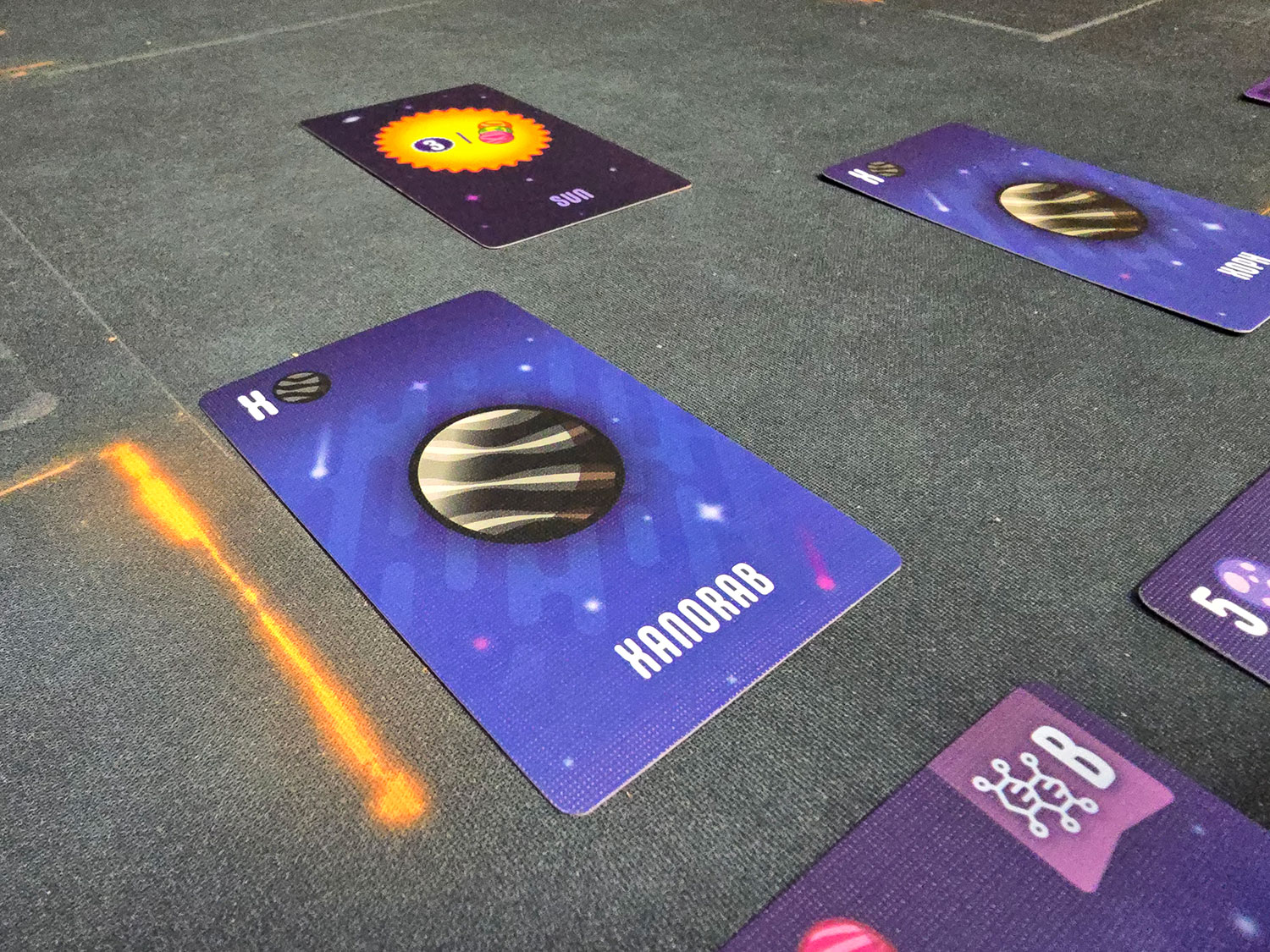 X planets count as any number, but do not count as a color for scoring.
Asteroids are a little extra investment game. They get tucked behind suns, and the player with the most scores 10 points, 2nd most, 6 points, 3rd most gets 2 points, and anyone else gets nothing.
The core puzzle in Point Galaxy is in picking the right cards and getting them in the right lanes for maximum points. The frustration lies in the randomness of the card market (6 available planet cards at any point, plus 3 specials).
Each planet is named, and those names are ridiculous enough to be the answers to a 1990s Flyers team sporcle quiz of 4th liners and black aces. In one play, we did not see a single 5 card in the market until the last 3 turns of the game. There’s no way to mitigate that other than to skip right past that number in your sequence and potentially sacrifice points.
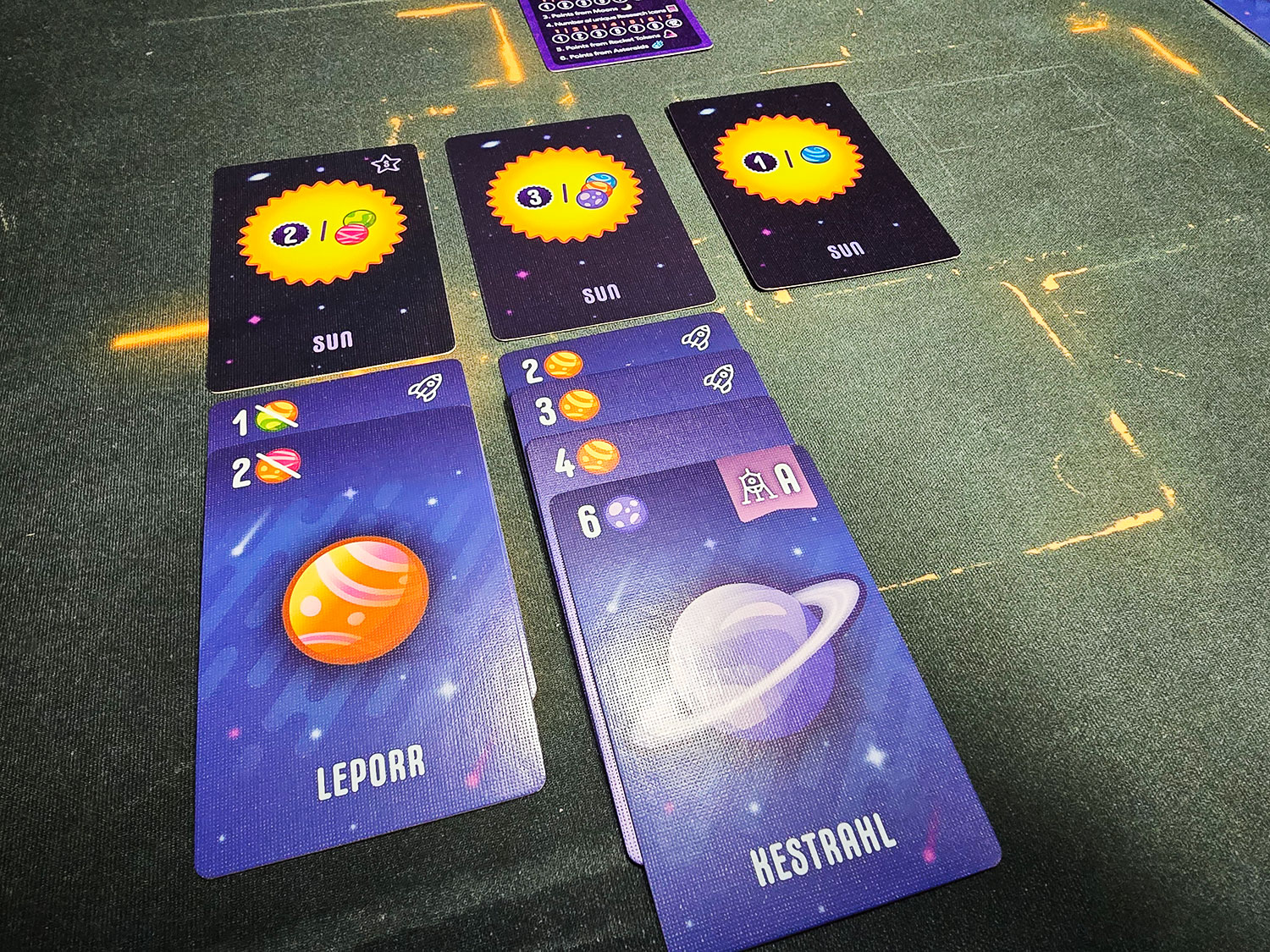 Leporr and Kestraahl, the ill-remembered Scandinavian defensive pair for the 1996 Oilers. Probably.
When you get stuck, you’ve got no choice but to start a new lane in your galaxy, and that can feel yucky, especially late game.
In the late game, I often found myself bored. Choices would become obvious. Or the market would force me into moves I did not want to make. I wanted the game to be 3 rounds shorter to become a true filler.
Final Thoughts:
Point Galaxy has a neat core. The suit-and-number matching across multiple lanes is crunchy and usually satisfying. It’s got too much fiddle to be a true filler game. And it’s not got enough to make it the main event.
I legitimately had to leave the table during my first setup, I was so irked. And that is not who I am. Generally, I relish the meticulous “everything in its right place” to start and end a game. Not here.
Some of the iconography is a little tough, especially for split-planet icons. Each suit has a unique color and planet shape. Except some of the planets’ art on the cards is different from the suit art, and that lead to some confused stares.
Final Score: 2.5 Stars – Point Galaxy is a good puzzle with a bit too much to be a filler game, and not enough to be the, ahem, star of game night.
 Hits:
Hits:
• Crunchy choices for card placement
• Good puzzle-to-playtime ratio
Misses:
• How on earth is Setup this fiddly with how few components this game has?
• The card offer randomness dictates gameplay
• The game lasts too long for me

/pic9148407.jpg)








 English (US) ·