
.jpg)
PROTECT YOUR DNA WITH QUANTUM TECHNOLOGY
Orgo-Life the new way to the future Advertising by Adpathway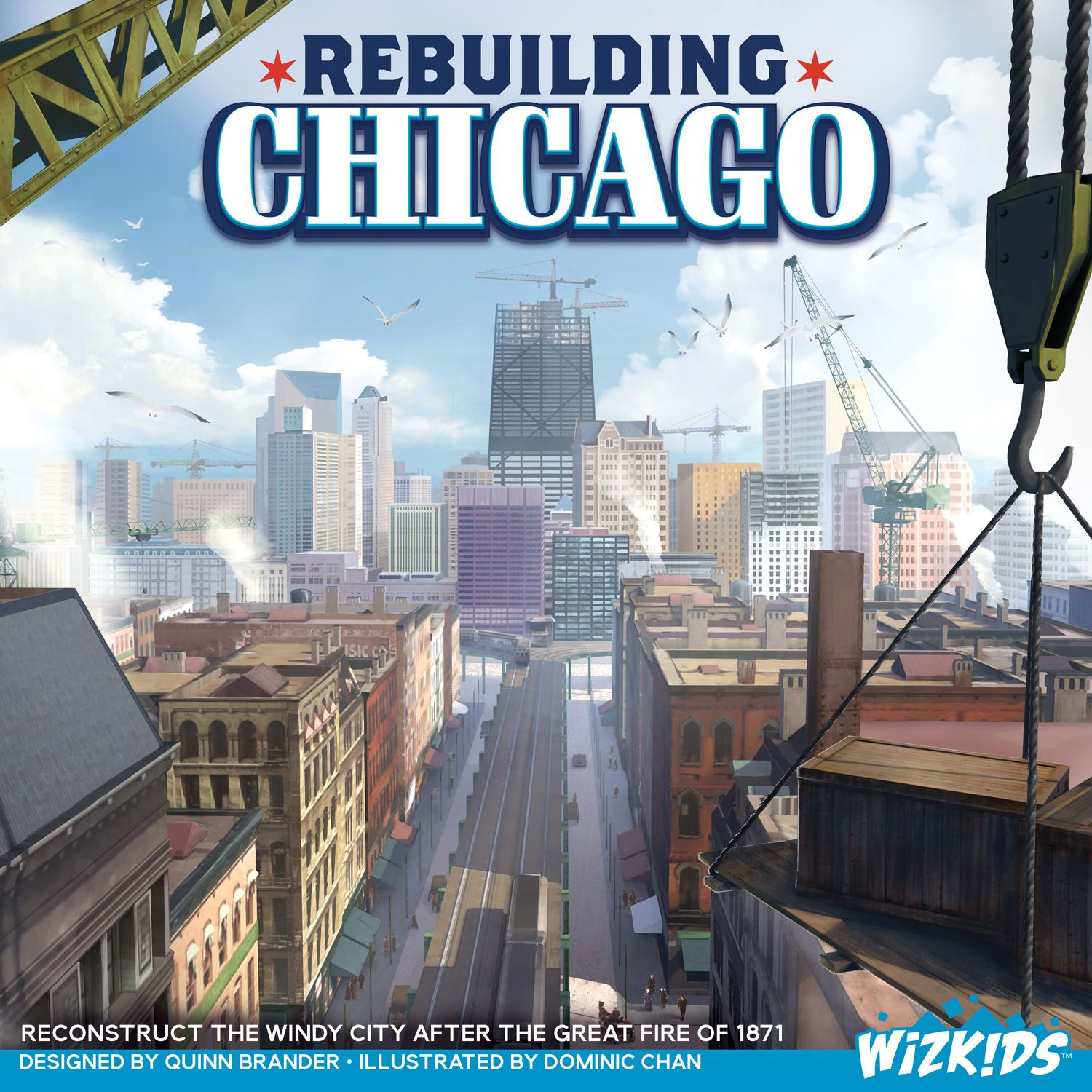 The year? 1871. The place? A mostly featureless Chicago, devastated after the Great Fire. The goal? To rebuild this great city to even greater heights.
That’s the idea, anyway. In truth, you don’t much care how the rest of the city fares, so long as your district is the happiest, best-fed, and most danceable in all the land. It’s sort of like a reverse Footloose, if the mayor was competing with other mayors, and also… constructing buildings? This comparison really got away from me.
Regardless, Rebuilding Chicago is a tile-laying and economy-building game for 1-5 players! It plays best with 2-4, and takes about 60-90 minutes at that player count.
Gameplay Overview:
Rebuilding Chicago is split into three rounds of a variable number of turns, and on your turn you have two options—buy a building card or trigger an event. When you buy a building card, you can choose to either place the building tiles listed on the card on your District board (following classic tile-laying rules), or keep the card for its ability. These abilities either provide more Suburb tiles to expand your district, additional income at the end of each round, or additional points at game end. Players are also given two unique Landmark cards during setup with special placement and scoring rules, which can be purchased and placed in lieu of a building card.
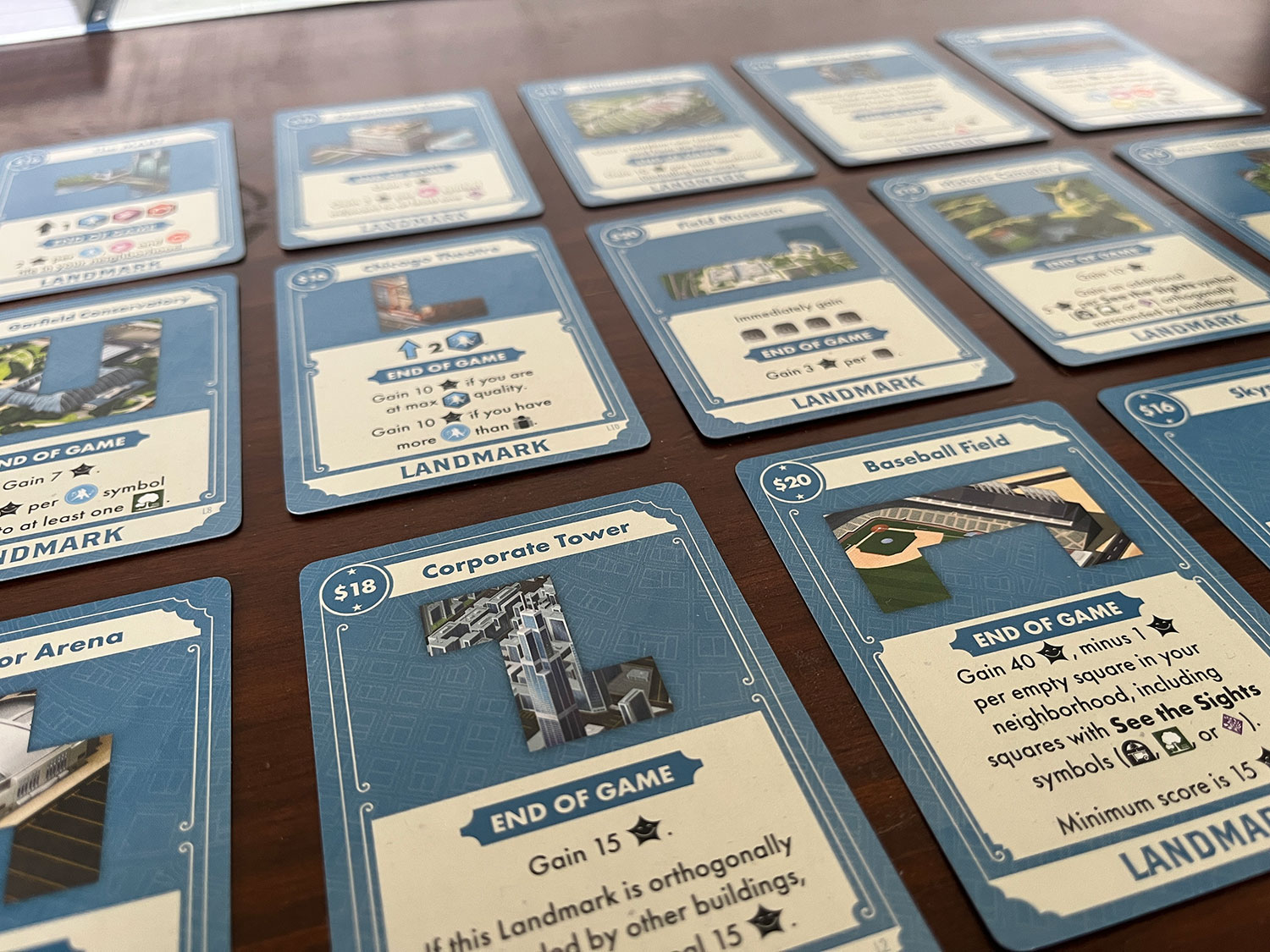 The landmark cards are mechanically fun, but I am baffled by how generic they are thematically, given the historicity of Chicago’s many famous features. Apparently, the publisher was worried about using the actual names of these landmarks for legal purposes, so they scrubbed the serial numbers before publication–a depressing reminder of corporations’ ownership and control of what should be a communal source of pride. Two thumbs up from a gameplay perspective, though!
If you trigger an event on your turn, the effects of that event resolve for all players, with the triggering player receiving a bonus. Each of the seven events can only be triggered once a round, and provide benefits corresponding to the state of your district; the Expansion event lets players expand their district according to how many yellow buildings have been placed, for example, whereas other events score points based on the number of specific building types compared to your district’s unhappiness (which ticks up each round and can severely limit scoring). Once per round, a player can also choose to pass a law instead of taking a regular turn, choosing from one of three special abilities unique to their player board.
Once all seven events have been triggered, the round ends, and players earn money according to the buildings in their district and the profit abilities they have accumulated. At the end of the third round, the player with the most points is declared the winner.
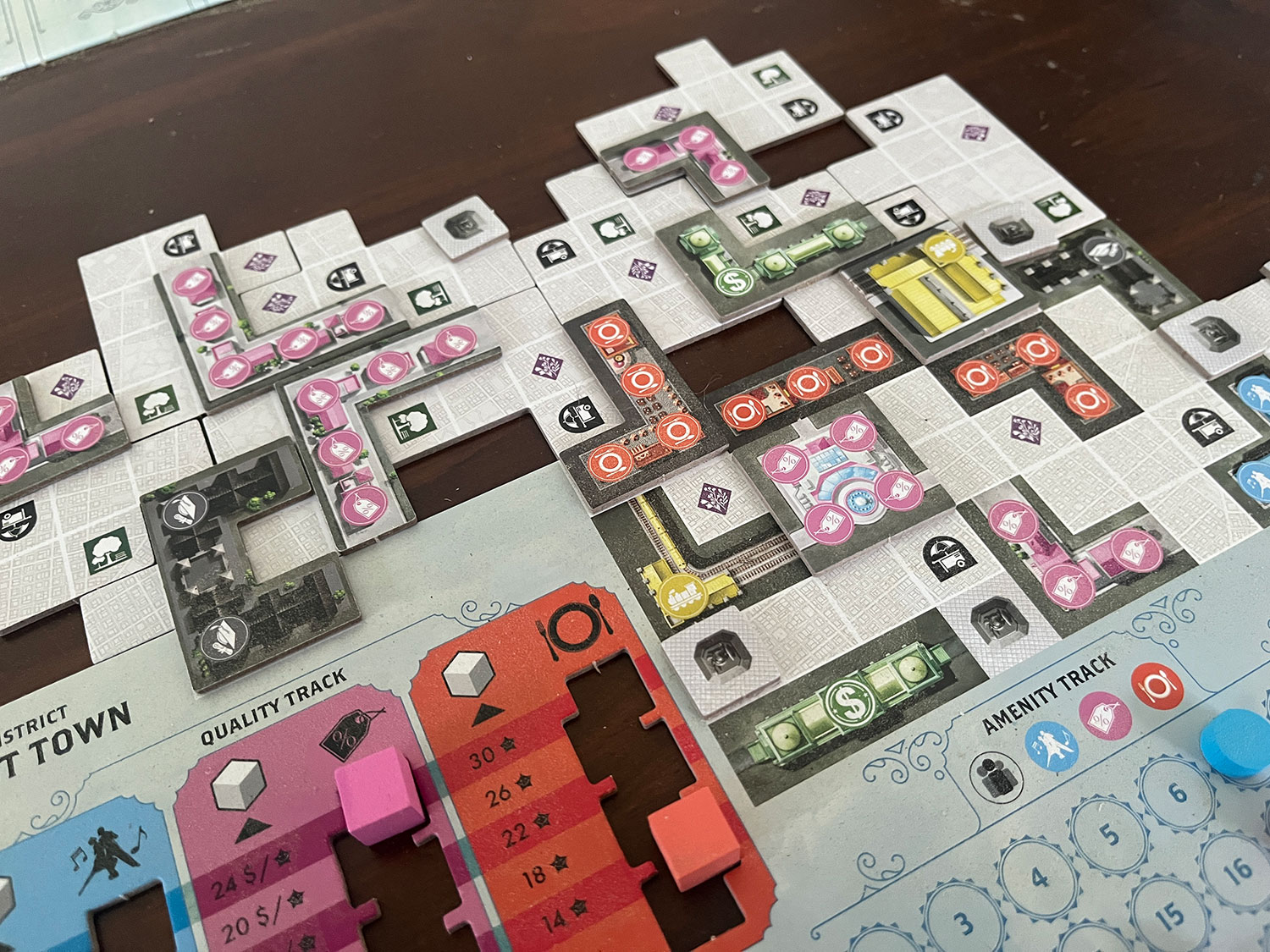 The weird suburb tiles and building shapes always lead to ugly and uneven district layouts by game end–which might sound like an insult, but is actually high praise.
Game Experience:
Rebuilding Chicago is an extremely simple game at its core. You can only take one of two choices each turn, and while the events take some getting used to, all of them follow the same basic pattern of comparing icons on your district board and receiving a proportionate benefit. However, while the mechanisms are simple, the decision-making space is surprisingly layered and nuanced.
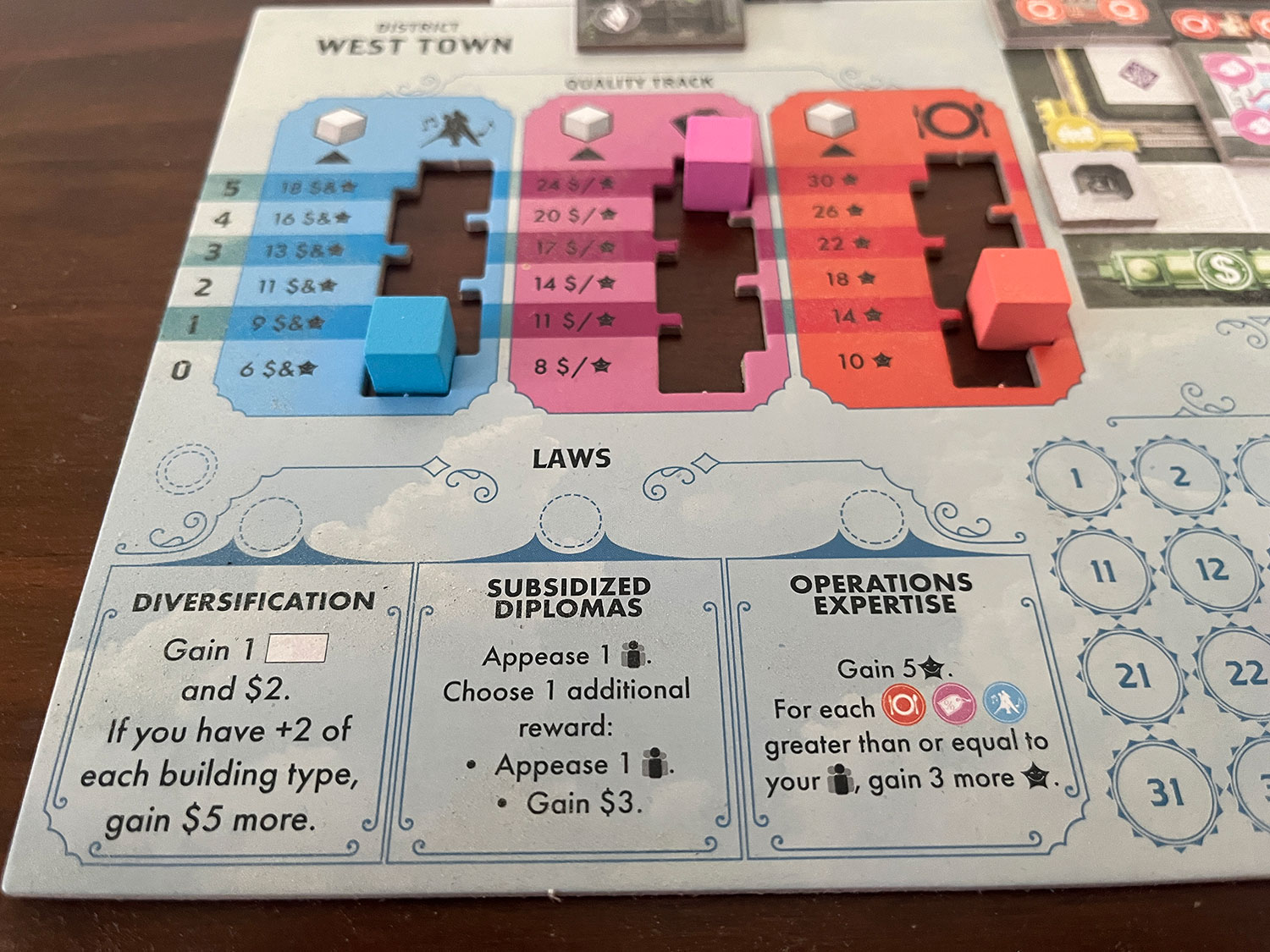 Each of the game’s three Amenities score based on progress down their respective Quality tracks–you may have a restaurant on every block, but that isn’t much of a draw if they’re all rat-infested McDonald’s.
Part of this is due to the sheer combinatorics of each turn. The card market has ten cards of varying prices at the start of each round, and each card has two possible uses, meaning your first purchase involves parsing twenty different options before you even think about how to place the buildings you buy. However, this is not just a case of “more is more”; the choice of when to trigger an event is incredibly limited on its own, and the difficulty comes not from parsing a massive decision tree, but from figuring out the correct timing within the round.
The events lead to a surprising amount of player interaction for a game that is mostly heads-down. Generally, you want to trigger an event as late in the round as possible to earn as much as you can… but you also want to minimize an event’s benefit for other players, which complicates things significantly. I found myself actually caring about what other players were doing with their districts, so I could know which events they were likely to trigger and when I should try to pre-empt their plans.
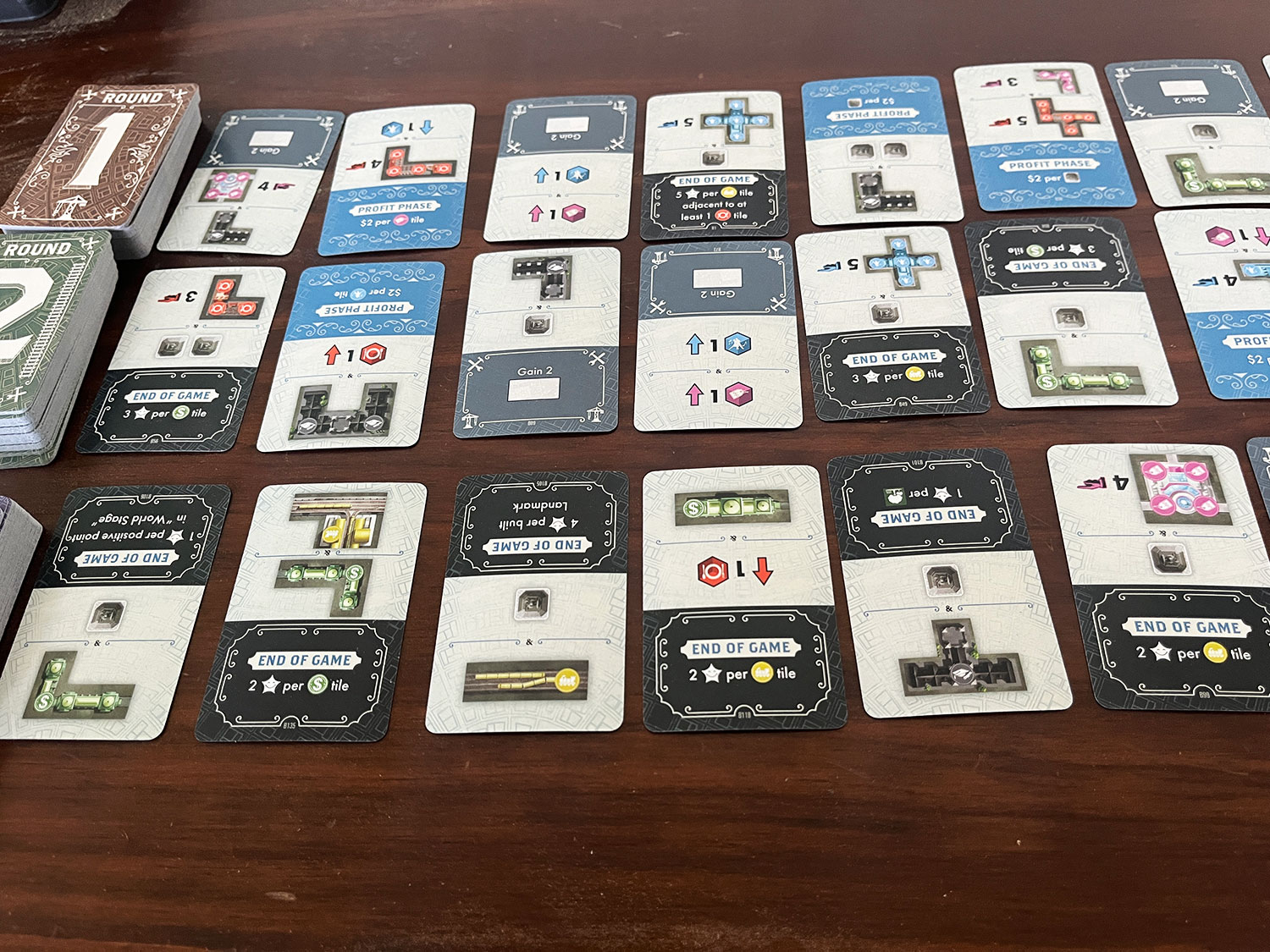 Each round of Rebuilding Chicago has its own deck of building cards, meaning the game scales nicely over the course of a game, and avoids end-game stagnation in the market.
The replay value here is quite high, thanks to the breadth of possible avenues to pursue. Rebuilding Chicago plays quickly, and you’re forced to specialize in a scant few of the myriad opportunities to score. The unique Landmarks and player abilities also push you in different directions each game, without railroading you into a specific path. As a city-building game, I especially enjoyed how organically your district grows over the game. New suburb tiles are never neat rectangles, and most building placements incentivize covering specific squares while leaving others open, meaning your district always ends up messy and unplanned in a way that feels natural.
Unfortunately, in every other regard, Rebuilding Chicago is thematically incoherent. This may not be surprising given that the game is at its core about advancing down tracks, and I don’t always expect a lot of thematic sinew in a city-builder… but for a game set in a very specific period of time in a very specific location, I had hoped for more to anchor play within that setting. Instead, what we have is an extremely competent (if abstract) city-builder, with an ill-fitting historical theme hastily stapled over its bones.
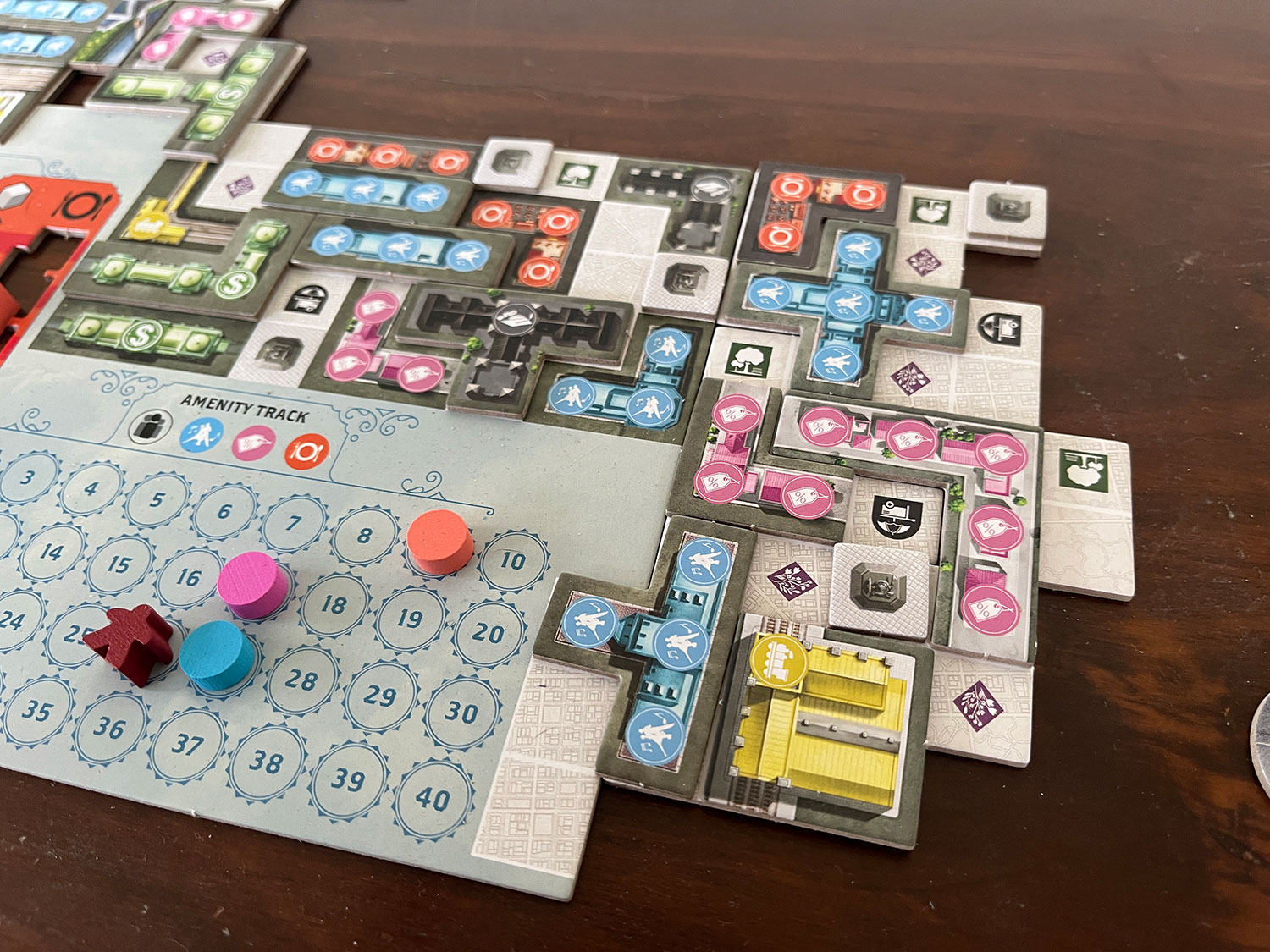 Each player board tracks your district’s Unhappiness level (the red meeple), which destroys any points you might earn if your Amenities aren’t up to snuff. No one is going out dancing if they’re all peeved at the local government!
Final Thoughts:
If I whinge about the thematics here, it’s only because I find the underlying game so enjoyable. Rebuilding Chicago takes a couple of strong mechanisms and weaves them together expertly, resulting in a game that is quick to play and fairly easy to learn, but with an amount of depth and variety that belies its simplicity. The Tetris-y building placement is as head-scratching as always, but bolstered by the events that make sure everyone cares about the other players.
Final Score: 4 Stars – an excellent mix of economy and tile-laying for those who don’t care about theming, and still a very good time for those who do.
 Hits:
Hits:
• Simple rules lead to interesting emergent gameplay
• Events create a lot of indirect player interaction
• Plenty of replay value
• Districts grow in a pleasingly organic way
Misses:
• Obnoxiously anti-thematic
• Initial learning curve for each event and the plethora of different scoring opportunities
• Middling solo mode











 English (US) ·