
.jpg)
 8 months ago
59
8 months ago
59
PROTECT YOUR DNA WITH QUANTUM TECHNOLOGY
Orgo-Life the new way to the future Advertising by AdpathwayMadison Lee navigates the sculpture at the center of staibdance's 'between dog and wolf' (Photos courtesy of Shannel Resto)
“It’s the in-between space of teeth and grit, like that moment when your pulse is racing just before you say something you’ve been holding in, and you’re about to explode,” said staibdance company member Anna Bracewell, describing Artistic Director George Staib’s most recent work between dog and wolf. “And that’s the space I am personally interested in as a choreographer and performer.”
On October 2, between dog and wolf premiered at DramaTech Theatre. It does indeed explore the in-between, the liminal territory where opposite things or opposite forces — like truth and lies or tenderness and violence — brush up against one another and become entangled. Staib drew the title from a French aphorism, “entre chien et loup,” that emerged as a way to describe the moment at dusk when the light is low and human eyes have difficulty distinguishing pet from predator.
Opening night unfolded with 60 minutes of almost excruciating tension sustained by outstanding performances from some of the strongest, most interesting dancers currently working in Atlanta. Ben Coleman, with whom Staib has collaborated before, created a new electronic score for between dog and wolf that he played live.
DramaTech’s black box theater was configured in the round for the show, with double rows of seating on three sides of the stage. As the audience took their seats, the performance floor was already dominated by a 20-foot tall polyhedron-shaped sculpture designed by Gregory Catellier, its form something like a slightly deconstructed parallelepiped. The audience realized that between dog and wolf had begun when the dancers started emerging one or two at a time from the stage entrances at each corner of the space as well as from the main entrance to the theater, striding — some with purpose, others more lackadaisically — to take seats among us.
Once the other seven dancers — Lilia Cardosi, Julianna Feracota, Faith Fidgeon, Andie Knudson, Madison Lee, Cailan Orn and Mia Shocket — had found seats, Bracewell entered to stand at a microphone placed in the corner to the right — from the audience’s perspective — of the main entrance. She began with the usual opening announcements: Please silence or turn off all cellphones and no flash photography, but she kept glancing up at the sculpture uneasily. Finally she announced, “Something’s not right. This was different last night.” She then enlisted the other dancers to help her tip the thing down onto one of its longer sides.
As Bracewell stood close to center stage, the rest of the ensemble settled the prop over and around her, and suddenly it was no longer an abstract shape but a three-dimensional schematic of a house, with a front porch or awning, a ceiling, a floor, two sides and a back.
At a work-in-progress showing in May, the stage design for between dog and wolf incorporated flashy costume elements that helped identify and distinguish the dancers’ individual personae. At the premiere, however, Staib and the dancers had pared the costume design down to simple shorts or pants and T-shirts, long-sleeved jerseys and tank tops. Nonetheless, although between dog and wolf lacked a narrative as such, in the finished work, the dancers retained distinctive characters and roles, building them in part through a spatial relationship between their movements and the set piece, with its demarcation of the performance area into an “interior” and an “exterior.”
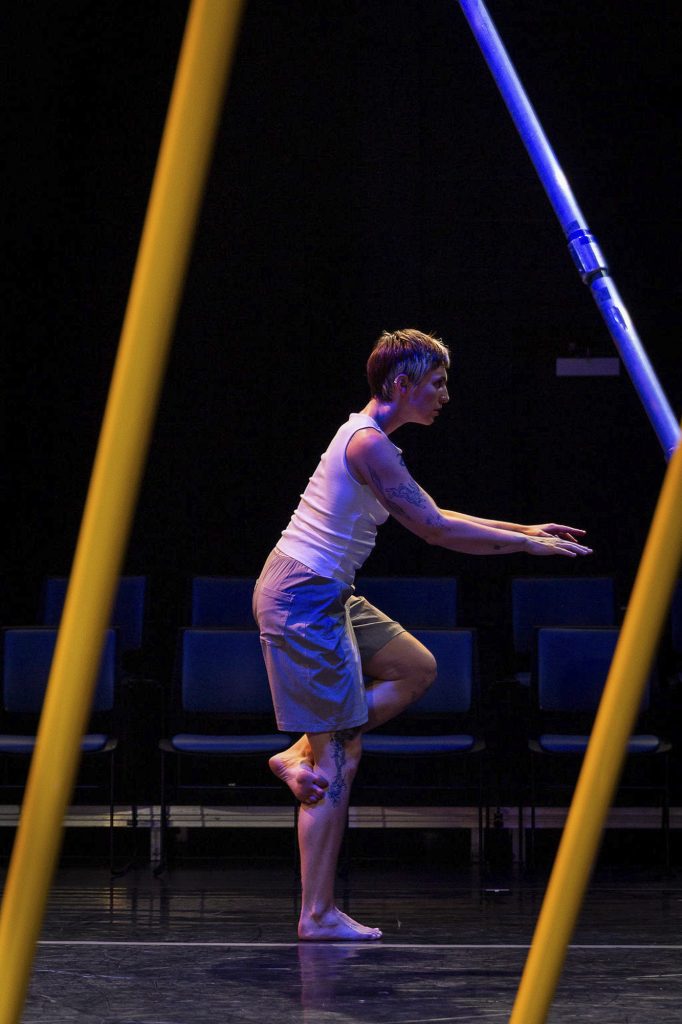 Faith Fidgeon prowled the stage during their solo performance.
For example, Fidgeon opened with a solo in which they circuited the stage, stopping before each of the seated dancers to say, “Watch me.” In prowling, fluid floor work in their solo, and partnered phrase work later in the piece in which they controlled the pace and direction of and space between their own and others’ bodies, Fidgeon was a wolf, dominating the space outside the sculpture.
In contrast, Orn, who had the second solo, was more feline than canine in how she seemed to completely ignore the spatial and social politics that seethed and boiled throughout. Her steps always seemed to take her the shortest distance between two points, even if that meant going through instead of around, and blithely ignoring while gracefully avoiding any obstacles standing in between.
Lee navigated the space within the sculpture expertly, stepping quickly over and around structural elements, almost like playing a game of architectural double dutch. At some points they conjured windows — and at others, walls — from almost empty space through the finely-calibrated and emphatic orientation of their body in relation to the gap between two cross bars.
Bracewell, who said she likes the interstices, offered a performance of edges. She seemed comfortable neither inside — where she ran into and rebounded off of parts of the structure, tripping over elements that Lee and Orn avoided with ease — nor outside the sculpture, as she moved stealthily from one dancer to the next. Bracewell partnered each of them in a contact phrase that began as she whispered, “Trust me” and ended with her kissing the wrist of the other dancer who just a moment prior seemed to have Bracewell in a stranglehold.
While these identifiable characters provided thematic focal points, the dynamic choreographic interactions among the ensemble as a whole — including equally memorable performances from Cardosi, Feracota, Knudson and Shocket — fueled tripwire-taught drama and a perpetual motion machine of confrontation, conflict and resolution. At the end of between dog and wolf, the tension did not resolve so much as snap.
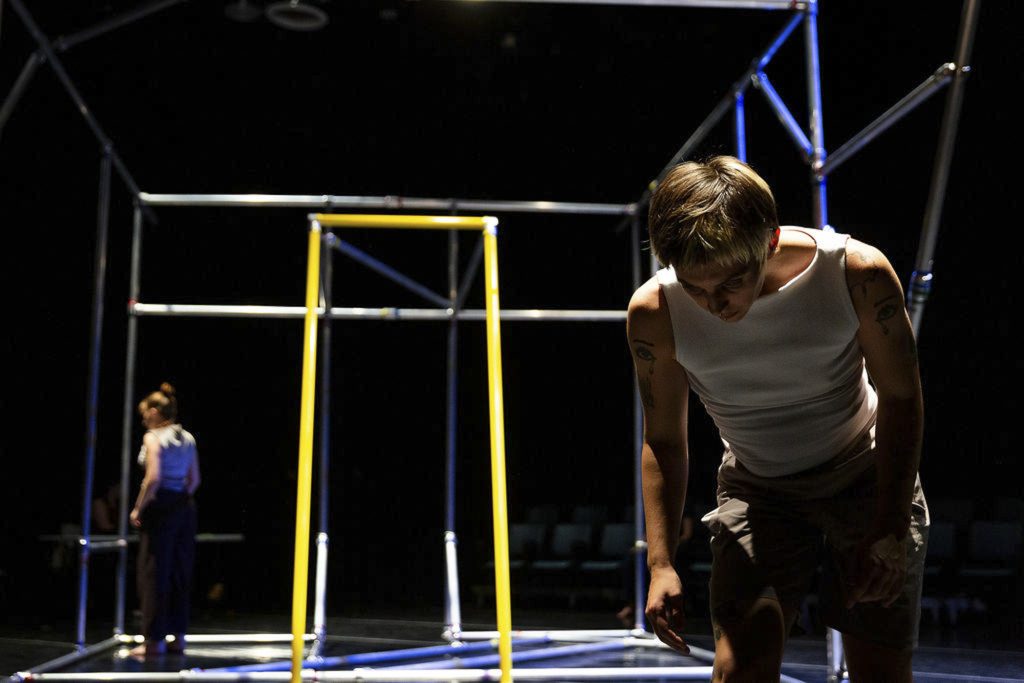 Faith Fidgeon and Lilia Cardosi.
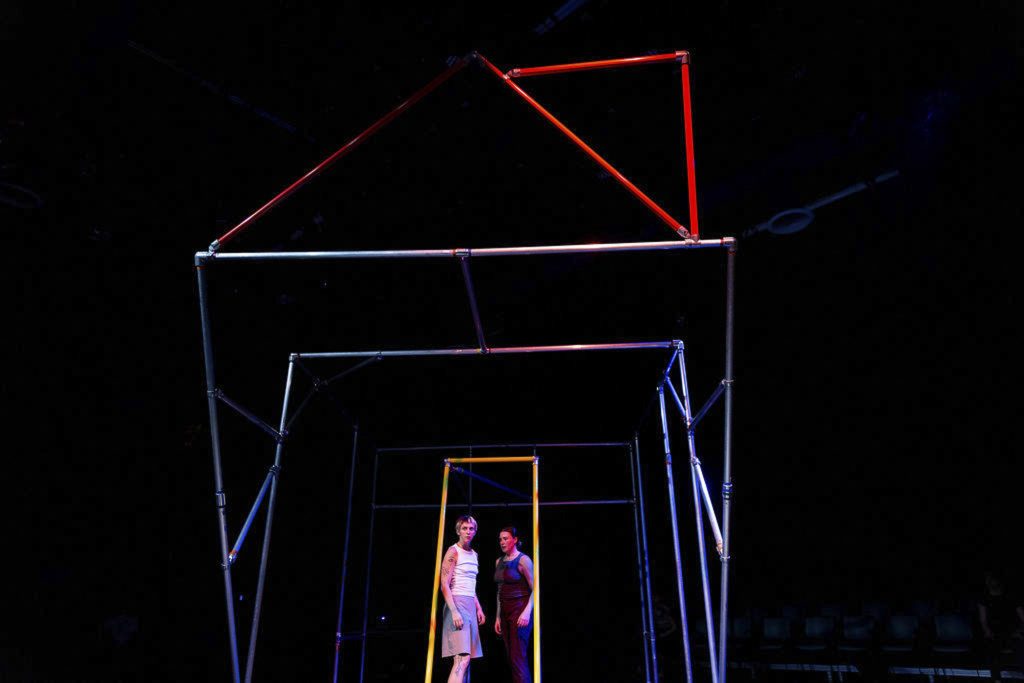 Anna Bracewell and Faith Fidgeon.
 Madison Lee and Julie Feracota.
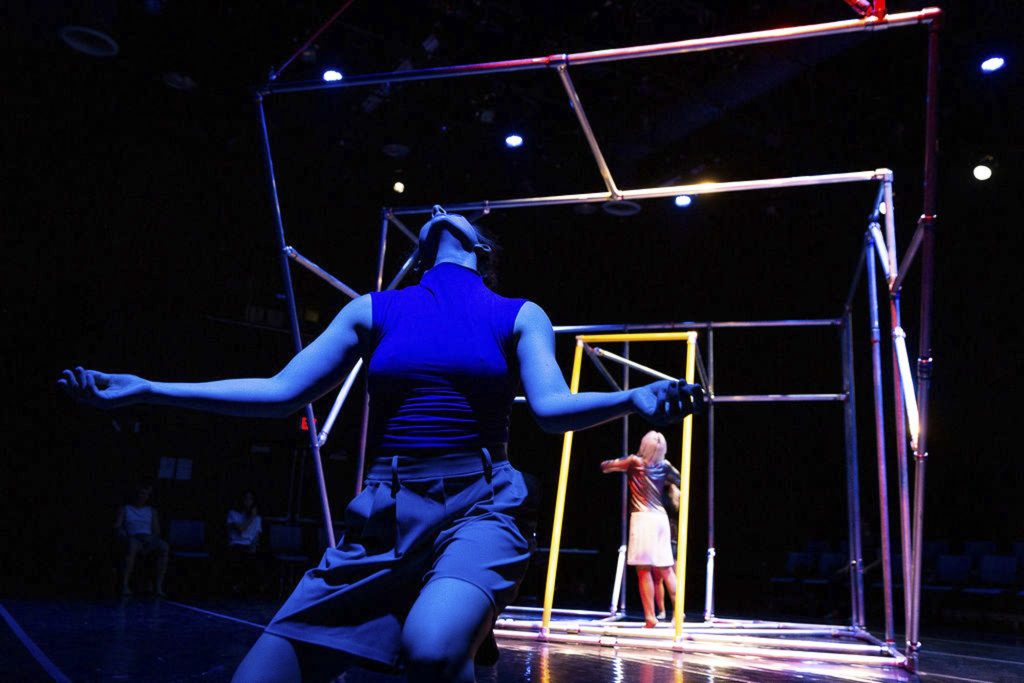 Julie Feracota.
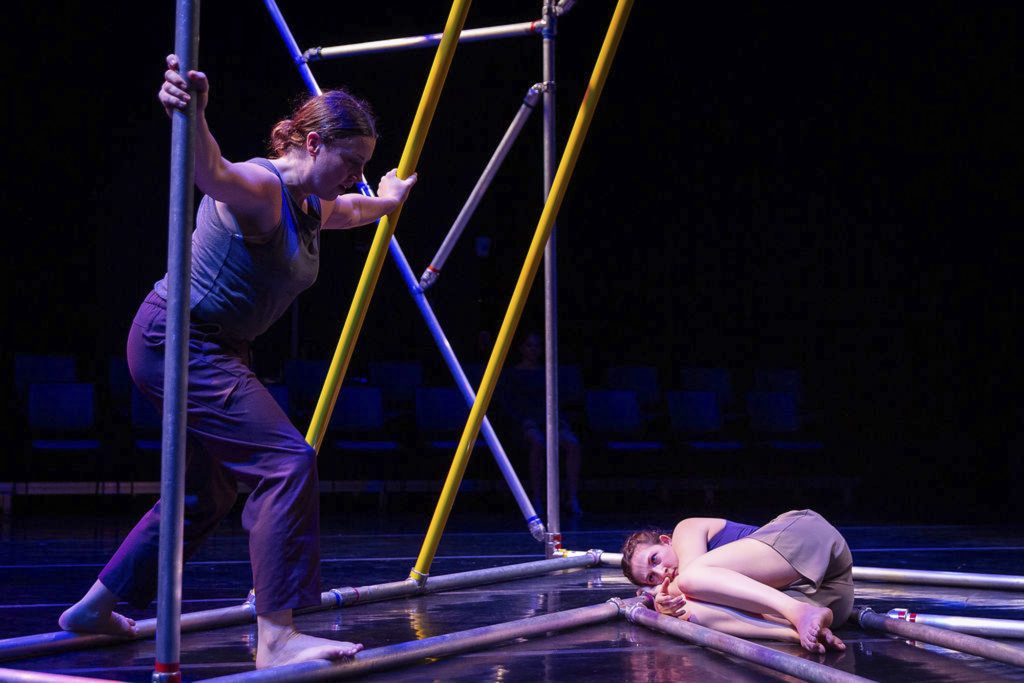 Anna Bracewell and Julie Feracota.
When viewed from the outside, group social hierarchies and relationships such as those within a pack of wolves or dogs may seem well-established and relatively static. Experienced from within, however, they may actually emerge minute by minute from a never-ending dance of challenge and submission. That insider’s perspective is what between dog and wolf succeeded in providing for its audience.
While between dog and wolf certainly stands on its own, it also forms a triptych with Staib’s fence from 2019 and ARARAT, which premiered in 2023. In all three works, Staib seems occupied — and maybe even a little obsessed — with the unreliability of memory, especially in the survivor’s account of traumatic events. Like fence and ARARAT, between dog and wolf drew narrative energy from the productive friction that sometimes exists between individual and collective histories.
That friction began to heat up in one section where members of the ensemble, individually and seemingly at random, announced facts both obvious — Fact: The sun is very big” and quotidian, “Fact: Many people think Madison is 5 feet 4 inches tall but in fact they are 5-foot-6.” It ignited a fire when Bracewell and Knudson verbally confronted one another from microphones placed at opposite diagonal corners from each other. “That’s not how it happened. You’re lying,” Bracewell eventually shouted, as Knudson stammered, “I don’t know why . . . You just . . . I just feel like . . .” And Staib seemed to locate its source as Feracota whispered, “I wish . . . ” over and over — in the subjunctive, that grammatical and conceptual groove in which reality collides with desire — for an explanation, for understanding or for another world altogether.
Staibdance will present between dog and wolf in Atlanta on October 16 at The Trolley Barn and October 26 at Wild Heaven West End Brewery, and the company will take the show to the PAL Theatre in Vidalia, Georgia, on October 23.
::

Robin Wharton studied dance at the School of American Ballet and the Pacific Northwest Ballet School. As an undergraduate at Tulane University in New Orleans, she was a member of the Newcomb Dance Company. In addition to a bachelor of arts in English from Tulane, Robin holds a law degree and a Ph.D. in English, both from the University of Georgia.









 English (US) ·