
.jpg)
PROTECT YOUR DNA WITH QUANTUM TECHNOLOGY
Orgo-Life the new way to the future Advertising by Adpathway Roll for the Galaxy is a 2014 dice-based tableau/engine-building game. Released seven years after what many in the hobby now consider a modern classic in the form of Race for the Galaxy, Roll had a lot to live up to.
Was Roll for the Galaxy able to strike its own path forward and do enough to really differentiate itself in the minds of players, or is it a game unfortunately stuck in the shadow of its predecessor?
Gameplay Overview:
Roll for the Galaxy is played over an indeterminate number of rounds and sees players building their tableaus using different dice. Each round is played in five phases, but only the ones chosen by the players are performed.
 The dice for Roll for the Galaxy are nice and chunky with clear iconography.
In Roll for the Galaxy, all actions are simultaneously performed, starting with players rolling their dice behind hidden screens and then placing those dice under corresponding symbols to organize them into each of the five different actions. Each player then takes any one of those dice and places it on their action selection board, representing the action they wish to occur this round.
All players reveal their selections, and each action chosen by a player will then be performed during the round. The number of dice each player has under each action is how many times they are allowed to perform said action, and if a player has no dice under an action, then they cannot perform it.
Each action (Explore, Develop, Settle, Produce, and Ship) assists the players with building their tableau, which can be filled with planets and technologies, and eventually triggering the end of the game if any one player is able to build twelve tiles into their tableau. Players also have various ways of mitigating the luck of the die throughout the game. The player with the most points (represented by VP chips) at the end of the game wins.
 Players placing dice representing different phases as their choice for a particular phase can be confusing.
Game Experience:
Fiddly is a word that gets thrown around a lot in the board gaming hobby. And while the term has cast a wide net that covers (probably) way too many things at once, Roll could be considered a fiddly game. Especially when compared to its predecessor, which is literally played with just a deck of cards. The addition of dice balloons the game space, not just on the table, but also the decision space of the game, which does not always end up being for the best. And those dice are LOUD, leading to a sometimes uncomfortable play experience.
Like its predecessor, Roll is an obtuse game at first. The rules, as written, do a great job outlining the flow and actions of the game and what will inevitably end it. However, when players are actually playing the additional components confuse the process.
 Players’ play space can grow quite large so make sure you have lots of space.
Each player rolls their dice and organizes them to corresponding symbols, but, in choosing an action, you can use any die with any symbol on it to represent your chosen action. While a nice touch that makes players ultimately choose between giving up certain actions to guarantee others and hedging bets that certain actions will be chosen by other players, this does lead to some confusion. After having played the game a number of times and with different groups of people, there are always questions about whether or not a certain action was chosen because of the die faces not matching the chosen action. This is before flipping over the tiles to indicate the chosen actions, which again is an extra layer that adds to the game’s fiddliness.
As it progresses, like with all games, the strategies and flow come to the forefront. Players rolling dice, selecting actions and building their engine that leads to cool combos, eventually. Especially when everything is happening simultaneously, Roll feels smooth to play. And because of how the settling/developing works in this game, it feels way more rewarding to build up your tableau, as until those tiles are finished your resources (dice) are stuck there contributing to their build value until finished.
 Rolling the dice in the plastic cups can get quite loud.
All of this leads into a decision space that, especially with the limited resources players start with, can lead to frustrating starts and rewarding ends. Building to get to that reward, however, more often than not feels like a slog as the cool combos present in Race rarely happen in Roll. It just feels like a slow grind to get to an inevitable conclusion that’s slowed down due to the dice. And while yes, there are ways to mitigate your luck with the dice, unless a player can generate generous amounts of wealth to buy those dice back, most of the time they end up stuck with what they have for far too long.
Especially at higher player counts, this issue is exacerbated, even with simultaneous play. Due to strategies being slow to develop and tiles hard to read, players rarely fully know what their opponents are capable of from turn to turn until they’re already doing that thing. There’s also very little interaction between players and few, if any, opportunities to mess with an opponent’s goals. This can lead to a runaway leader problem as well.
Roll ultimately ends up being a cool concept with frustrating execution at every turn. And while the design may lend itself to repeated plays, it unfortunately succumbs to the issue of what players prefer, and most of the time, that’s going to end up being Race for the Galaxy over Roll for the Galaxy.
Final Thoughts:
Roll for the Galaxy is a game that, unfortunately, could not live up to the mantle passed by its predecessor. It has good ideas that are let down by an elongated mid-game that makes the end feel limp and unrewarding. The tactile nature can also be overwhelming, especially for players with sensitive sensory experiences.
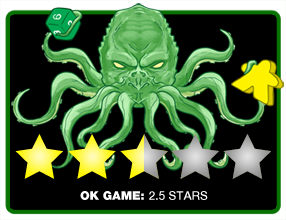
Final Score: 2.5 Stars – A new take on a classic in the board gaming sphere that does enough to differentiate itself from its predecessor but, unfortunately, does not live up fully to that previous title’s legacy.
 Hits:
Hits:
• Rewarding endgame
• Plays quickly
Misses:
• Frustrating beginning and mid-game
• Decision space feels constricting for how many choices are presented to players
• Tactile experience of the game may be overwhelming for some players









 English (US) ·