
.jpg)
PROTECT YOUR DNA WITH QUANTUM TECHNOLOGY
Orgo-Life the new way to the future Advertising by Adpathway This is a story of a time long ago—a time of myth and legend. When the ancient gods were petty and cruel, and plagued mankind with suffering—oh sorry, wrong script. Walking around GenCon last year, I saw advertising from Rush of Ikorr everywhere. Seemed like most people had a Rush of Ikorr lanyard, even. Given my long history of playing CCGs, I was interested, particularly due to the obvious mythology connection. I was finally able to try it out and see what I was missing, if anything.
Rush of Ikorr is a trading card game from Upper Deck, pitting one or more divine Avatars against one another. It is a game for 2, 4, or 6 players and takes 60-90 minutes to play. The best experience is with 6 players.
Gameplay Overview:
If you are familiar with Lorcana, much of Rush of Ikorr will seem familiar, but with different terms (and a less cute appearance), though there are certainly some differences as well that are reminiscent of other popular games in the genre (Hearthstone is one I kept coming back to). The ultimate goal is to accumulate a set number of “Ikorr” with your Champions. These victory points vary based on your player count, with 1v1 requiring 10 Ikorr to win, and 2v2 and 3v3 both requiring 15.
Each player has an Avatar, representing different mythological gods such as Zeus, Osiris, Isis, Apollo, Kukulkan, and more. These Avatars have a couple of elements that guide the rest of your deck: unique Avatar and Rush abilities, which strategically guide you, and Aspects that determine which cards can go into your deck (Ambition, Prophecy, Devotion, etc…). Each Avatar only has 2 of the 6 Aspects, so your deck can only include cards from those 2 Aspects/colors, and not the remaining 4.
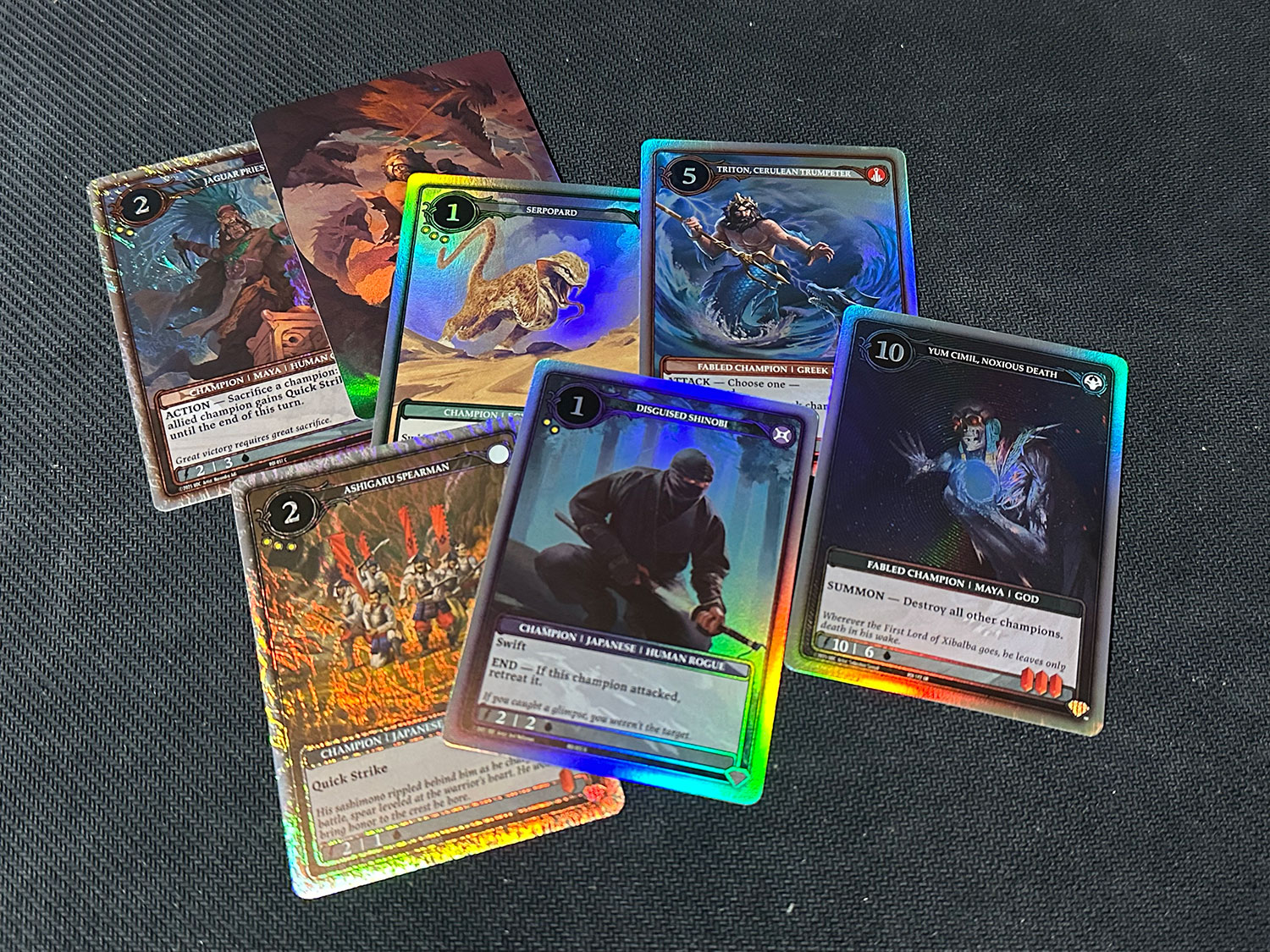 Like any modern TCG, Rush of Ikorr has cosmetic variants hidden in packs: foils, alternate art cards, or even some borderless cards.
Like many other TCGs, the turns are broken up into phases. Each turn consists of a Start Phase, Draw Phase, Action Phase, and End Phase. The Start and Draw Phases are automatic actions. You gain any Ikorr your Champions collected your previous turn, gain an Influence from your Influence deck (this is the resource that you use to play cards. You gain 1 per turn to a max of 10 in a very Hearthstone-y fashion), and draw 1 card from your deck. The meat of the action takes place during the appropriately named Action Phase, when you have most of your strategic decisions to make regarding playing cards, using activated abilities, deciding which Champions to attack with, or raiding for Ikorr. The End Phase is just a time when some abilities will trigger.
In the 2v2 and 3v3 formats, you might expect from other games that each player would go through a turn and then pass to the next player. However, to speed up gameplay, the entire team takes a turn at the same time, with all your allies completing each phase of the turn at the same time, rather than sequentially.
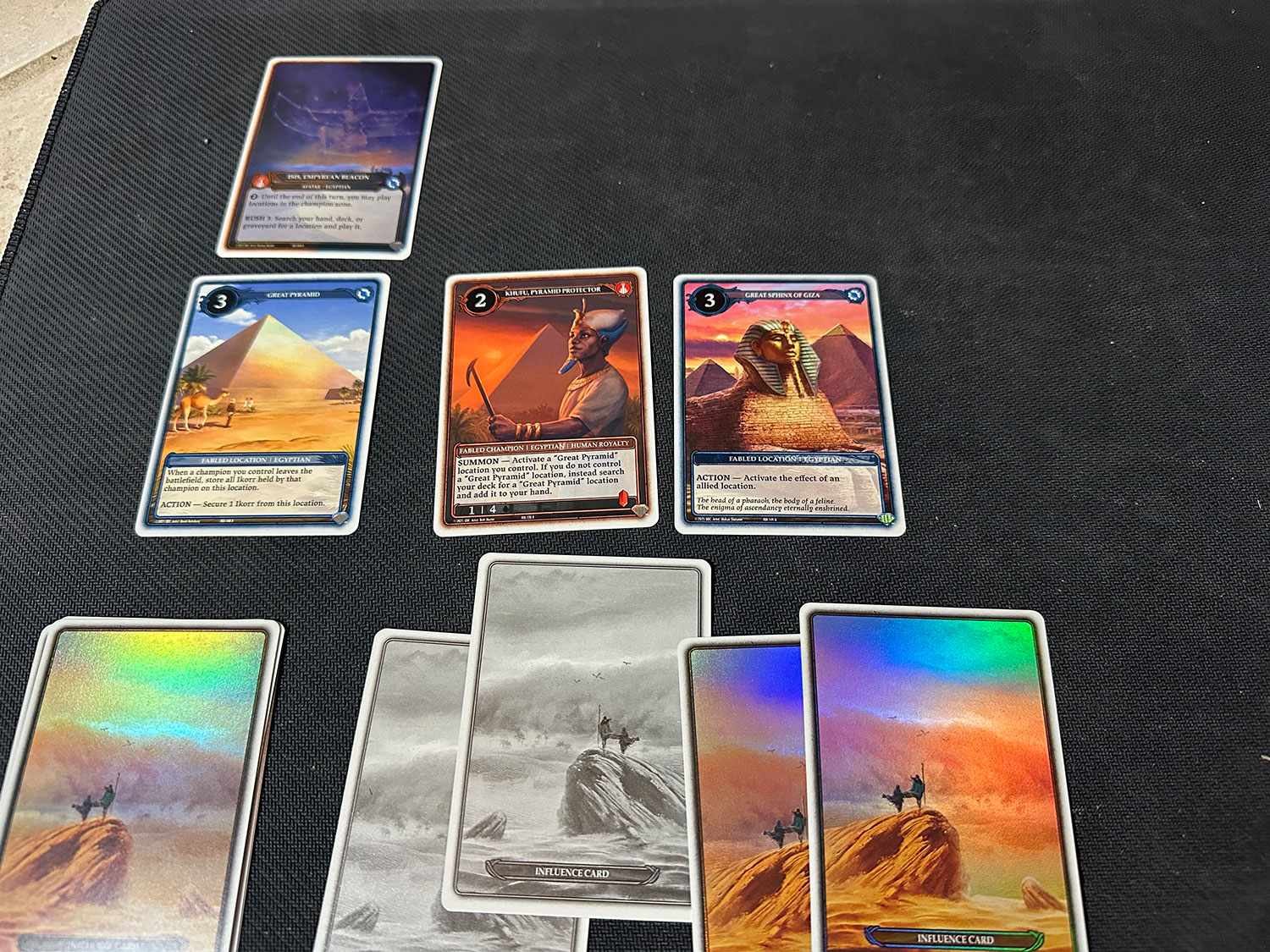 The fabled champions and locations you may summon have abilities themed around their histories and mythologies. Khufu helps you build the Great Pyramid. Who knew?
Game Experience:
The core of the game is, obviously, the Action Phase. Everything you can do and every actual choice you have takes place during your Action Phases. You are limited only by the cards that you have in your hand and your available Influence (which will build up by 1 every turn, and refresh at the start of the turn). Making effective use of your resources as they accrue is important, as anyone who has played this style of game in the past can attest.
A lot of your strategy and deck construction will be defined by your Avatar due to its attributes. The two powers on Avatars give you a direction that you’re going to want to follow, since your Avatar is the one card that you will be assured of access to for the entire game. In another Hearthstone similarity, these are akin to the Hero Powers. The first power is typically an activated power that just takes influence, while the second is referred to as RUSH ability, which requires destroying a certain amount of Ikorr you’ve obtained to use. Since this sets you farther back from victory, they need to be powerful, and knowing when to use them can be tricky.
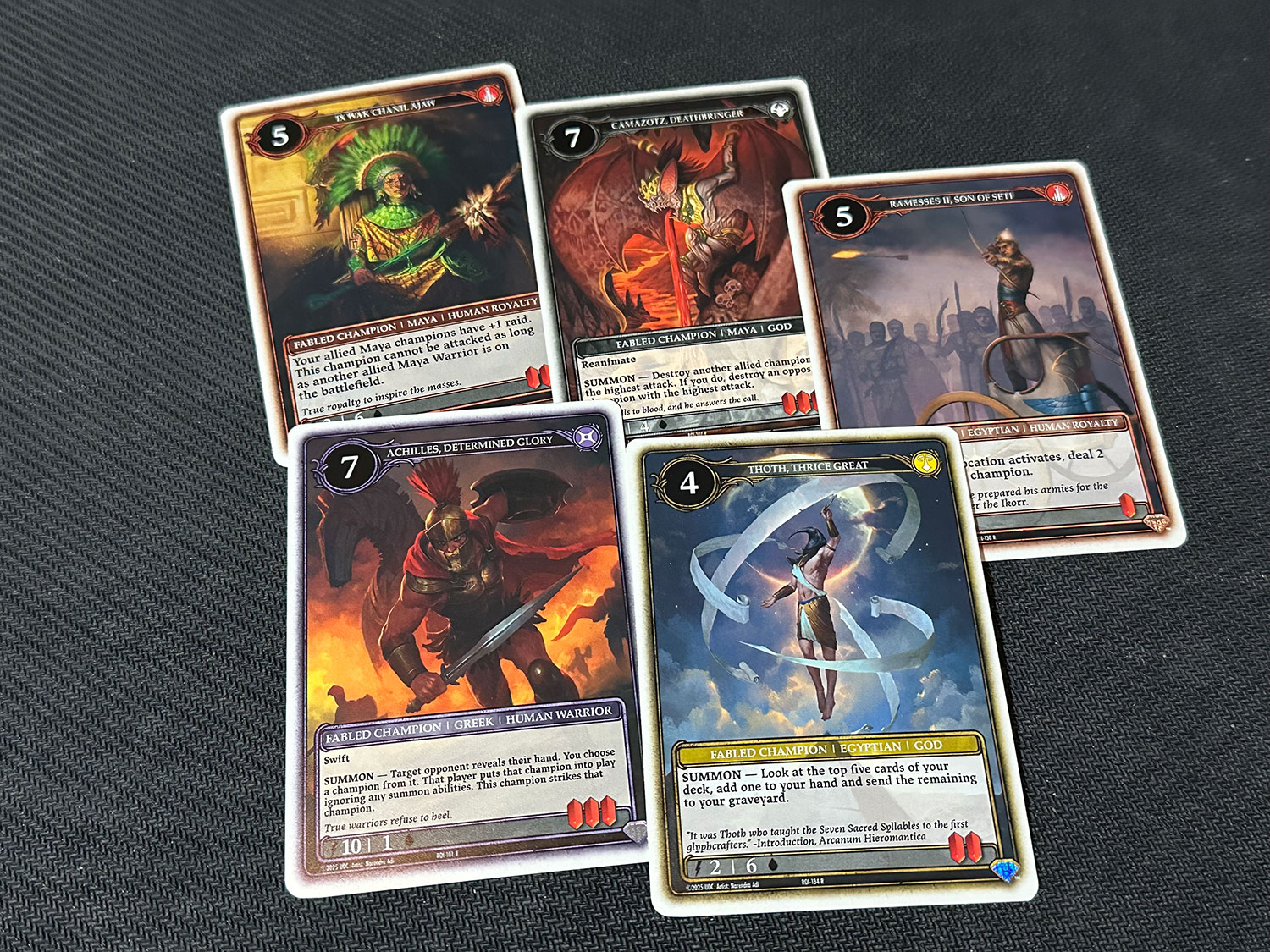 Champion cards are the core of gameplay and many are recognizable faces from history or mythology. From mortals of legend like Achilles to real-life royalty like Ramses the Great to gods like Thoth, there are many allies in your quest to control the Ikorr.
This makes it very much a game of managing your resources. Powers that require destroying Ikorr can be a big swing, but they can also be a significant setback. You have to balance them with the other key aspect of the Action Phase: Champions. The various Champions can be everyday generic characters like an Egyptian Accomplished Architect, or they can be a unique character like Imhotep. They are used for both attacking and dealing damage to opposing Champions, or for raiding to secure Ikorr. They can only do one or the other in a given turn. Some are better at attacking, some are better at defending, and some are better at raiding (not every Champion is able to raid). Though Champions are the most important cards in your deck much of the time, there are also Spells and Locations, rounding out the types of cards you can find in the game. Spells are one-shot effects that are discarded after being played, and Locations are ongoing effects with activated abilities (though you can only have one in-play at a time!).
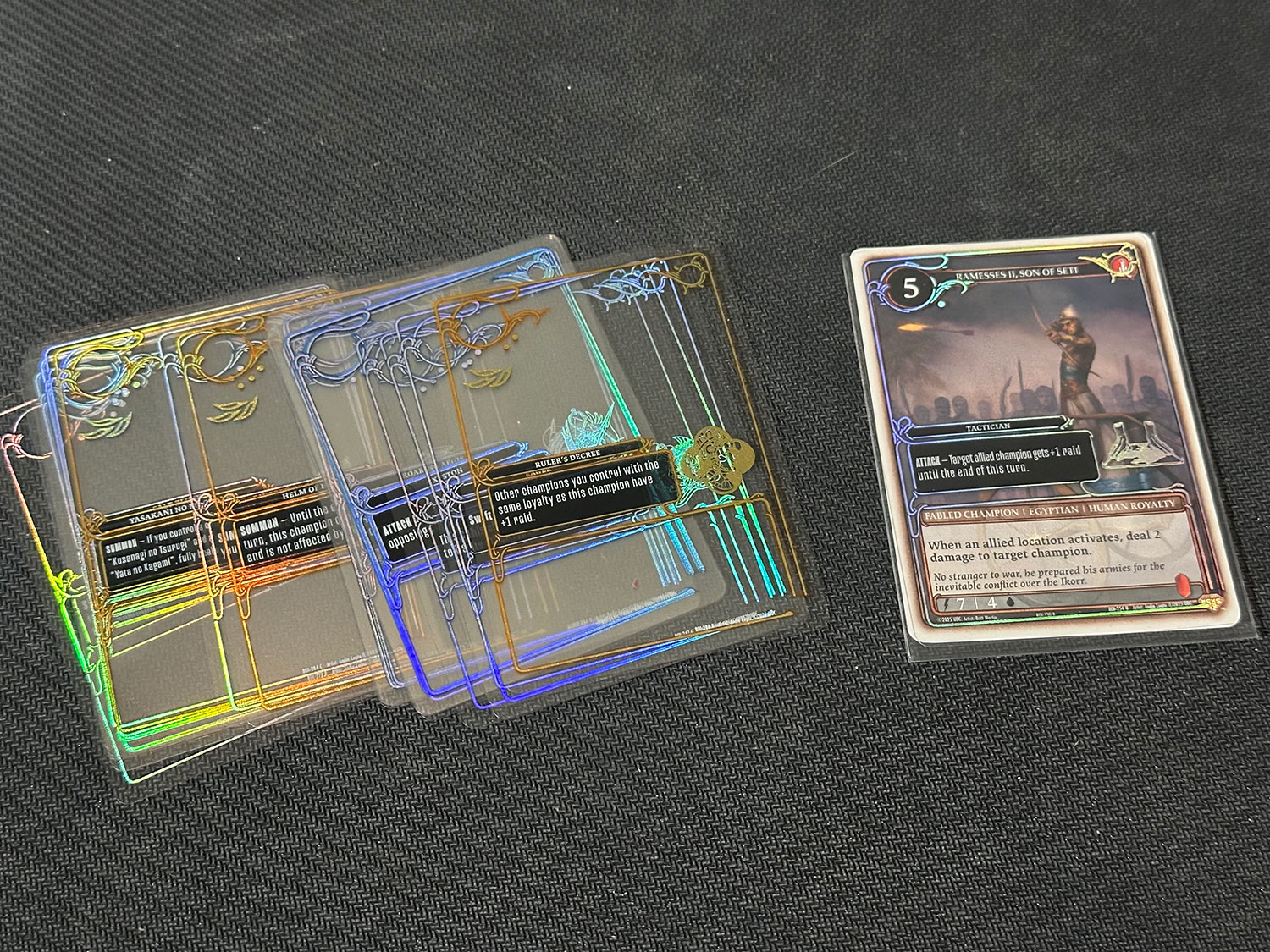 The Infusion cards are the game’s primary innovation. They slide into a sleeve with another card (making sleeves a requirement if you use them). One comes in every pack.
The last “card” you may find in packs is the Infusions. These cards are printed on clear plastic and are meant to be overlaid with Champions in sleeves, adding additional effects to the Champions. They ended up being a bit finicky, and I didn’t feel they added enough to the game to offset that. You add them during deck-building, and they can only go on certain Champions, which is a bit difficult to read. It seemed they tried to limit what was on them for readability, but it did not work out as well as I would have liked.
That downside aside, I think the other innovation of the game does work out pretty well, and that would be being designed from the ground up as a multiplayer team game. The danger in that sort of game is that once you start adding too many players, things can get bogged down with a lot of downtime between turns (try playing Commander with more than 4 players…). While it does require a bit of coordination so that everyone isn’t trying to talk over each other, having the entire team take its turn at the same time is helpful in keeping game time down. I wasn’t very much in favor of a greater than 2-player format, but it worked better than I’d expected.
Final Thoughts:
I respect that the designers here were trying to keep the game streamlined, with more depth of gameplay than you might expect from a simple game. I think that they did largely succeed at that. If you discount the Avatar and Influence, which are not actually in your deck, there are only really 3 types of cards, and you’re mostly only dealing with the Champions. If the Avatars are pointing you in a strategic direction, the Champions are what you use and interact with most. I felt like that brought home the thematics pretty well, and I am a big Vorthos, with ancient mythological champions fighting it out at the behest of their gods’ whims. That said, while it was thematically on point and I feel that they met their objectives of a game that’s easy to learn, but with depth, I didn’t particularly like it a lot. Never really got excited about it, win or lose. I think the issue was that very little of it felt new. Everything borrows from something (impossible not to with so many good games coming out every year), but I didn’t find a whole lot here that was innovative or exciting.
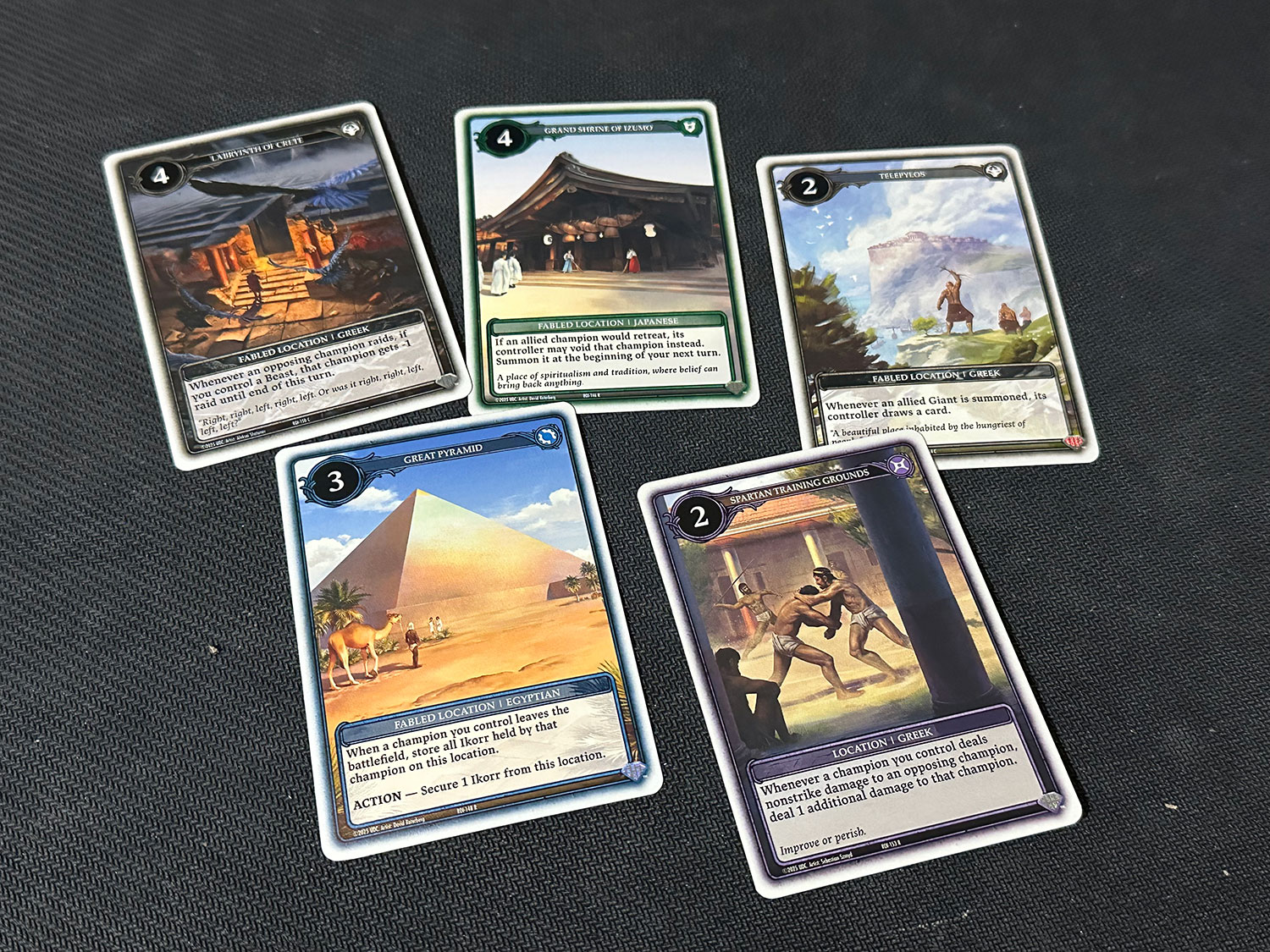 Typically, you can only have one location in play at a time (unlike champions), so their effects tend to be ongoing and impactful. With places like the Labyrinth of Crete and the Great Pyramid, its like a travelogue of the ancient world.
The thing I probably liked most about this game was the built-with-multiplayer-in-mind aspect. Back when I did my Top 10 Classic CCGs list last year, one of my (likely controversial) inclusions was Blood Wars, which likely might seem odd given my comments about 4+ player games earlier. But that is only because pulling off a game with more than 4 players is quite difficult. Since Blood Wars, I never found a CCG I’d be willing to play a game with more than 4, but this one did make it work. The sense of teamwork and cooperation is great, and the targeting rules make things not get bogged down (you can only target the person directly across from you or the person(s) sitting next to you).
The other big innovation fell flat for me: the transparent Infusion cards. I already discussed their shortcomings, so I won’t go into them too deeply, but I think this is an area where they could improve the game and maybe make it a bit more interesting. As it was, it isn’t really gameplay per se, because you assign your Infusions during deck construction. It seems like it would have been much more interesting to make them something you could add with spells or abilities to Champions that you have already summoned. This would skirt some of the restrictions that made them annoying to read or the requirement to slide them into sleeves in front of cards. That would be more interesting than just “these cards are now better.”
The game was, at its core, good enough that I’d be willing to give it another look after they release some expansions and see how it goes a second time. I think it has potential, and it just is not fully realizing it at this point. Since I love throwing lightning bolts, I’d like to see it improve.
Final Score: 2.5 Stars – A game with a solid core and thematics, let down a bit by slightly stale gameplay and a miss on innovation.
 Hits:
Hits:
• Cooperative team play at 2v2 and 3v3 is well done with simultaneous play
• Rules don’t get bogged down by trying to do too much
Misses:
• Infusion cards are a little annoying to deal with and add little in terms of gameplay.
• Very little feels new here
• No Hera to get cranky at Zeus (ok, so this isn’t a real miss. . .).

/pic9148407.jpg)








 English (US) ·