
.jpg)
PROTECT YOUR DNA WITH QUANTUM TECHNOLOGY
Orgo-Life the new way to the future Advertising by Adpathway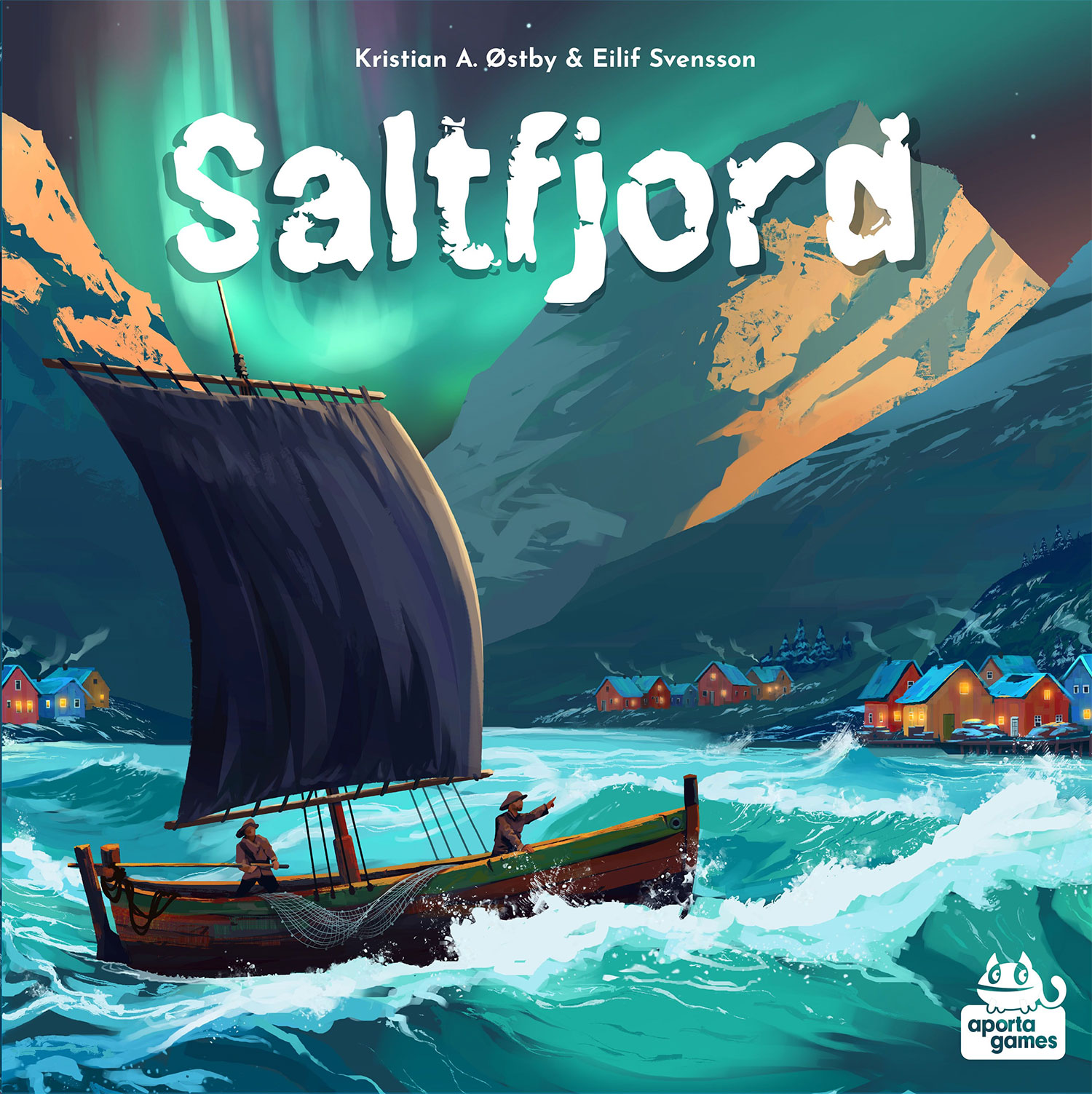 On April 1, 2022, the All You Can Board YouTube channel officially announced that they would be changing their name to All You Can Fjord, owing to their enthusiasm for excellent fjord-themed games, encompassing all of three games: Fjords (2005), Nusfjord (2017), and Fjords (2022). At the time, this was an April Fool’s joke. If they had waited for the 2024 release of Saltfjord, however, the true awesomeness of fjord-themed games would have been no joke.
Saltfjord is designed by the duo of Kristian Amundsen Ostby and Eilif Svensson, who previously brought us Revive and Santa Maria, but for this game, they picked a theme closer to their Nordic roots. In Saltfjord, 1-4 players compete over 45-90 minutes to bring prosperity to their early 20th-century Nordic villages by expanding settlements, fishing, trading, and researching new technologies. Featuring dice drafting, tech trees, and engines within engines, Saltfjord brings the heat to an otherwise frosty theme.
Gameplay Overview:
The center of Saltfjord is a 6×6 grid on each playerboard that allows activation of icons on specific rows or columns depending on the pip-value of drafted dice.
Each of three rounds will have 4-6 dice per player rolled as part of a common draft pool; orange dice can only activate rows and white dice can only activate columns. Playerboards start with some pre-printed icons, and in lieu of drafting a die on their turn, players can opt to construct a large building (paying the cost) which adds additional icons to their board.
As a free action on any turn, players can have their personal fisherman directly visit a single icon anywhere on their playerboard for activation.
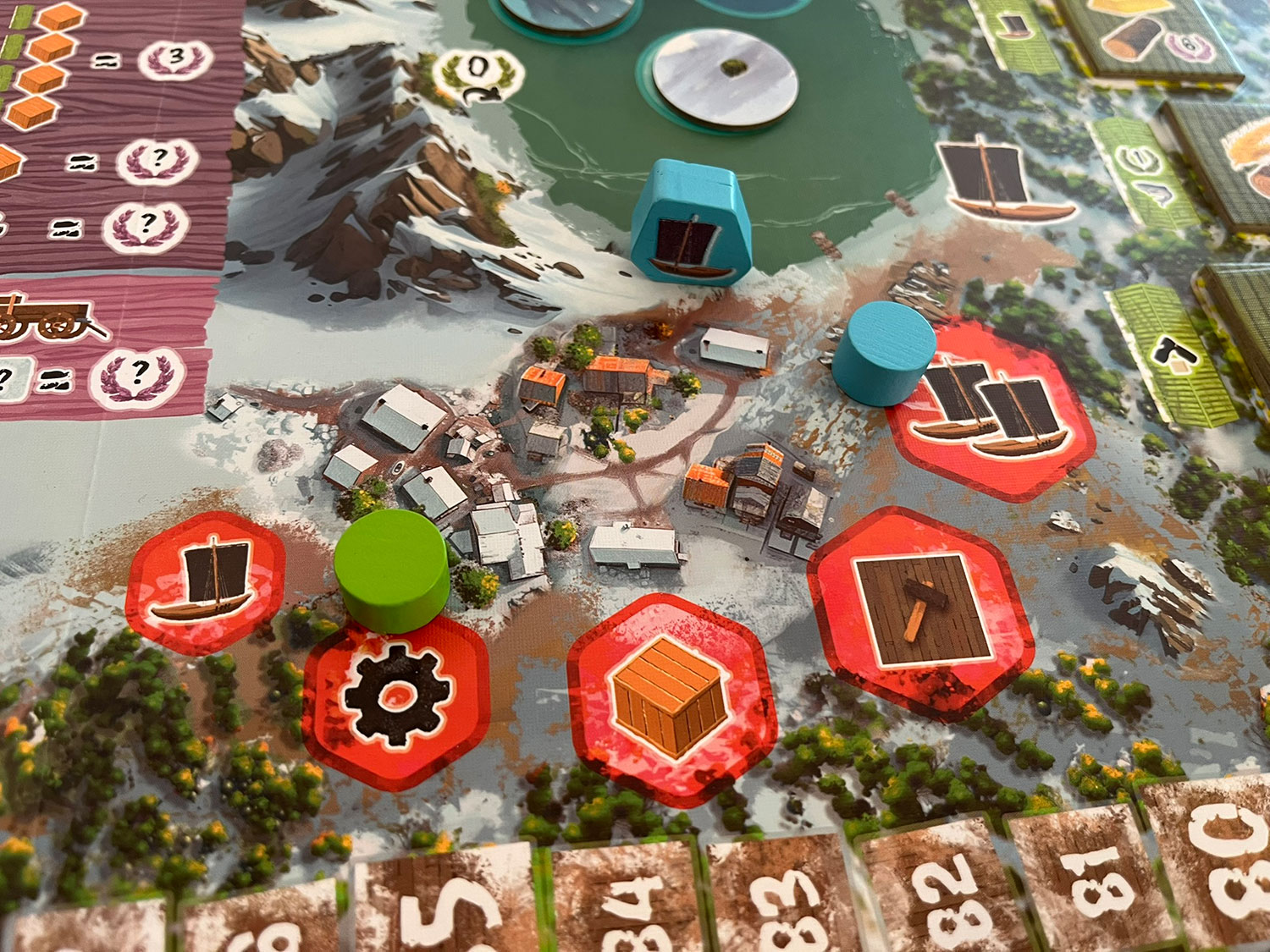 Players can race for the best tavern actions at the end of each round, shown here.
Otherwise, icons are predominantly activated through use of drafted dice which will move top to bottom or left to right for columns and rows, respectively, activating the icons in order.
The main icon corresponds to the following actions:
- Gain a resource
- Fishing: send your boat outward to collect fish and other rewards
- Building: construct small buildings on your playerboard
- Trading: Fulfill a contract by packaging up desired resources in a crate, and place that crate in your personal storage area
- Upgrade a resource—All resources are represented by cubes that can be upgraded in a flowchart-like manner to more valuable resources
- Research technology: pay the cost to advance up one of four technology tracks which will improve the power of other actions.
If at any point, construction of a small or large building results in completing an entire row and/or column of your 6×6 grid, collect all non-icon related rewards printed on those tiles (usually resources or points).
Once players have passed for the round, their fun is not over. They first perform one free tavern action in a worker placement like fashion. They then take additional bonus actions for each crate in their storage area, based on the row in which it’s stored.
At game-end, the highest score wins.
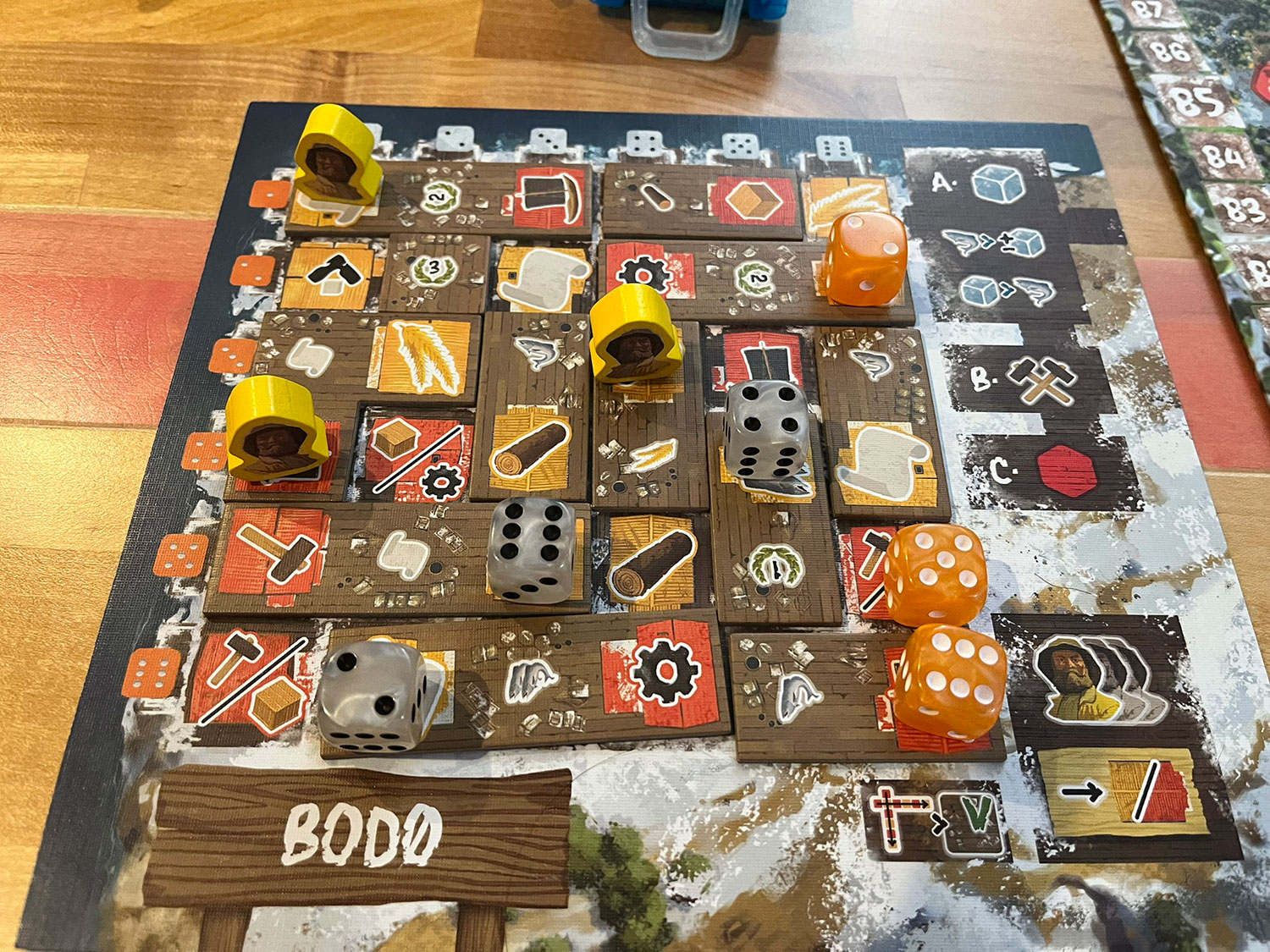 An individual playerboard at game-end is shown here, completely covered in building tiles
Game Experience:
Saltfjord is a dream for players who enjoy medium-weight engine builders. As you add buildings/icons to your personal 6×6 grid, each dice activation gets more powerful. Plan well, though, because icons will get triggered in order top to bottom/left to right, and you need to make sure you gather appropriate resources before trying to fulfill contracts, building, or leveling up technology tracks. Furthermore, the last icon in any given activated row/column becomes locked by the die; thus, triggering the appropriate rows/columns in the right order can potentially grant double-activation of an intersecting icon over two turns—but only if you haven’t already locked it with a die.
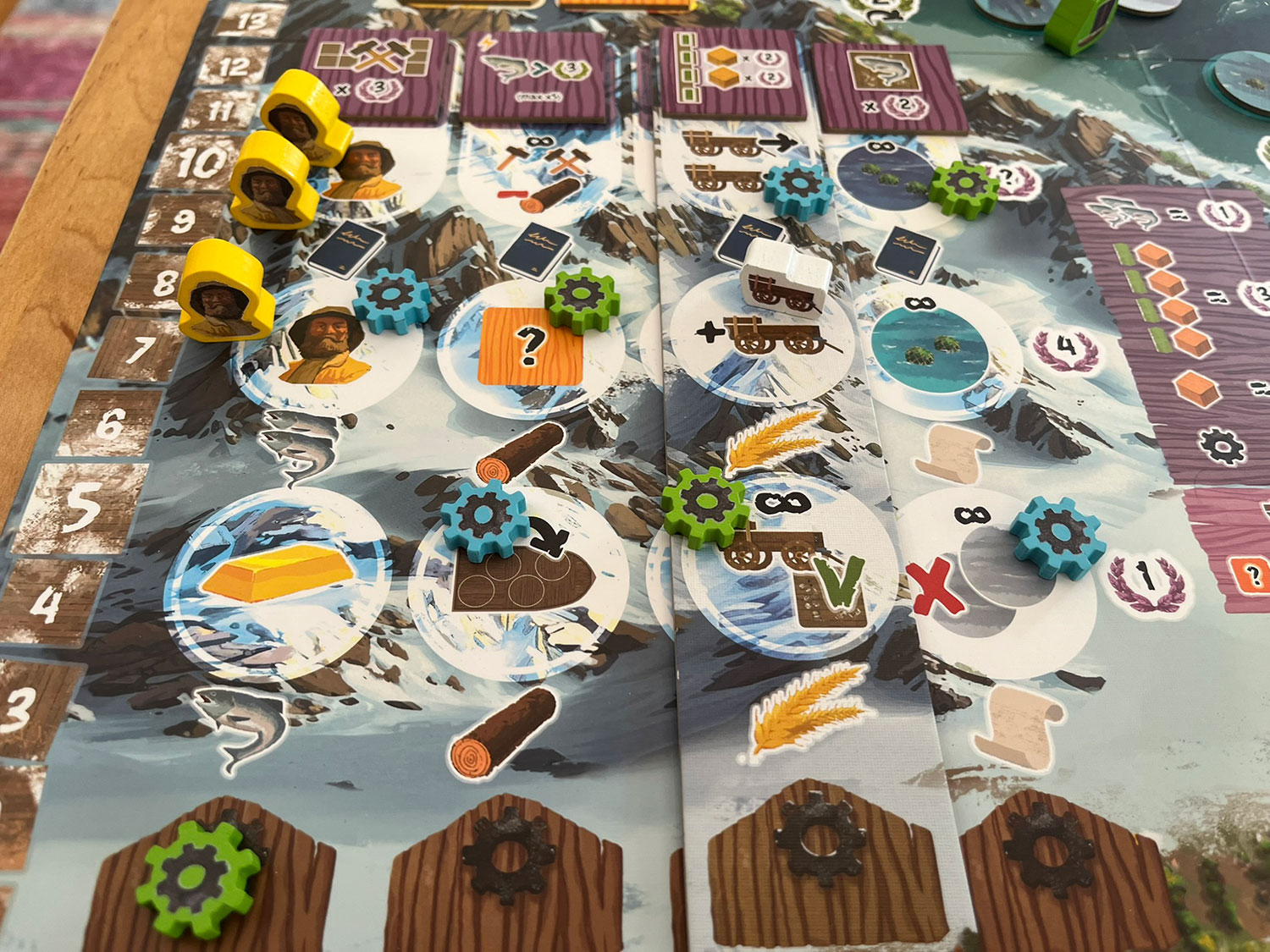 Four tech tracks are shown here.
Each of the four tech trees is similarly tantalizing, as they all offer tremendously helpful engine-building abilities to make your respective actions better. Plan on doing a lot of fishing? You’ll want to increase your boat’s capacity and/or unlock the ability to fish in deeper (more lucrative) waters. If you want to fill out your 6×6 board quickly, the tech that decreases building costs is useful.
If you plan to focus on contracts, you will want the abilities that maximize their rewards. And if you start with one of the asymmetric abilities that make your fishermen more powerful, you may want the techs that give you more fishermen. Heck, if you’re underwhelmed with your starting asymmetric ability, there’s a tech that gives you an additional asymmetric ability. Each tech tree is linked to a unique end-game scoring ability for players who reach the top, so this can also incentivize specialization in a particular tech.
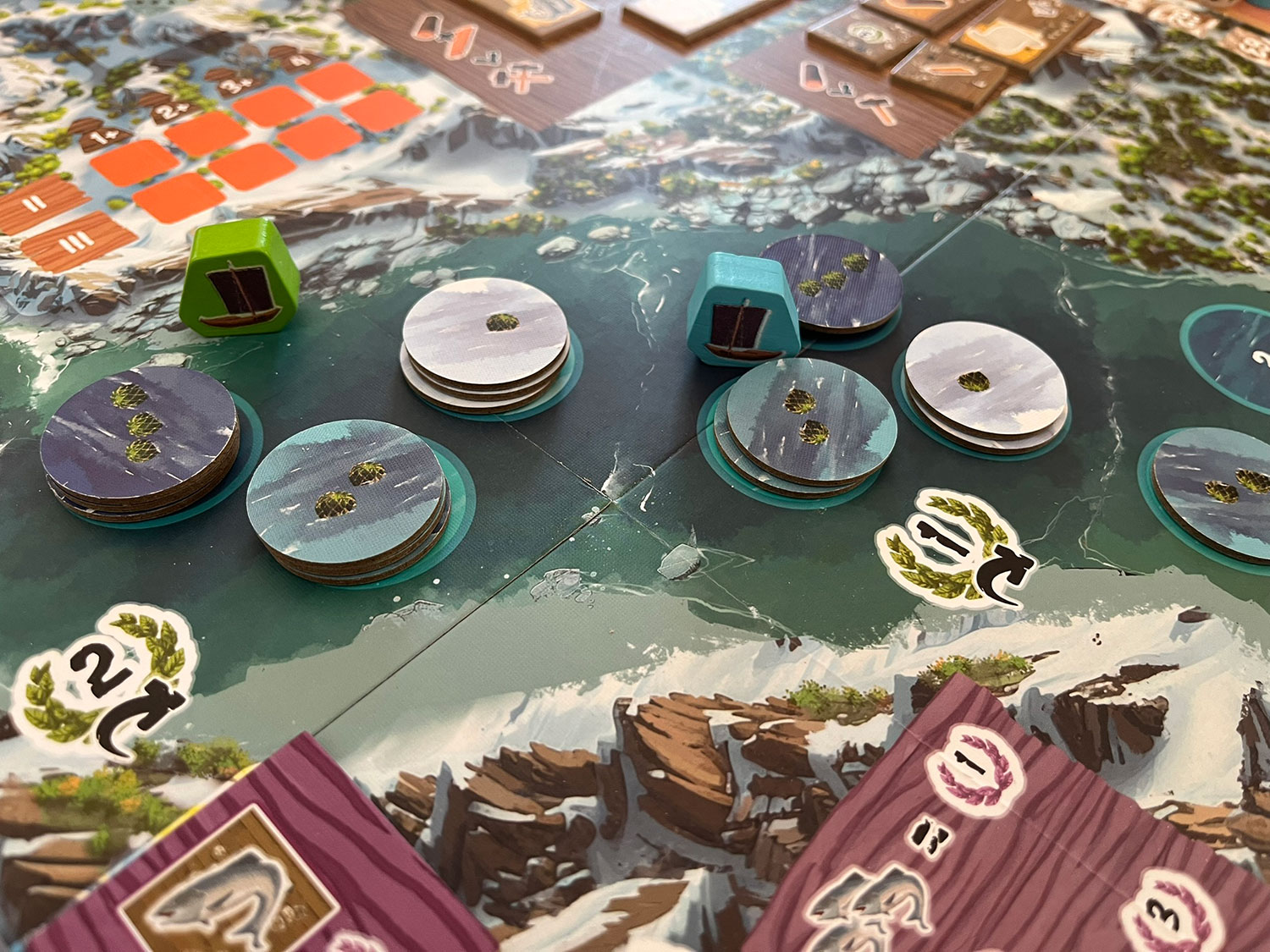 Fishing can provide valuable resources and points. There is some randomness as to what you’ll find, but upgrading technologies allows you to venture farther, fish in deeper waters, and mitigate bad luck.
Players may feel as if they get little done in the first round, but if they play well and get their engine going quickly, it is possible—although difficult—to completely fill their 6×6 grid, reach the top of every tech tree, complete multiple sets of trade contracts, and find themselves overflowing with leftover resources (worth points) by game-end, which all feels quite satisfying. Some might complain that if it’s possible to do everything, then the game is too easy, but I would counter that efficiency in maximizing points still very much matters. If you’re not doing well in a particular game-end scoring condition, is it worth paying valuable resources to max out that particular track?
The strategy for maximizing points will also change from game to game. Players will initially draft a set of variable resources, starting building tiles, and asymmetric abilities (among 8 total); these factors will often dictate how to best build out your board or which technologies to acquire. The combination of available game-end scoring conditions also dictates strategy. There’s also an option to completely replace the trading tech track with a wagon track that introduces a completely new and fun mechanism to get extra activations from your playerboard with specific dice selections.
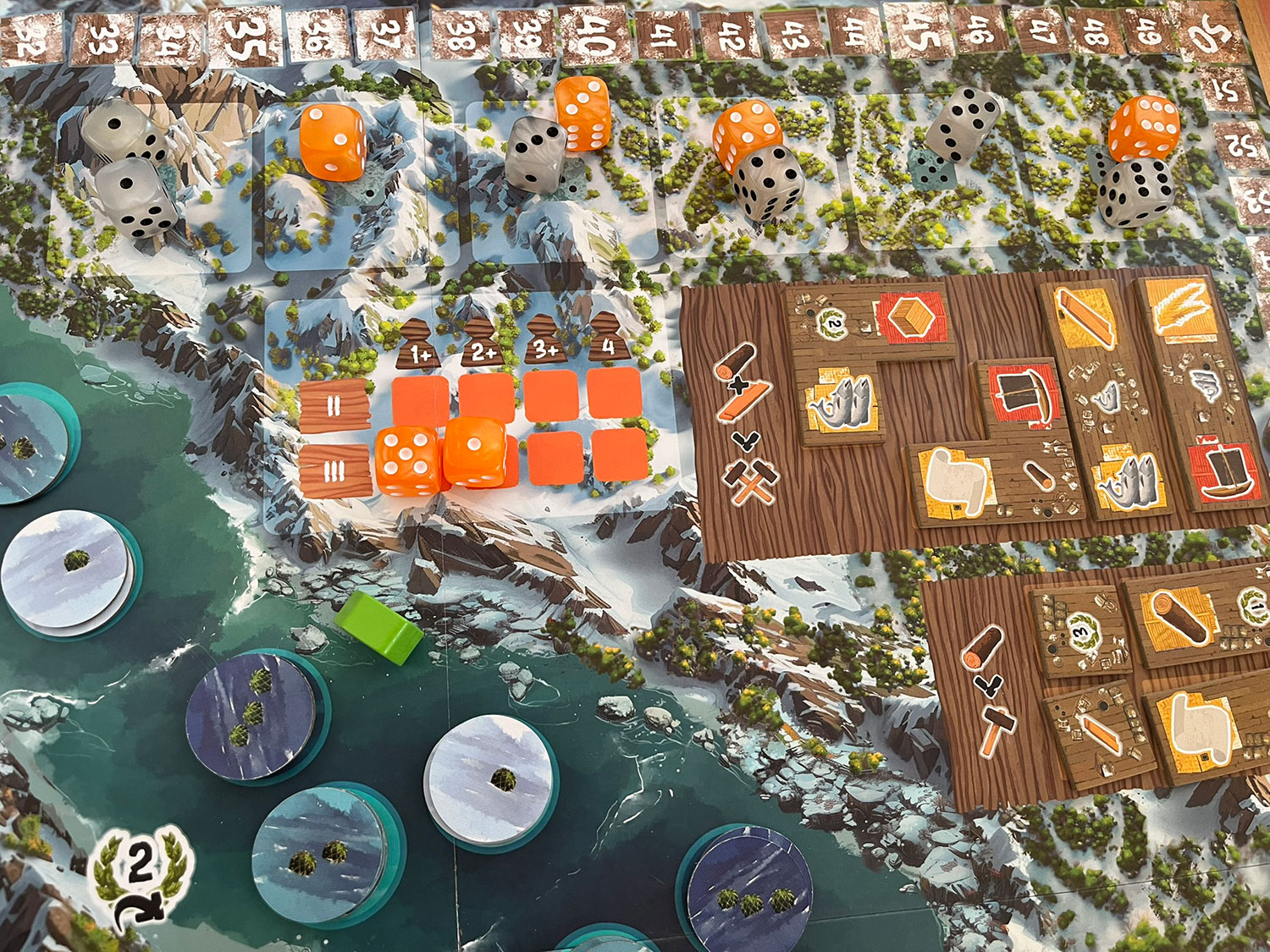 A shared draft of orange and white dice that, respectively trigger rows and columns on your personal playerboard is the hart of Saltfjord.
Finally, the trade contracts, as well as the tiles available to fill out your 6×6 playerboards, always come out in a randomized order, which will, respectively, dictate which resources you want at different points of the game and how to most efficiently get them. Maybe it would be nice if there was a way to refresh these tiles if you don’t like the current options, especially at 2-player, but this restriction does make the game more challenging.
How about luck with the dice rolls? There are a decent number of dice, which scale to player count, thus providing some inherent flexibility. Also, fish resources can be used to change pips, and some asymmetric abilities provide built-in dice mitigation. Nonetheless, the shared dice pool and the importance of triggering certain rows and columns in the correct order create a nice tension in the game. At two players, I’m definitely studying my opponent’s board to evaluate the likelihood that they might draft the only available 1-pip dye this round. At higher player counts the dice draft does feel a bit more chaotic. Ultimately, building your 6×6 board such that every row/column is lucrative is part of the strategy.
How about critiques? I mean, the designers could have provided us with even more asymmetric abilities, end-game scoring conditions, and tech-tree overlays. What comes in the box already allows for great replay value, so this really is more of a nice-to-have.
Final Thoughts:
Saltfjord is an excellent medium-weight game that weaves together engine-building, dice-drafting, tech-trees, and more into a smooth-playing 45-90 minutes. A 6×6 grid on each playerboard that gets increasingly more packed with dice-activatable icons is the heart of the game, representing a unique form of action selection that requires plenty of clever planning ahead. With 8 exciting asymmetric starting powers, 8 possible end-game scoring conditions, and 5 possible tech tracks, there is also plenty of replay value.
You may start with a humble dinghy and a few fish to your name, but the fast acceleration of player capabilities will have you admiring your built-out Nordic village, overflowing with lobsters and packed crates of goods by game-game. It’s the type of game that makes you feel accomplished even in defeat, and that’s definitely worth taking this cold plunge.
Final Score: 5 stars—tech trees, dice drafting, and engine-building galore combine for an exciting medium-weight Eurogame that’s cool as a fjord
 Hits:
Hits:
• Awesome grid-based dice action-selection
• Multiple inter-woven engine-building opportunities
• Exciting asymmetric powers
Misses:
• Somewhat fiddly set-up
• How about even more end-game scoring conditions and asymmetric powers?
• Player-interaction may be too mild for some

/pic9516264.jpg)
/pic9148407.jpg)








 English (US) ·