
.jpg)
PROTECT YOUR DNA WITH QUANTUM TECHNOLOGY
Orgo-Life the new way to the future Advertising by Adpathway In a gaming world where there are a few prominent themes, it’s nice when something new comes along. I remember seeing bottles of colored sand at beach towns when I was younger, so the theme of Sand Art brought back some positive memories.
Sand Art is a game by Kory Jordan and published by 25th Century Games for two to four players ages 10 and up. It takes about an hour to play, and has you collecting resources and then coloring in a bottle, making art in a bottle out of sand, in case the name didn’t give away the plot.
Gameplay Overview:
Sand Art has you gathering and mixing sand, which is used to fill your bottle. A row of cards with different actions on them sits in the middle of the table.
Each round, you will move your hand marker along the row of action cards and then take one of the listed actions. The movement has you go in the direction your marker’s thumb is pointing, which gets flipped after the move. Most cards have an upper and lower action to choose from. One restriction is that you can’t place your marker on an occupied action space.
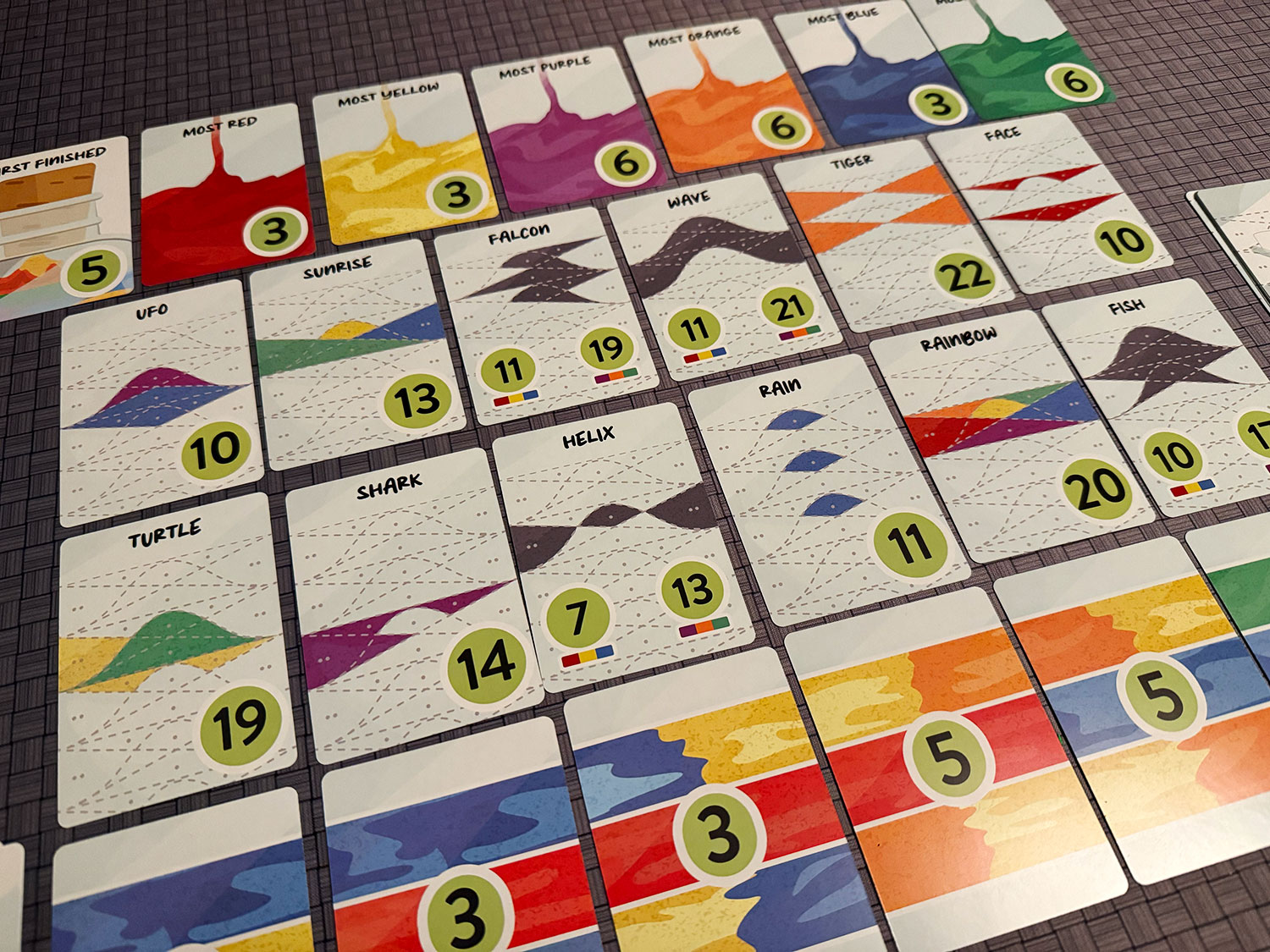 A selection of scoring cards. Most, patterns, and layers.
The actions are as follows:
• Gain sand of one or more colors. Each unit is marked off on your supply shelf.
• Mix sand of two colors, crossing out the colors used and adding to the color made on your supply shelf
• Pour sand into your bottle, marking off one unit for each dot area you fill
• Shake it up spreads sand in your bottle, filling up to two additional dots of an adjacent color.
• You can also move to the ends to grab one of the layer cards at that location. These cards are worth points for each time you complete the pattern shown on each card.
There are some nuances to the pouring action as sand has to follow pesky rules like gravity, so you can’t pour sand and have a void underneath it (as I brace for the keyboard warriors telling me all about their awesome sandcastle drawbridges they built as kids).
As you fill your bottle, you’ll unlock special abilities, like gaining an extra sand, allowing you to move in either direction (ignoring your thumb), or taking an extra movement and action each turn.
Besides layer cards, the main source of points is from the color objective cards, which will be the same for all the players for the entire game. Each of these can be repeated multiple times.
The game continues until someone finishes their bottle, gaining the first finished card, and then the game ends after each player has had the same number of turns. Points are scored for patterns, matching layer cards that have been picked up, and color objectives which reward points for having the most of each color. Highest score wins.
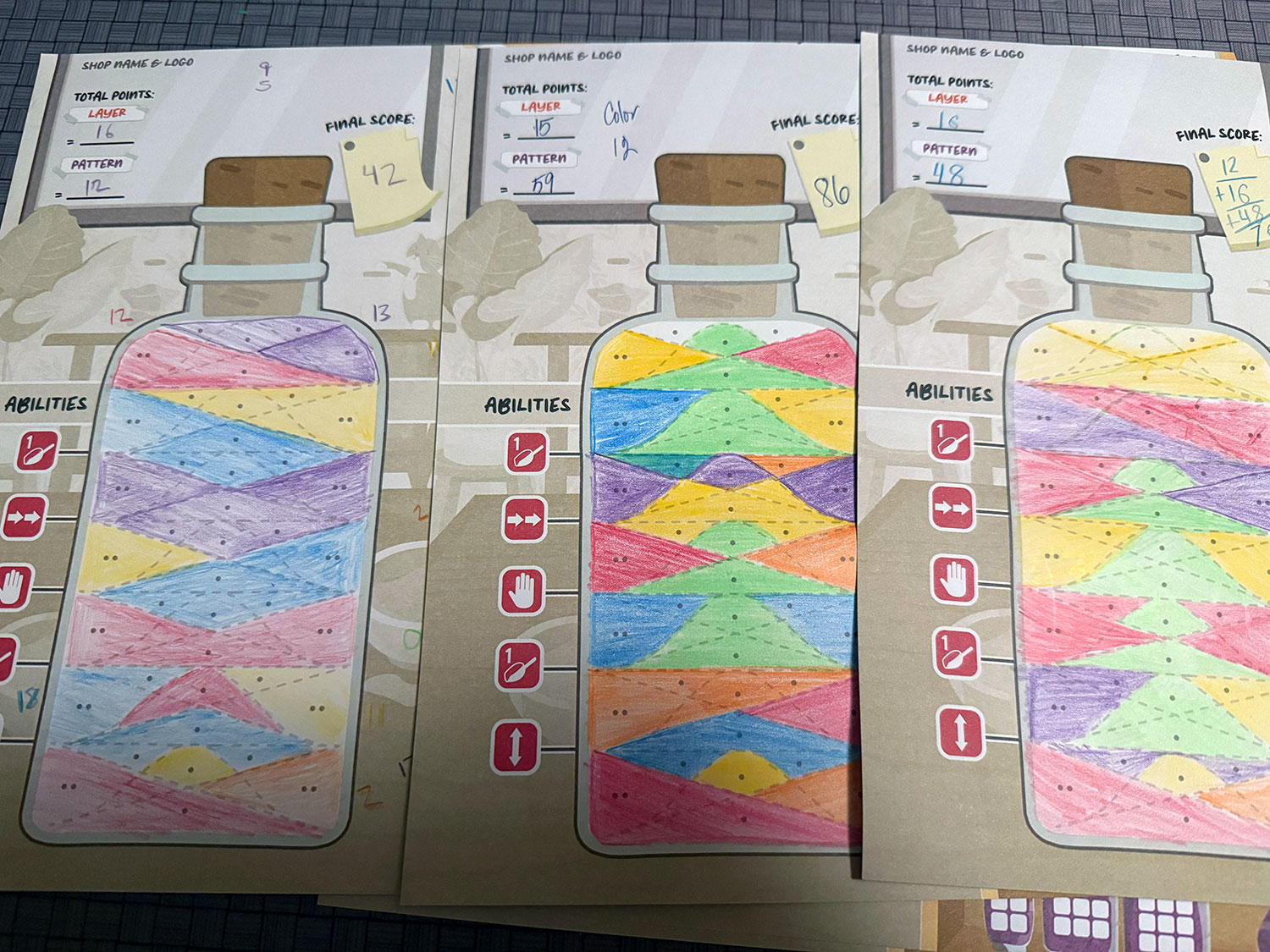 Players bottles could be quite different. Going for layers didn’t work out so well.
Game Experience:
Sand Art is another entry in the [Mechanic] and Write genre, and what makes it feel a little different is that you are coloring in shaped areas, which is a relaxing activity on its own, and not just Xing off boxes. People can spend time finishing coloring while another player takes their turn, which, as people get familiar with the rules, does make the game speed up.
The game also accelerates as you fill your bottle with the bottle sheet abilities. Besides gaining sand faster, you’ll also free up the movement of your hand token, which makes the game easier to manage. Meanwhile, halfway up, you’ll start making two moves and taking two actions per turn.
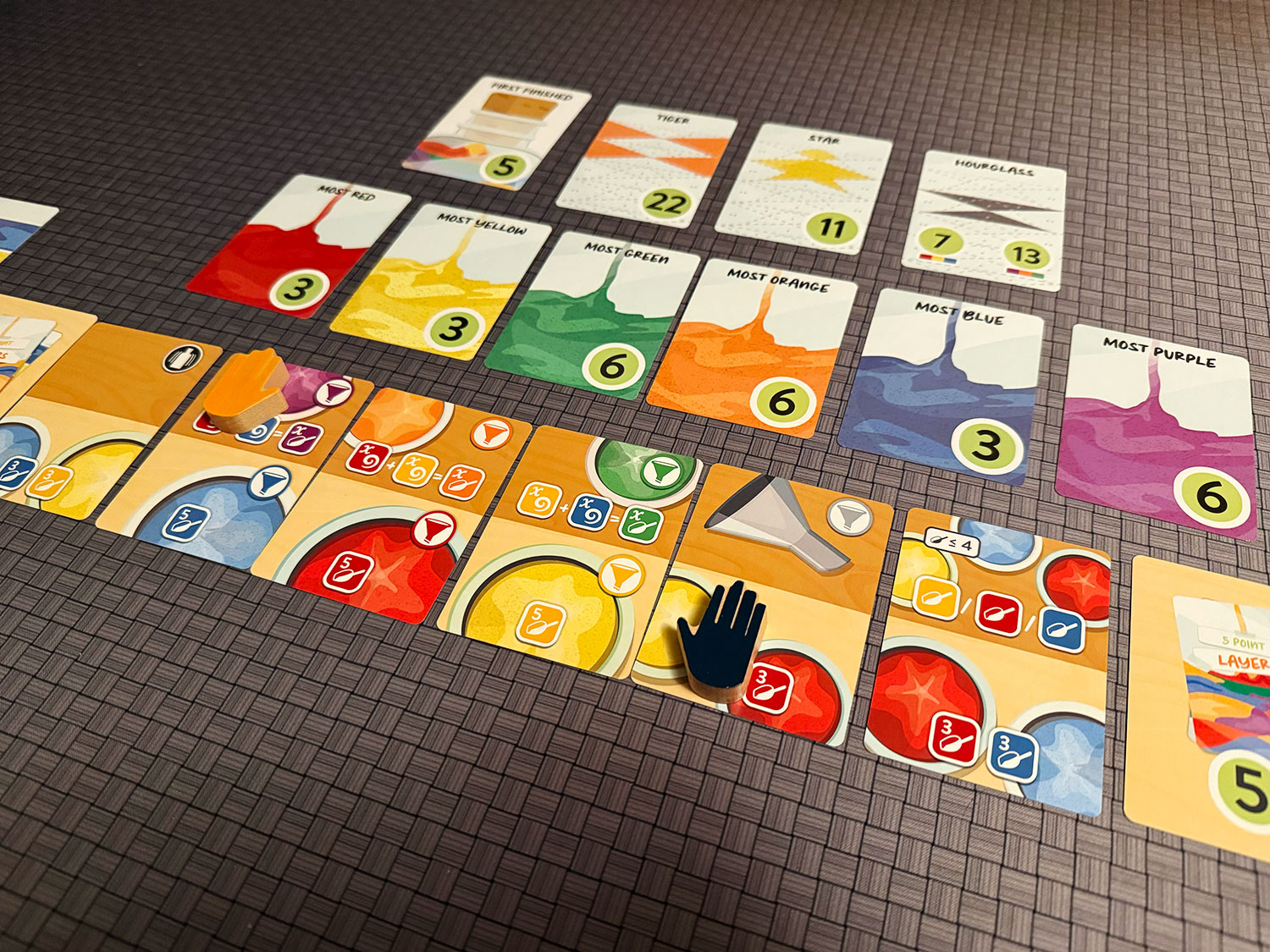 A two player setup. Adding players adds more action cards to choose from.
Gaining the ability to move your token independent of which way it is pointing really keeps you from feeling boxed in and needing to really plan as far ahead or be as impacted by other players’ tokens. While there are one or two more cards in three and four-player games, respectively, getting the action you want to take blocked is a part of the game, as, besides layer cards, everyone is working towards the same objectives. This means you may have to spend turns doing things for the future if your immediate goal’s action is blocked by another artist. Who knew sand art creators could be so mean?
In Sand Art players, I found that blocking was more of a factor of each player working towards their objectives instead of hatefully taking spaces, but I’m sure there will be people who prove me wrong (and I have the feeling that they’re the same people still raging about the sandcastle drawbridges).
Replay value is from the different pattern objective cards you’ll see each game, but each game will follow a similar loop of gather, mix, and pour varying colors. There could be some combinations that both more challenging from shape and color perspectives.
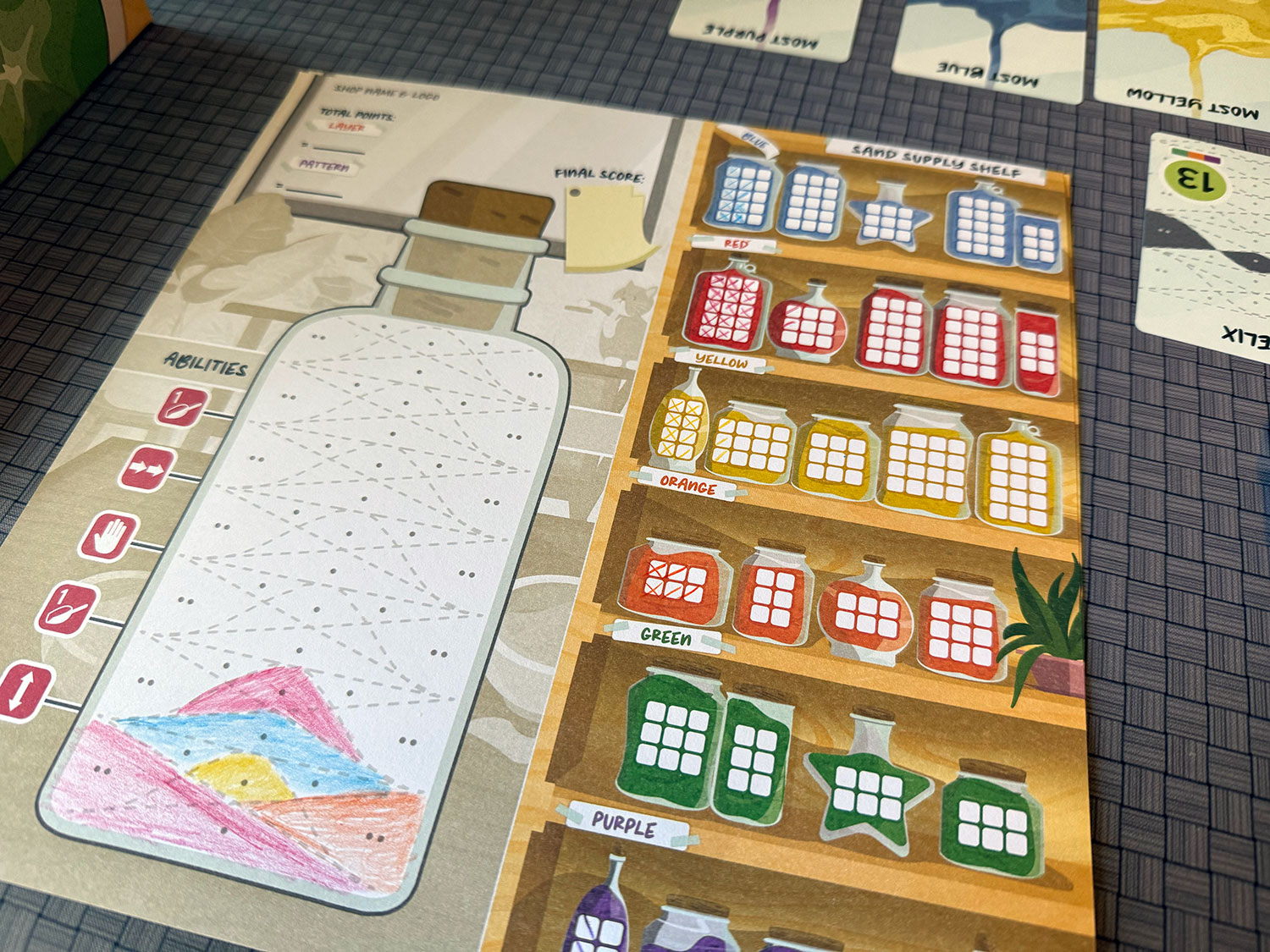 Checking g off boxes and coloring. The symbols on the left are perks you unlock as your bottle fills up.
One thing that I found odd was color mixing. When mixing a unit of yellow and a unit of blue, I’d expect to end with two units of orange, but apparently, conservation of mass isn’t a thing, or the game is accounting for spillage. This loss of mass is made up for when shaking a bottle adds more sand. I think Antoine Lavoisier would be appalled.
Movement-related challenges decrease, and the game accelerates as the game progresses, which helps the game end before it gets too long in the tooth. However, Sand Art feels a touch on the long side for this type of repetitive gameplay as every turn is either collecting resources, mixing them, or spending (coloring). The box says 25 to 45 minutes, but either they were mailing in their coloring (hatching feels like cheating the experience) or my table was too OCD with staying inside the lines. I did find myself while waiting, often touching up areas on my own bottle.
I also found the yellow and green pencils a little hard to read on the supply shelf, as I marked boxes with a single hash for collected and a double for used, but I tend to struggle when colors are close to each other. But I was able to understand the colors on the cards just fine, but it’s worth mentioning, this game may not be the most color-blind friendly, depending on the person’s type and magnitude of color vision deficiency.
Lastly, scoring could be a little uneven, with patterns seeming to be the key to victory over color objectives. In one game, I went for color objectives and finishing first, while the other players focused on patterns, and I lost by a huge margin. In tighter games, the person who can figure out how to do both effectively will likely win.
Final Thoughts:
Sand Art is much like the bottles of sand I would see as a kid. It was neat to pick it up and enjoy it for a moment, but it may not be the thing I need to keep. It’s enjoyable and relaxing while also giving lots of opportunities to make decisions to impact your game. If you or your family likes cozy games and coloring, Sand Art is worth picking up for lazy weekend games.
Final Score: 3 Stars – Sand Art has you planning ahead, checking off boxes, and coloring with a unique theme.
 Hits:
Hits:
• Cozy coloring activity
• Lots of small decisions each game
• Game accelerates as your bottle fills up
Misses:
• Even with acceleration, games can run a little long
• Scoring seems to favor patterns
• Color mixing and shaking sand makes me question everything I know about conservation of mass.

/pic9148407.jpg)








 English (US) ·