
.jpg)
PROTECT YOUR DNA WITH QUANTUM TECHNOLOGY
Orgo-Life the new way to the future Advertising by Adpathway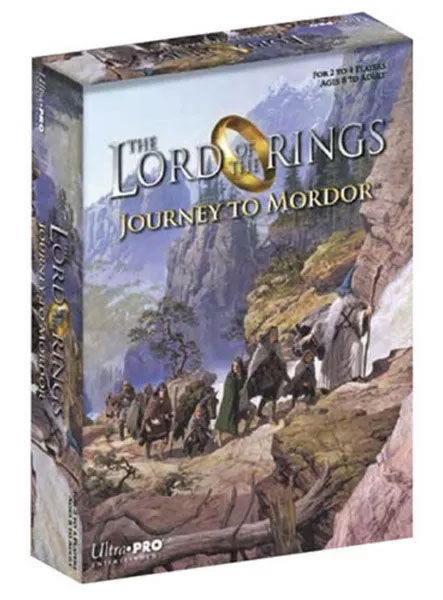 As a fan, I’m starting to feel overwhelmed by the number of The Lord of the Rings games out there. Do you want a war game? There’s a Tolkien game for that! Living Card Game? Look no further than the Shire. There are trivia games, trick-taking games, deck building, strategy, battle, and more than one version of Monopoly. Some of them are phenomenal! Some of them… less so. But there’s no lack of game choices out there for Token fans.
Each selection trods its own path through the mythos, some traversing great expanses of time through the Ages and some looking narrowly at specific chapters or characters.
The Lord of the Rings: Journey to Mordor, from UltraPro, takes the story of Frodo and Sam’s path to Mount Doom and translates it into a quick to learn, fast-paced push-your-luck dice game for 2-4 players. In the wide world of Tolkien games, the corner of the market this one tries to corner is a casual play, portable offering. But does Journey to Mordor offer anything unique enough to contribute to such a large thematic collection, or is it just one more pretty box to set on your shelf?
Gameplay Overview:
Each player chooses a dice color and takes an identical map sheet. The map is divided into two tracks, one for your hobbit’s arduous climb towards Mount Doom and one for the Nazgul. The goal of the game is to roll dice that help you move your hobbit forward along the map track, but with every roll you risk forwarding the Nazgul along their track, instead. The first player to make it to Mount Doom wins, but if the Nazgul get there first, you immediately lose.
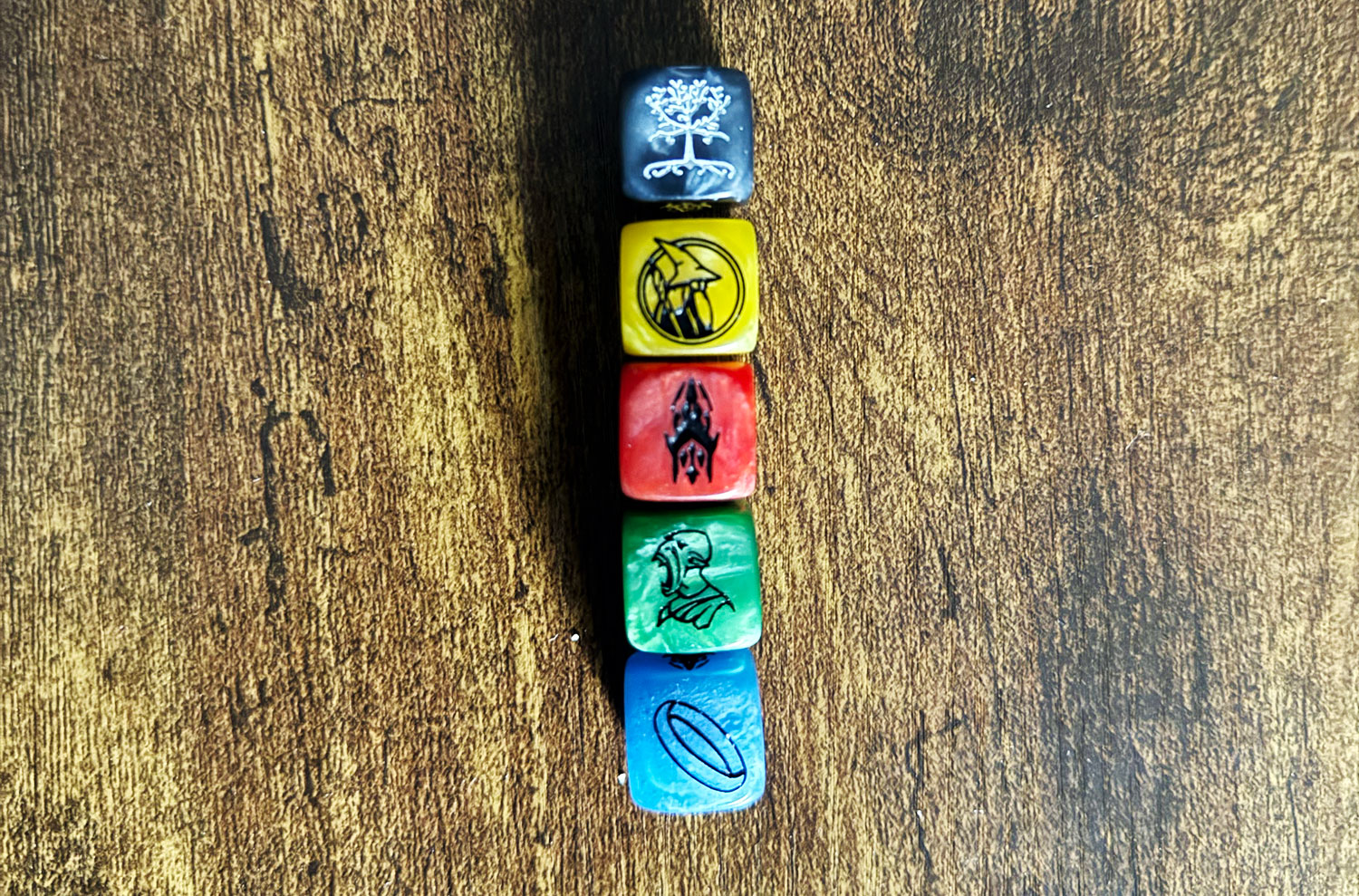 The symbols on the dice face guide which actions you can mark off.
The dice faces each have unique symbols. The Orc symbol will block you from moving forward on the track, but it can be canceled out by a Sword symbol. The Nazgul symbol moves their track forward, but a Gandalf symbol splits their track sections into two, lengthening their journey to slow them down. A Ring symbol allows you to progress forward along your own track. A White Tree symbol lets you stop your turn early if you don’t want to risk a negative dice roll.
On each turn, you roll all of the dice of each color over and over until there are either none left or you roll a Tree and can stop. With each roll, you have to take at least one die out of the pool to keep and lock in. If you roll any Nazgul, you must lock in at least one of them, and the player the dice color belongs to has to mark another box off along the Nazgul track on their own sheet.
In addition to the dice color-coded for each player, there is also a black die. Anything on this die only affects the player who is rolling.
Any player who has the Nazgul reach Mount Doom on their map before their Hobbit does is automatically out of the game. When the first Hobbit reaches their goal, everyone else gets one more turn to try to get there. If multiple Hobbits reach Mount Doom, the one with the fewest squares ticked off on their Nazgul track wins.
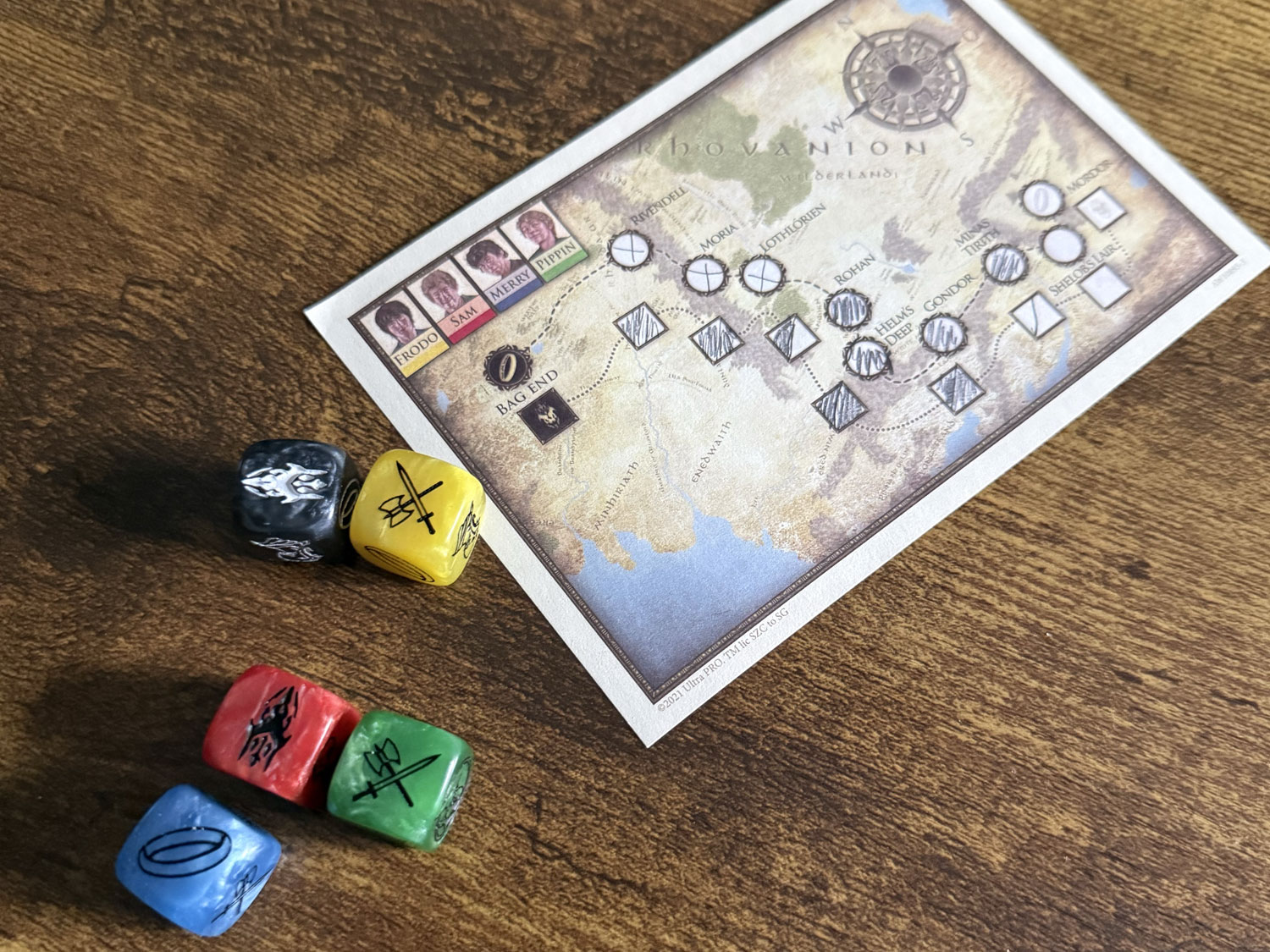 The game is compact without many pieces, but the pieces it does have are well produced and look good.
Game Experience:
All of the pieces are nicely made, and the game achieves its goal of being a pretty box to put on your shelf. The art design is classy and refined, especially the map. The production could fit into a Tolkien collection full of leatherbound classics on a mahogany shelf. It’s quick to learn and play, and portable enough to fit in my purse, which are exactly the qualities that I want in a roll and write.
The game can feel a lot like side-by-side solo play. Each player tracks their own board, ticking off boxes as they go. What keeps it from being entirely solo is the way that other players can negatively affect your Nazgul track with their roles. This mechanic is what makes the game competitive, but it also feels a little awkward.
It’s hard to want to engage in a push your luck game where the consequences of your risk affect other players more than they affect you. Why not roll again? If the dice are positive, great. If they’re negative, it also often benefits you by hurting your opponents. It takes away a lot of the nail-biting, but also the reward of making a wise choice. If you get lucky and roll well, or make strategic choices that benefit your Hobbit, it can all be undone by another player’s rolls that are beyond your control. It’s not that their strategy is superior, so much as that their luck is worse. There are other roll and write games that manage this balance more effectively, making this one feel lackluster in comparison.
Final Thoughts:
The Lord of the Rings: Journey to Mordor is fine. It’s not the most interesting or innovative roll and write, and it’s not the best small box Lord of the Rings game. If you’re a die-hard fan, you’ll get some play out of this, and it’ll add some variety to your collection. If you’re a casual gamer, look into Ultra Pro’s The Lord of the Rings: The Battle for Middle-earth for more interesting gameplay.
Final Score: 2 Stars – It doesn’t do anything particularly well, other than helping you complete your Tolkien game collection.
 Hits:
Hits:
• Attractive art design
• Portable and compact
Misses:
• Push your luck mechanic is undermined by a lack of consequences
• Does not add anything new or innovative to the Roll and Write genre. You probably already have a game in your collection very similar to this.

/pic9148407.jpg)







 English (US) ·