
.jpg)
PROTECT YOUR DNA WITH QUANTUM TECHNOLOGY
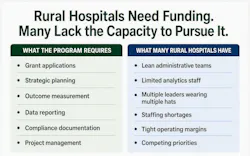
Orgo-Life the new way to the future Advertising by AdpathwayNavigating the shift from volume to value in healthcare Some rural hospital leaders are hesitant to even apply for CMS Rural Health Transformation funds because they lack the administrative resources to apply, manage reporting requirements and demonstrate long-term results. And failure to meet those requirements could jeopardize continued funding or trigger repayment. ID 436517199 | In © Andrii Lysenko | Dreamstime.com Imagine being offered hundreds of thousands, or even millions, of dollars to modernize your hospital but feeling like you must walk away. That's the reality some rural healthcare leaders face as they evaluate the federal Rural Health Transformation (RHT) Program. But why? Two key reasons: Many rural hospitals operate with lean administrative teams. Executives often wear multiple hats, balancing strategy, operations, finance, compliance, workforce challenges and patient care priorities simultaneously. Taking on a complex grant application, building a transformation plan, coordinating stakeholders, and preparing for years of reporting requirements can feel overwhelming. Administered by the Centers for Medicare & Medicaid Services (CMS) through participating states, the $50 billion RHT Program is designed to support workforce development, technology modernization, care delivery innovation, and other rural healthcare initiatives. On paper, it's one of the largest rural healthcare investments in decades. But getting the funding may be only the beginning. Before many hospitals can benefit from the program, they must first overcome a challenge that receives far less attention: administrative capacity. Most rural healthcare leaders already understand what needs improvement in their organizations. They know where workforce shortages exist. They understand technology gaps. They know which service lines need investment, and which patient populations need better access to care. The challenge is often finding the time and expertise needed to pursue funding opportunities while continuing to run the organization. For some hospitals, concerns begin long before a project launches. "A lot of states have it set up where the hospital gets approval of the grant but spends the money upfront first, and then gets reimbursed later," explains Effie Carlson, CEO of Watershed Health. (Learn more about Watershed in our Healthcare Innovation article, “CEO Describes Growth of Watershed Health’s Care Coordination Role.”) While reimbursement timing concerns matter, Carlson says another issue receives less attention: the amount of work required to pursue funding opportunities. Effie Carlson, CEO, Watershed Heath "One of our larger provider partners only has rural locations," Carlson says. "They opted out of several opportunities because their leadership said, 'Just go hire someone to write a grant.' It was going to cost about $1 million to manage the process." The application process resembles a large grant effort and requires skills many rural hospitals don't have, including expertise in data analysis, budgeting, planning, compliance, stakeholder coordination and proposal writing. For a small rural hospital, assembling those capabilities can cost $1 million or more, creating a significant barrier to pursuing the funds in the first place. And simply completing an application isn’t the only hard part. Hospitals must explain how funding will improve outcomes, develop measurement plans, identify implementation resources, coordinate community partners, and prepare to meet reporting requirements for years afterward. For larger health systems, those responsibilities might be spread across multiple departments. In smaller rural facilities, they may fall on a handful of already overloaded leaders. In many cases, the hospitals that need the funding most are the ones least equipped to go after it. Even after funding is awarded, resource constraints don't disappear. CMS expects participating organizations to document outcomes, report performance metrics, demonstrate progress, and comply with program requirements. States are reassessed annually, and funding levels can be adjusted based on implementation progress and reported results. For hospitals with limited analytics, informatics or reporting capabilities, meeting those expectations may require additional staffing, outside support or technology investments. Success in obtaining and keeping Rural Health Transformation (RHT) Program depends not only on what rural hospitals do, but on what they can prove. That accountability requirement is one reason some rural hospital leaders hesitate to apply in the first place. They must not only execute a project successfully but also prove its impact over time. What does that look like? Imagine a critical access hospital that: From the community's perspective, the initiative is successful. But the hospital may struggle to prove that success if: In that case, the hospital may have improved care while still producing weak evidence during CMS reviews. Another concern involves the systems supporting the RHT Program itself. Because funding flows through states, rural hospitals depend on states to establish reporting processes and infrastructure that function efficiently. Carlson says that dependency creates uncertainty for some providers. "It's contingent upon the state to develop an infrastructure that can take in the data that hospitals send them, collate it, then push it up to CMS for the reimbursement mechanism to exist or flow correctly," she says. “And that means people are bringing many Excel sheets together, and you're hoping they don't miss a cell or that it doesn’t get populated wrong, because then hospitals don’t get reimbursed,” she adds. "When a small hospital is running on a cash-flow window for one or two months but there's a 60-day reimbursement delay because of a reporting problem the hospital doesn't control, there's risk there." While reimbursement concerns aren’t the primary issue for many rural hospitals, they can reinforce reluctance to pursue funding opportunities that already require significant administrative effort. Rural hospital leaders don't need a lesson in transformation. Most already know where they need to improve and how they would use additional funding to serve their communities. The challenge is finding the administrative capacity to apply for the money, manage the requirements and prove results over time. The RHT Program is still in its early stages. As it moves into implementation, success may depend less on having the best ideas and more on having the people, time, and reporting infrastructure needed to bring them to life. For some rural hospitals, the hardest part isn't transformation. It's getting to the starting line. Theresa Houck, Senior Editor, is an award-winning B2B journalist with more than 35 years of experience. She writes about strategy, policy, and economic trends for EndeavorB2B on topics including healthcare, cybersecurity, IT, OT, AI, manufacturing, industrial automation, energy, and more. With a master’s degree in communications from the University of Illinois Springfield, she previously served as Executive Editor for four magazines about sheet metal forming and fabricating at the Fabricators & Manufacturers Association, where she also oversaw circulation, marketing, and book publishing. Most recently, she was Executive Editor for the award-winning The Journal From Rockwell Automation publication on industrial automation where she also hosted and produced podcasts, videos and webinars; produced eHandbooks and newsletters; executed social media strategy; and more 
Key Highlights

The real barrier may be staffing, not strategy

Winning the funding is only the beginning
State infrastructure can affect a hospital’s success
The real test may not be innovation
About the Author

Theresa Houck
Senior Editor










 English (US) ·