
.jpg)
Neilson Studio, Sydney Dance Company, Sydney.
8 May 2026.
Week two of INDance 2026 at Sydney Dance Company offered two dramatically different performance experiences across its 6:30pm and 8pm programs. Christopher Gurusamy’s 5 Arrows immersed audiences in an intimate world of queer longing and devotional desire through Bharatanatyam, while Oli Mathiesen’s The Butterfly Who Flew Into The Rave transformed the theatre into a pulsing, sweat-soaked warehouse party. Although aesthetically worlds apart, both works shared a fascination with bodies surrendering completely to sensation — emotional, rhythmic, spiritual, or physical. Yet, it was The Butterfly Who Flew Into The Rave, particularly when considered alongside week one’s Wet Hard Long, that solidified an emerging throughline across the INDance season: endurance as spectacle, ritual, and bodily test.
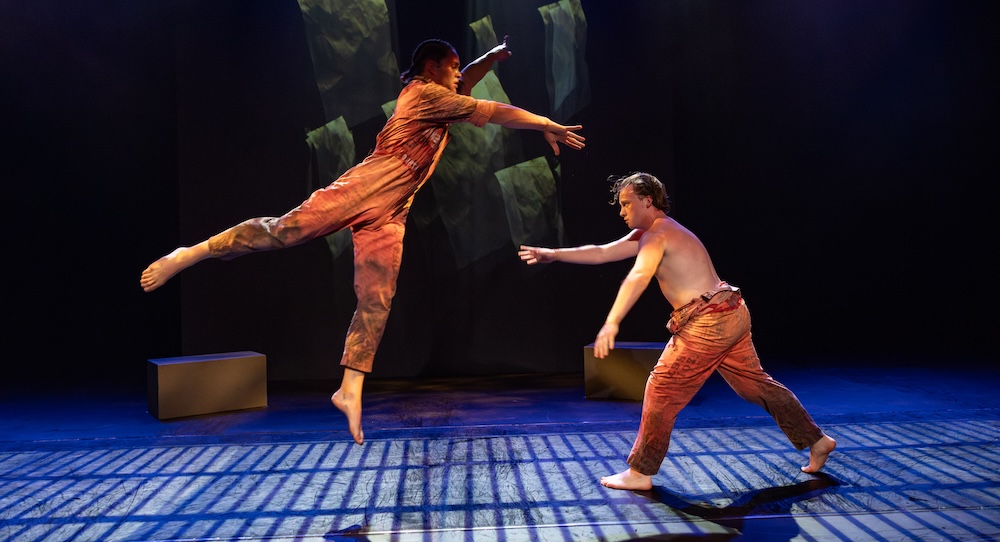
Christopher Gurusamy’s 5 Arrows unfolded as a deeply embodied exploration of yearning. Opening with the line, “I’m just a boy standing in front of a god, asking for him to love him,” the work immediately framed itself through vulnerability and desire. Inspired by the five flower-tipped arrows of Māran — the Hindu equivalent of Cupid — Gurusamy’s solo traversed emotional states of flirtation, seduction, sadness, desperation, and longing.
The performance centred around an implied exchange between Gurusamy and an unseen figure positioned somewhere within the audience: a god, lover, or fantasy onto whom all emotional energy was projected. Throughout the work he flirted, pleaded, posed, recoiled, and reached outward, constantly shifting between confidence and emotional exposure. One moment he seemed playful and teasing; the next he appeared almost crushed by rejection. The emotional instability became the work’s core tension.
While Gurusamy has described the Nayika figure within the work as liberated and fully empowered in her sexuality, what emerged onstage felt far more emotionally precarious. Rather than presenting a straightforward portrait of empowerment, 5 Arrows captured the vulnerability inherent in longing itself. The figure at its centre appeared emotionally dependent on the responses of the god they sought affection from, forced to continually perform, charm, and emotionally expose themselves in pursuit of attention.
What made the work so compelling was Gurusamy’s total commitment to that emotional landscape. His movement quality was mesmerising — buoyant, supple, rhythmically intricate, and endlessly expressive. Bells around his ankles punctuated sharp footwork while his arms and hands carved fluid, highly detailed gestures through space. His face remained alive throughout, constantly shifting between ecstasy, grief, vanity, seduction, and despair.
Visually, the work was equally striking. Draped in layered sari-like fabrics with jewellery, scarves, belts, and dramatic makeup, Gurusamy embodied a heightened theatrical sensuality that occasionally bordered on drag. The costume and styling reinforced the work’s themes of performance and seduction, where identity itself became something carefully constructed and presented.
Integral to the atmosphere were the four live musicians, positioned in the corners of the room, creating an enveloping sonic environment that feels inseparable from the dance. Their contribution cannot be overstated. The score pulses with life: intricate rhythms, soaring vocals, and rich textures that propel the performance forward. The vocalists alternate between melodic singing (Arjunan Peveendran) and the rhythmically spoken passages of Nattuvangam (Ranjeev Kirupairajah), while percussion and strings generate a constant dialogue with Gurusamy’s body. Saumya Sritharan’s Venna adds a shimmering melodic layer, while Lojen Wijeyamanoharan on the Mridangam drives the rhythmic intensity. Particularly fascinating was the apparent tension between improvisation and precision. Gurusamy has spoken about emotionally improvising the work through lived memories of desire and heartbreak, yet the synchronicity between dancer and musicians remained astonishingly exact.
Lighting (Lavania Pallavan) further intensified the emotional environment. At one point, Gurusamy stood isolated in a saturated red wash at the front of the stage, the surrounding darkness swallowing everything else. The image felt simultaneously seductive and oppressive, perfectly capturing the work’s emotional push-and-pull.
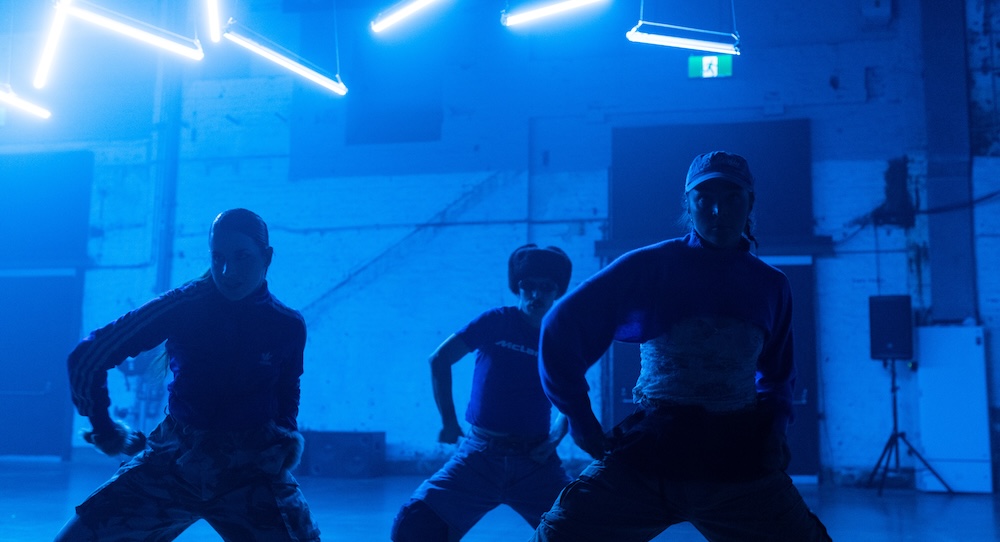
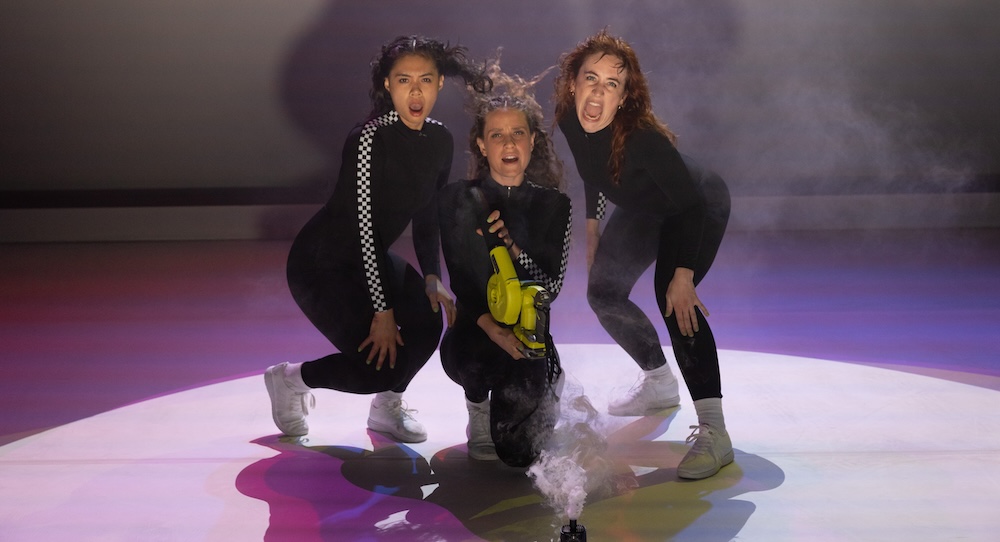
If 5 Arrows was intimate and emotionally consuming, Oli Mathiesen’s The Butterfly Who Flew Into The Rave exploded outward with relentless physical intensity. Performed by Mathiesen alongside Lucy Lynch and Sharvon Mortimer, the 65-minute endurance work began before the audience had even taken their seats. The dancers were already moving upon entry, and they barely stopped until the performance ended.
The work condensed the arc of a three-day rave into a single uninterrupted theatrical experience. Euphoria, connection, exhaustion, absurdity, ecstasy, and collapse all emerged through constant movement and booming techno rhythms. Watching it became trance-like. The audience slowly surrendered to the repetitive pulse and physical persistence of the performers.
What made the piece particularly compelling was its balance between celebration and parody. The choreography drew heavily from recognisable club and rave vocabularies — house dance, hip hop, jazz, commercial dance, popping and locking — but frequently exaggerated them into something knowingly theatrical and absurd. The dancers performed with hyper-expressive faces and exaggerated coolness, gently making humorous theatre out of rave culture, while also clearly loving it.
It recalled the specific energy of dancers late in a studio session: exhausted, euphoric, increasingly ridiculous, yet still technically brilliant. That contradiction gave the work much of its humour and charm.
Lynch stood out especially for her astonishing stamina in keeping her technique and strength on-point, though all three performers sustained remarkable intensity throughout. Exhaustion gradually became visible in their bodies, but even during moments of rest they continued subtly pulsing to the beat. The rave never truly released them.
The visual environment (lighting design a collaboration by Mathieson, Shannell Bielawa, Bekky Boyce, Jazmin Whittall and Jacobus Engelbrecht) effectively evoked underground rave culture. Red lighting saturated the stage while fluorescent bar lights flashed overhead in shifting patterns. Sudden blackouts and strobe effects fragmented the audience’s sense of time and space, recreating the sensory disorientation of nightclub environments.
Among the work’s many memorable moments was a surreal sequence involving retractable step-aerobics platforms. The dancers launched into a rave-inflected aerobics routine before the platforms were gradually pulled away one by one. Elsewhere, they repeatedly returned to a side-stage table covered in glowing red party cups, drinking water between bursts of movement — a reminder of the immense physical labour underpinning the work.
Beneath the humour and chaos, however, the piece carried genuine affection for rave culture and the queer communities from which it emerged. Tender moments surfaced unexpectedly: holding hands, leaning into one another, supporting each other briefly before plunging back into the relentless rhythm again.
Importantly, The Butterfly Who Flew Into The Rave also reinforced a thematic connection emerging across the wider INDance 2026 season. Alongside week one’s Wet Hard Long, the work positioned endurance itself as a choreographic language. Both pieces transformed sustained exertion into spectacle, though each approached it differently. In Wet Hard Long, endurance emerged through relentless muscular labour and physical strain; in The Butterfly Who Flew Into The Rave, endurance manifested as rhythmic persistence and communal survival on the dance floor.
Together, these works suggest an INDance season increasingly fascinated by bodies under pressure — bodies driven toward exhaustion, ecstasy, collapse, and transcendence. Gurusamy’s 5 Arrows approached this through emotional vulnerability and devotional yearning, while Mathiesen’s rave odyssey embraced collective physical depletion. Across the season as a whole, however, the recurring image has been one of performers refusing to stop: bodies surrendering completely to rhythm, sensation, labour, and desire, even as exhaustion threatens to overtake them.
By Linda Badger of Dance Informa.

Arjunan Peveendran, Bekky Boyce, Choreographer, choreographers, choreography, Christopher Gurusamy, dance review, Dance Reviews, INDance, INDance 2026, Jacobus Engelbrecht, Jazmin Whittall, Lavania Pallavan, Lucy Lynch, Oli Mathiesen, online dance review, online dance reviews, Ranjeev Kirupairajah, review, reviews, Shannell Bielawa, Sharvon Mortimer, Sydney Dance Company






 English (US) ·