
.jpg)
Neilson Studio, Sydney Dance Company, Sydney.
2 May 2026.
Week 1 of Sydney Dance Company’s 2026 INDance program, supported by The Neilson Foundation, delivered a compelling double offering of contemporary Australian choreography, with two distinct yet thematically resonant works sharing the evening. Presented as separate ticketed performances – Emma Harrison’s High Octane at 6:30pm, followed by Jenni Large’s Wet Hard Long at 8pm – the pairing formed an unofficial dialogue across the night.
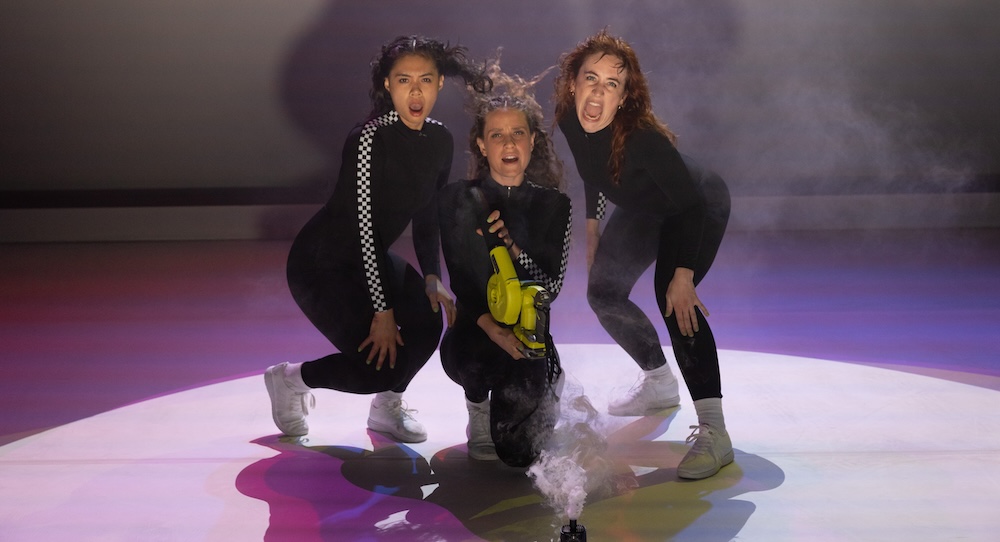
In its second season, Harrison’s High Octane arrives not only louder, sharper and more immersive, but unmistakenly more assured. What was already a bold and biting work in its premiere outing has evolved into something far more refined – an experience that grips from the moment you enter the space and refuses to let go.
The atmosphere is immediate and electric. Before the work even formally begins, the performers occupy the stage in a state of heightened presence – strutting, circling, embodying a kind of performative bravado – as the audience enters the space. Thick fog rolls through the space, lighting pulses, and Amy Flannery’s sound design engulfs the audience from all directions. It’s visceral. The deep, guttural roar of V8-style motors lands not just in the ears but in the body. Harrison’s world is total: sensory, immersive, and unapologetically loud.
Where the earlier iteration occasionally felt episodic, this version demonstrates a far clearer throughline. Transitions that once jarred not flow with intention, allowing the work’s thematic concerns – ambition, class, consumer desire, and identity – to unfold with greater coherence. Harrison’s choreography, shaped by her working-class background and regional upbringing, continues to anchor the work in something deeply personal, even as it critiques broader systems of value and aspiration.
The trio (Harrison, Emma Riches and Frances Orlina) deliver performances of unwavering commitment. Orlina, in particular, appears more mature and grounded this season, bringing a quiet authority that sharpens the work’s emotional stakes. All three performers commit with a level of conviction that is both compelling and confronting – they don’t just perform the work; they inhabit it fully.
One of the work’s most striking sequences remains the devastating moment in which Riches is stripped of her helmet. Collapsed on the floor, gasping and exposed, she embodies a kind of existential unravelling, while Harrison delivers a nostalgic monologue about Supre, childhood dance costumes, and early dreams. The dissonance is extraordinary – two emotional worlds colliding like vehicles at full speed. It is absurd, hilarious, and deeply unsettling all at once, capturing the chaos of ambition and the fragmentation of identity and remarkable clarity.
The expanded physical and emotional range of the work is one of its greatest strengths in this iteration. The choreography surges through peaks and troughs – moments of explosive energy giving way to stillness, vulnerability, or absurdity – creating a dynamic rhythm that sustains engagement throughout. The final image, with performers spreading tarmac across the stage as light fractures across its surface, is visually arresting and thematically potent, leaving a lasting imprint.
Sound continues to be a defining force. The layering of vocals, text, and music is sophisticated and immersive, with the performers’ voices blending seamlessly into the score. The result is a sonic landscape that feels alive, constantly shifting and amplifying the work’s emotional intensity.
Harrison is an artist who feels deeply, and in High Octane, that emotional intelligence is now matched by a growing clarity of voice. It is increasingly evident that she knows exactly who she is and what she wants to say. This second iteration doesn’t just work – it solidifies it. Bold, chaotic, and strikingly self-assured, High Octane stands as a powerful testament to an artist coming fully into her own.
Jenni Large’s Wet Hard Long, is a work of sustained tension – physical, visual and conceptual -that refuses the audience the comfort of release. Expanded from her 2022 Keir Choreographic Award-winning duet, this full-length iteration doubles down on endurance as both method and meaning.
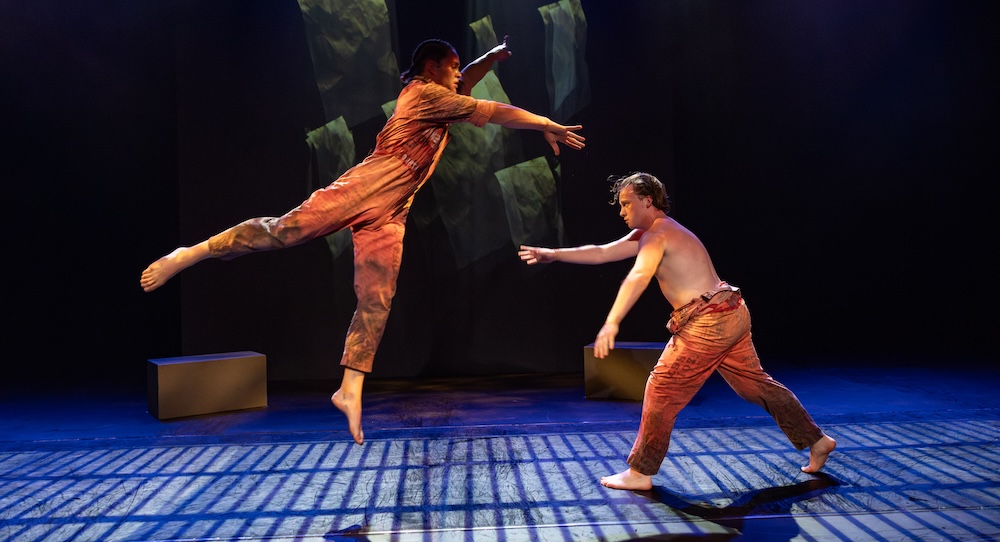
Performed by Large with co-collaborator Amber McCartney, the work unfolds through an exacting physical language of near-continuous slow motion. Over the course of an hour, the performers sustain an extraordinary level of muscular control, moving in close unison with a precision that is both rigorous and mesmerising. The durational quality is key: time elongates, effort accumulates, and the audience is drawn into a shared state of anticipation.
The design world is immediately striking. A high-gloss, slick floor reflects and distorts the performers’ bodies, generating fluid, shifting images that echo the work’s thematic preoccupation with multiplicity and instability. A sculptural metal apparatus – part ladder, part suspended monkey-bar structure – anchors the space, its warped, melting aesthetic evoking both industrial strength and collapse.
Water becomes both material and metaphor. Buckets are slowly lifted, suspended and eventually spilled, transforming the stage into a precarious terrain. As the surface grows increasingly slick, the performers transition to sliding, centrifugal motion, spinning and propelling themselves across the floor. The use of the towering platform heels, worn throughout, subverts expectation, resisting the immediate fulfilment of the visual codes they evoke.
Large’s choreographic world draws on recognisable iconography – fetish aesthetics, cabaret stylings, dominatrix references – but stretches them across a durational framework that destabilises easy consumption. Rather than offering spectacle as instant gratification, Wet Hard Long withholds, extends and complicates it. The result is less about display and more about labour: the labour of holding form, of maintaining composure, of enduring.
Midway through, Sydney Dance Company’s own Piran Scott enters as an audience participant, tasked with holding a rope that sustains one of the work’s central tensions. His presence introduces a subtle triangulation of power and observation, but he remains largely passive – an anchor point rather than an agent of change.
Crucially, the absence of climax or release is not a gap but a thesis. The work’s refusal to resolve mirrors the ongoing, unresolved pressures placed on femme bodies: to perform, to endure, to maintain control without collapse. In this context, the sustained tension becomes both subject and experience. The audience, like the performers, is held in a state of prolonged expectation that is never satisfied.
What emerges is a portrait of endurance that is as relentless as it is considered. Large and McCartney’s performances are formidable – demanding not only strength and precision, but an unwavering commitment to the work’s durational intensity. Their control of tempo, weight and timing sustains the piece’s internal logic with impressive consistency.
Wet Hard Long is visually arresting and physically extraordinary, but it’s true impact lies in its insistence: on duration, on effort, and on the refusal of easy resolution. It does not offer relief – and in doing so, it makes clear why that relief is so persistently sought, and so rarely given.
Despite their differences, the two works share a preoccupation with systems — whether mechanical, social or embodied — and the ways in which bodies operate within them. Each choreographer constructs a distinct world: Harrison’s is driven, kinetic and urgent; Large’s is viscous, reflective and unrelenting. Together, they offer two ends of a spectrum, united by a focus on labour, control and the limits of physical experience.
As the opening week of INDance’s two-part program, this pairing sets a strong tone. It highlights the breadth of contemporary Australian choreography while drawing subtle thematic connections across contrasting styles. Seen together, High Octane and Wet Hard Long do more than share a bill — they expand each other, framing Week 1 as an exploration of pressure, endurance and the shifting conditions placed on the performing body.
By Linda Badger of Dance Informa.

2022 Keir Choreographic Award, Amber McCartney, Amy Flannery, Choreographer, choreographers, choreography, Contemporary dance, dance review, Dance Reviews, Emma Harrison, Emma Riches, Frances Orlina, INDance, INDance 2026, Jenni Large, Keir Choreographic Award, Neilson Studio, online dance review, online dance reviews, Piran Scott, review, reviews, Sydney Dance Company, The Neilson Foundation








 English (US) ·