
.jpg)
Studio Theatre, Sydney Opera House.
6 May 2026.
At the heart of The Other Side of Me is a wound that cannot be neatly healed. In this deeply affecting work choreographed by Larrakia man Gary Lang, Artistic Director of Gary Lang NT Dance Company in collaboration with Northumbria University (UK) and produced by BlakDance, identity is not presented as something stable or easily reclaimed, but as a living force that continues to call across oceans, prisons, systems and generations. Presented in the Studio Theatre of the Sydney Opera House, this Sydney season arrives with enormous emotional weight, carrying with it the histories of the Stolen Generations and the ongoing psychic damage of displacement.
Based on a true story, The Other Side of Me follows the fractured journey of a First Nations man removed from his Aboriginal family as a child and adopted by a white English family in a small village overseas. Though raised with love, the severing of cultural connection leaves an absence that grows impossible to ignore. As one brother falls into incarceration and is prevented from returning to Australia, the work becomes less about geography than spiritual exile — a man trapped between countries, families and versions of himself, desperate to understand who he is and where he belongs.
Lang approaches this material with remarkable restraint and humanity. Rather than constructing a didactic political statement, he creates something more intimate and devastating: a portrait of longing. Following the performance, Lang spoke about the work not as a story designed to induce guilt, but as “our story” — a collective reckoning with loss, systems and inherited trauma. That philosophy permeates every moment of the production. There is no sensationalism here, no overworked theatricality. Instead, The Other Side of Me achieves its power through honesty, collaboration and emotional precision.
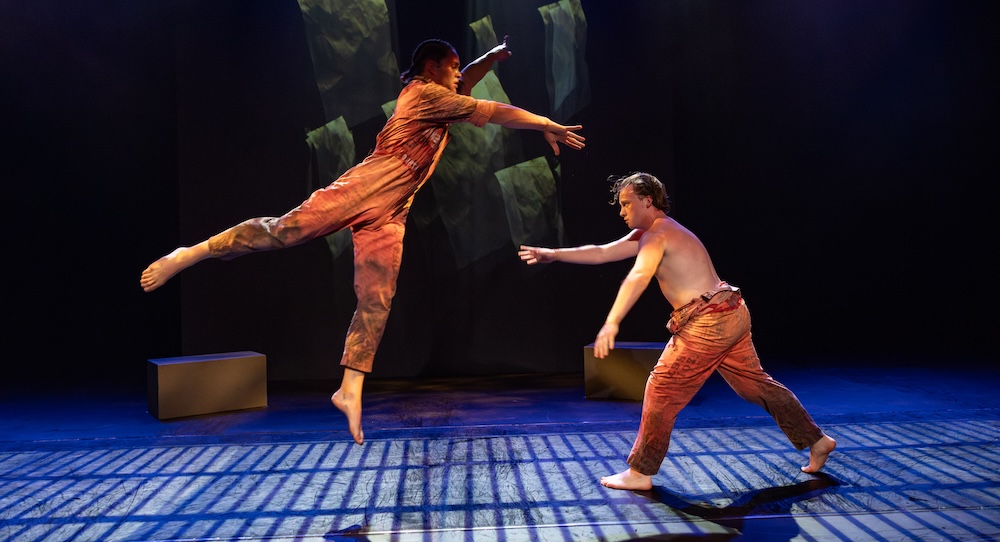
Performed by Blake Escott and Alexander Abbot, the duet is extraordinary in both its physicality and emotional depth. The two men move with immense strength and sensitivity, embodying conflict, memory and dependence through constantly shifting states of connection. Their choreography is filled with catch-and-release partnering, weighted counterbalances and moments of collapse and recovery that suggest both brotherhood and internal fracture. At times they cling to one another with desperation; at others they repel, separate and circle back together again, as though trying to physically negotiate the split within a single identity.
The choreography never feels decorative. Every lift, hold and collision carries psychological weight. One particularly striking sequence sees one dancer pinned against the projection screen while the other supports and propels him horizontally along its surface, creating the impression of a body suspended between worlds — unable to fully land anywhere. Elsewhere, the dancers smear a clay-like substance across their skin, an act that feels both ritualistic and instinctive, as though attempting to reconnect themselves physically to earth and ancestry. Throughout the work, the body becomes a site of memory: scarred, searching and profoundly alive.
The visual design reinforces this sense of spiritual and geographical dislocation. Vast projections of ocean, bushland and Australian terrain fill the rear screen, interspersed with intimate images of shells, bones and drifting paper. Some footage, captured from above, evokes both surveillance and transcendence — landscapes seen from a distance, yet felt viscerally within the body. These images are not simply illustrative; they operate like fragments of memory or dreams. Even when the story moves overseas or into institutional spaces, Country remains present. The work insists that connection to land is not erased by removal. It persists internally, pulsing beneath systems designed to sever it.
The prison setting is especially affecting. The dancers, dressed in prison orange, evoke not only literal incarceration but the mental imprisonment produced by dislocation and trauma. Lang explores the devastating impact of institutional systems on First Nations lives without reducing the work to sociological commentary. Instead, the emotional and psychological toll is embedded in the movement itself: repetitive patterns, sudden ruptures, exhausted collapses and frantic attempts to escape invisible constraints. The result is deeply visceral.
Sound also plays a crucial role in shaping the production’s emotional landscape. The integration of Yolŋu song, voice and sound design creates a work that feels spiritually anchored even in its moments of greatest despair. There is an aching sense throughout that the protagonist’s soul is attempting to find its way home. Lang spoke after the performance about the idea of “calling the spirit back home,” and that concept resonates powerfully across the entire production. The work repeatedly returns to this tension between physical absence and spiritual belonging.
Particularly moving is the production’s relationship to voice and text. Early in the work, excerpts from journals and writings connected to the original story are heard aloud. Lang reflected afterwards that, upon reading these diaries, he felt he could truly hear the voice of the man behind them — an experience that became central to the creation of the work. That sense of listening deeply to another person’s inner life permeates the entire production. The Other Side of Me does not attempt to explain trauma from the outside; it sits within its contradictions, grief and yearning.
What ultimately makes this work so compelling is its authenticity. The performers never appear to be “performing emotion” for effect. There is nothing mannered or artificially stylised in the delivery. The masculine physicality of the choreography — raw, grounded and emotionally exposed — gives the work enormous immediacy. Escott and Abbot inhabit the material completely, dancing with an intensity that feels lived rather than presented.
In an era where contemporary dance can sometimes disappear into abstraction or aesthetic self-consciousness, The Other Side of Me remains committed to story, spirit and human truth. It is not interested in easy catharsis. Instead, it offers something more difficult and more valuable: a compassionate examination of fracture, identity and survival. Lang has created a work of profound soulfulness — one that honours not only the specific experiences of the Stolen Generations, but the universal human desire to know where we come from, who we are and whether it is ever possible to fully return home.
By Linda Badger of Dance Informa.









 English (US) ·